Supply chain management (SCM) is the planning and coordination of the work that takes a product from its sources of supply to the customer: sourcing, production, logistics and the partners who carry them out. Part of its cost is now measured officially in India: a DPIIT assessment puts logistics at 7.97% of GDP in FY2023-24. This guide explains what supply chain management includes, its stages, how it differs from logistics, and which work a business can hand to a provider.
What Is Supply Chain Management?
The Council of Supply Chain Management Professionals (CSCMP) says supply chain management “encompasses the planning and management of all activities involved in sourcing and procurement, conversion, and all logistics management activities”. It adds that SCM includes coordination and collaboration with channel partners, “which can be suppliers, intermediaries, third-party service providers, and customers”. In CSCMP’s summary, it “integrates supply and demand management within and across companies”.
That last phrase is the useful part. Supply chain management is not one department’s job. It connects decisions inside a company with decisions made by the companies on either side of it.
A supply chain and supply chain management are different things. Wikipedia describes a supply chain as a set of organisations directly linked by upstream and downstream flows of products, services, finances or information, and SCM as the management of that chain. It credits Keith Oliver, a Booz Allen Hamilton consultant, with introducing the term in a 1982 Financial Times interview.
The Stages of Supply Chain Management
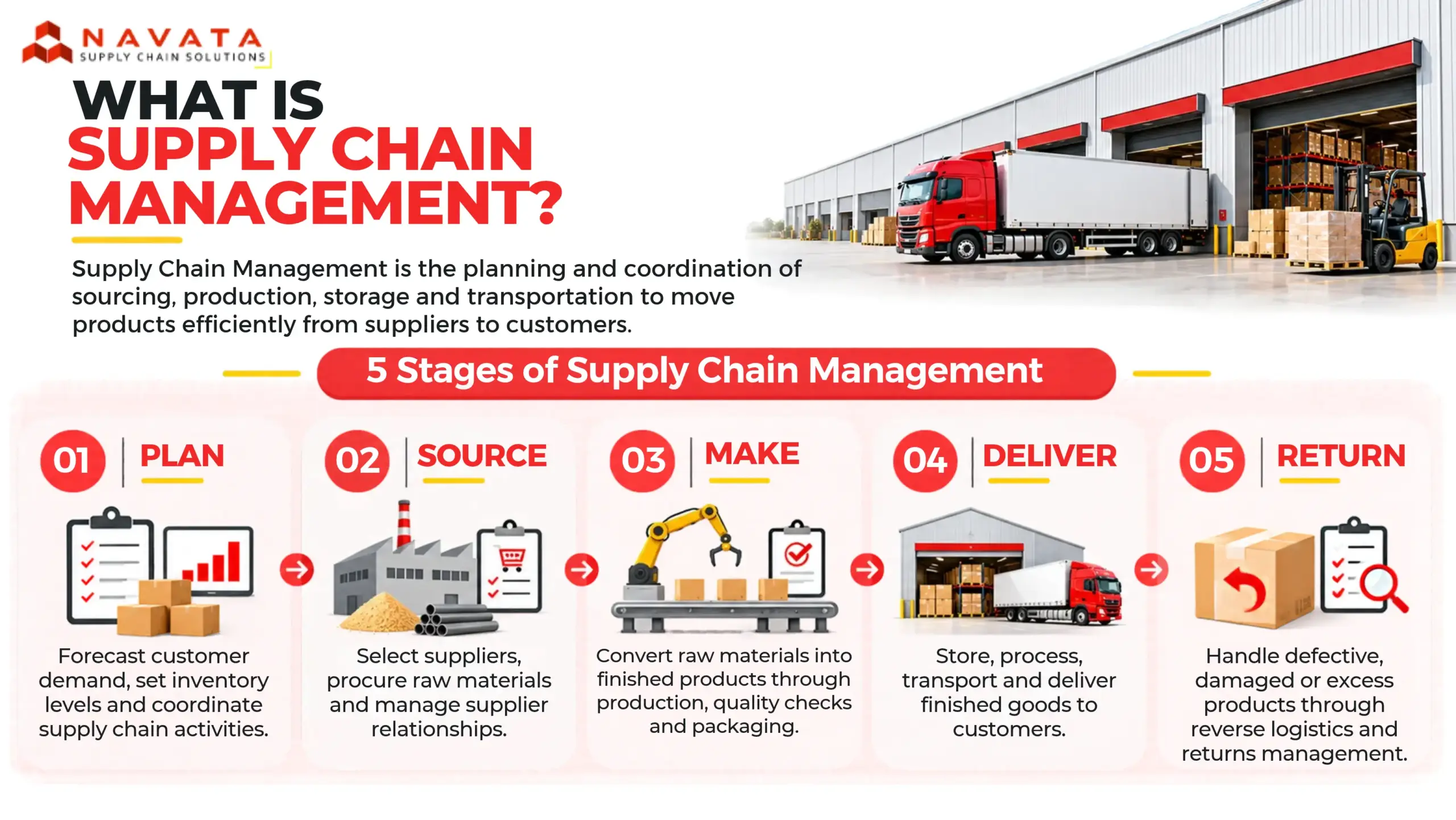
Most explainers teach the stages of supply chain management as five: plan, source, make, deliver and return. IIM Udaipur, DP World and Godrej Capital all use versions of this list, while IBM adds inventory management as a separate step. Treat the list as a teaching model and not as a formal standard.
-
1
Plan. Forecast demand, set inventory targets and schedule restocking (DP World). IIM Udaipur describes this stage as balancing supply against demand.
-
2
Source. Choose suppliers, negotiate contracts, manage supplier relationships and handle ordering and payments (IBM).
-
3
Make. Convert inputs into finished goods by scheduling production, checking quality and packing (DP World). A reseller starts by sourcing finished products instead of raw materials (Packsend).
-
4
Deliver. Store and move finished goods to customers, including warehousing, order fulfilment and transport (IBM), with routing, carrier selection and delivery windows (DP World).
-
5
Return. Take back defective or excess products through reverse logistics (IBM), and send defective or excess materials back to suppliers (IIM Udaipur).
Each stage answers a different question, and a problem seen in one stage can start in another. The failure signs in the table below are our operational reading, not survey findings.
| Stage | Decision it makes | How failure shows up |
|---|---|---|
| Plan | How much is needed, where and when | Too much of one item and too little of another |
| Source | Who supplies what, on what terms | Late or short supply holds up production or dispatch |
| Make | What to produce, in what order | Output misses the plan, or quality rejections rise |
| Deliver | Where stock sits and how it moves | Missed delivery windows and part deliveries |
| Return | What comes back and what happens to it | Returned goods wait unprocessed and value is lost |
Each stage has its own detail. See demand forecasting and inventory management for planning, supplier relationship management for sourcing, a warehouse management system and OTIF for delivery, and reverse logistics for returns.
How the Stages Work on One Order
This is an illustrative example, not a client case. A building materials manufacturer expects higher demand from distributors next quarter.
- Plan: sales and operations agree a forecast by product and region, and set how much stock to hold in each market.
- Source: purchasing confirms raw material quantities and delivery dates with suppliers against that forecast.
- Make: the plant schedules production and checks quality before goods are released.
- Deliver: finished goods move to regional warehouses, then to distributors against their orders.
- Return: damaged or wrongly supplied goods come back, are checked, and are reworked, resold or written off.
If distributors then report shortages, the visible problem is in delivery. The cause could be a low forecast, a late supplier, a production delay or a transport failure. Supply chain management is the discipline of looking across those stages to find which one it was.
The Difference Between Logistics and Supply Chain Management
Logistics is a part of supply chain management. CSCMP calls logistics management “that part of supply chain management” that plans, implements and controls the forward and reverse flow and storage of goods, services and related information between origin and consumption. Inbound Logistics draws the same line: logistics centres on moving and storing goods, while the supply chain covers the whole path from supplier to customer.
| Factor | Logistics | Supply chain management |
|---|---|---|
| Scope | Flow and storage of goods, services and related information | Sourcing, conversion and all logistics activity, across partners |
| Core question | How do goods move and where are they held? | What should be bought, made, held and moved, and by whom? |
| Typical work | Warehousing, transportation, inventory control, packaging, materials handling (Inbound Logistics) | Planning, sourcing, production, distribution and delivery (Inbound Logistics) |
| Who is involved | Operations teams and logistics providers | Also suppliers, intermediaries, service providers and customers (CSCMP) |
The distinction matters when choosing a fix. A faster carrier can solve a transport problem. It does not solve a forecasting or sourcing problem, even if both appear to the customer as a late delivery.
The SCOR Model: How Practitioners Name the Same Work
The five-stage list resembles the Supply Chain Operations Reference (SCOR) model. CIO reports that SCOR was developed in 1996 by the consulting firm PRTM and endorsed by the Supply-Chain Council, now part of the Association for Supply Chain Management (ASCM). Version 12.0 used Plan, Source, Make, Deliver, Return, and Enable.
The current SCOR Digital Standard, version 14.0 from 2022, names seven processes: Orchestrate, Plan, Source, Transform, Order, Fulfill and Return. ASCM says it expanded Make to Transform, and separated Deliver into Order and Fulfill to better represent omni-channel. If a consultant or software vendor uses these names, most of them map to the stages above.
Supply Chain Management in India: What the Cost Data Shows
The official figure this guide uses for supply chain management in India covers the logistics part. DPIIT’s Assessment of Logistics Cost in India, prepared by NCAER and published in September 2025, estimates total logistics cost for FY2023-24 at Rs 24.01 lakh crore. Policy Edge reports that earlier unofficial estimates were 13 to 14% of GDP.
| Measure | Figure |
|---|---|
| Total logistics cost | Rs 24.01 lakh crore |
| Share of GDP | 7.97% |
| Share of non-services output | 9.09% |
| Transportation, share of logistics cost | 59.1% |
| Storage and warehousing, including inventory carrying | 24.8% |
| Material handling and administrative | 16.1% |
| Small firms (turnover up to Rs 5 crore), share of output | 16.9% |
| Large firms (turnover above Rs 250 crore), average share of output | 7.6% |
Read these figures within their limits. They measure logistics cost, not the full cost of sourcing and production, so they are not a total supply chain cost. The firm-size figures come from the report’s survey, and the report attributes the gap to economies of scale in logistics management. The gap does not show what any one company would save by changing how it runs logistics.
Why Supply Chains Are Hard to Coordinate
In our reading, three problems come from the structure of a supply chain itself, so fixing a single issue may not remove them.
Demand Signals Get Distorted
The bullwhip effect describes orders to suppliers varying more than sales to buyers, so demand swings grow as they move upstream. Jay Forrester introduced the concept in 1961, and Lee, Padmanabhan and Whang studied it in a 1997 paper on information distortion in a supply chain.
Information Sits with Different Companies
Stock, order and shipment data often sits with separate partners, and CSCMP’s definition makes clear that the work runs across companies. That is the practical case for supply chain visibility.
One Stage's Saving can be Another's Cost
As an example, buying in larger lots can lower a unit price and raise the stock a warehouse has to hold. Judging each stage only on its own budget can hide that trade-off. Our page on challenges in supply chain operations covers more of these issues.
What a Business Keeps and What It Can Hand to a Provider
CSCMP names third party service providers among supply chain partners, so outsourcing part of the work is still supply chain management. There is no single correct split. A practical starting point:
- Keep the decisions that define the business: what to sell, service levels, supplier strategy and how much risk to carry.
- Consider handing over repeatable physical work, such as warehousing, transportation and returns handling.
- Share the planning inputs a provider needs, such as forecasts and order data, because an outsourced operation can only follow the plan it can see.
In our reading, the business stays accountable to its customer for outsourced work, so agree measures and reporting at the start. Provider arrangements range from 3PL warehousing to longer-term contract logistics.
Supply Chain Management with Navata Supply Chain Soluions
Navata Supply Chain Solutions (NSCS) is a technology-enabled, asset-light B2B logistics and supply-chain company. Its services cover 3PL and integrated logistics, supply chain planning and consulting, transportation, and warehousing for industries including FMCG, agro, FMCD, apparel, pharma, and building materials. NSCS describes GamanIQ as its AI-driven, self-optimising B2B logistics platform.
Reviewing how sourcing, warehousing and transport fit together across your supply chain? Discuss your requirement with the Navata Supply Chain Solutions team.
What is supply chain management in simple words?
It is the planning and coordination of how a product gets from its sources of supply to the customer. It covers sourcing, production, logistics and the partners who carry out that work.
What is the difference between a supply chain and supply chain management?
A supply chain is the set of organisations linked by flows of products, services, finances or information. Supply chain management is the management of that chain.
What is the difference between logistics and supply chain management?
Logistics is part of supply chain management. It covers the flow and storage of goods, services and related information, while SCM also covers sourcing, conversion and coordination with partners, according to CSCMP's definitions.
What are the stages of supply chain management?
Most explainers teach five: plan, source, make, deliver and return. IBM also lists inventory management separately, and the current SCOR model names seven processes.
What is the SCOR model?
SCOR is the Supply Chain Operations Reference model, published by ASCM. Version 14.0 from 2022 names Orchestrate, Plan, Source, Transform, Order, Fulfill and Return.
Why does supply chain management matter for smaller businesses?
DPIIT's FY2023-24 assessment found logistics cost at 16.9% of output for small firms with turnover up to Rs 5 crore, against an average of 7.6% for large firms above Rs 250 crore. The report attributes the gap to economies of scale in logistics management.
Can a company outsource supply chain management?
It can outsource parts of the work, such as warehousing, transportation and returns handling, and CSCMP counts third party service providers among supply chain partners. As a practical starting point, keep decisions on service levels, supplier strategy and risk in-house, because they define the business.