FMCG distribution is the system that moves fast-moving consumer goods from the manufacturer to the shops and platforms that sell them. In India it has traditionally run through carrying and forwarding (C&F) agents, super stockists, distributors and wholesalers before reaching retailers, and NielsenIQ still gives traditional trade 82% of FMCG on a moving annual total to June 2026. This guide explains who does what in the FMCG supply chain, who owns the stock at each step, what primary and secondary distribution mean, and what general trade, modern trade and quick commerce each ask of logistics.
What Is FMCG Distribution?
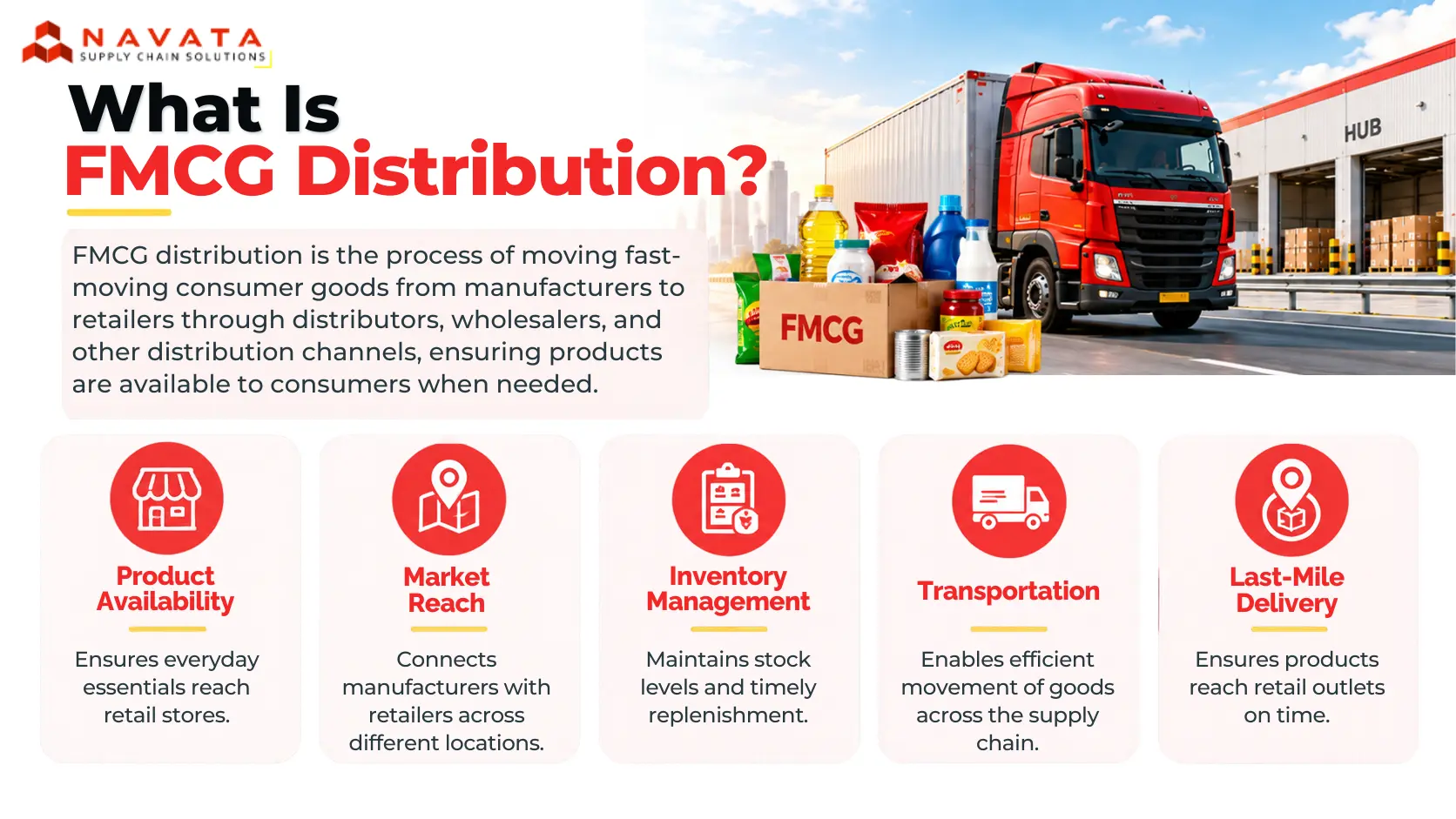
FMCG distribution covers the steps between a factory and the point of sale: holding finished goods close to demand, selling and invoicing them to channel partners, and delivering them in progressively smaller lots to shops and platforms. Fast-moving consumer goods are bought often and in small quantities, so the network has to keep many products available at many points of sale at the same time.
The number of outlets explains the shape of the FMCG distribution network. Ambi Parameswaran, writing in Business Standard in 2022, estimated that India has roughly 12 million shops, and Kotak Neo cites nearly 13 million kirana stores. Hindustan Unilever reports a network of over 9 million outlets for FY 2025-26, of which it reaches over 2.4 million general trade outlets directly. Even at that scale, direct reach covers only part of the network, and Parameswaran notes that small shops rely on stockists and wholesalers rather than on the company itself.
Most FMCG sales value still goes through the traditional route. NielsenIQ’s India FMCG Quarterly Snapshot for Q2 2026 gives traditional trade 82% of FMCG on a moving annual total to June 2026, modern trade 11% and e-commerce 6%.
How FMCG Distribution Works, From Manufacturer to Retailer
The classic general trade route has up to six stages. Sources describe the tiers slightly differently, and not every company uses every tier: Kotak Neo describes manufacturer, super stockist, distributor, and retailer, while eChai Ventures adds a C&F agent and a sub-stockist. The sequence below combines them, adds the wholesaler that Vanik and Business Standard describe, and leaves out the sub-stockist.
-
1
Plant to distribution centre. Finished goods leave the plant for a distribution centre or depot. Mahindra Logistics describes this primary transportation as PTL and FTL haulage from plants to distribution centres.
-
2
C&F agent. The agent holds stock in a territory on the company's behalf and dispatches it to the next tier.
-
3
Super stockist. Used in smaller markets, as Vanik describes it, to stock goods and supply the tier below.
-
4
Distributor. Takes retailer orders in its territory, delivers them and commonly extends credit.
-
5
Wholesaler. An independent reseller that buys in bulk and supplies small retailers that distributors do not service.
-
6
Retailer. The kirana or other shop sells to the consumer, the point where, as mAssist puts it, consumption actually happens.
Parameswaran credits Hindustan Lever, now Hindustan Unilever, with pioneering this system: redistribution stockists were first served by company depots, which C&F agents later replaced. For how the facilities at the first stage operate, see what is a distribution center. Modern trade and quick commerce often skip several of these tiers, as covered below.
Roles in an FMCG Distribution Network
An FMCG distribution network is defined as much by who owns the stock as by who moves it. Vanik cautions that its role descriptions may not match textbook definitions, and arrangements differ by company, so treat the table as a common pattern and not as a rule.
| Role | Job in the chain | Who owns the stock | Sources |
|---|---|---|---|
| C&F agent (CFA) | Receives goods from the company and delivers them to distributors in its territory | The brand keeps title; the CFA holds stock as a consignment agent and earns a service fee | Vanik, Terra Insight |
| Super stockist | Works like a smaller-scale C&F operation in smaller markets, with some sales and marketing work | Takes title on the primary invoice and holds stock on its own books | Vanik, Terra Insight |
| Distributor (redistribution stockist) | Fulfils retailer orders in a territory, often with exclusivity, and reports market feedback | Buys the goods, takes ownership and carries the risk of unsold stock | Vanik, Xflow, Business Standard |
| Wholesaler | Independent reseller that buys in bulk and is the main supply point for small retailers that stockists cannot service | Owns what it buys and decides where to sell it | Vanik, Business Standard |
| Retailer | Kirana, retail chain or online seller that sells to the consumer | Buys its stock, commonly on 30 to 60 days of distributor credit | Vanik, Kotak Neo |
Title changes what each party reports. Terra Insight explains that a brand books revenue on the primary invoice to a super stockist, but books revenue on a CFA route only when the CFA dispatches onward, because that stock stays on the brand’s inventory ledger and is reconciled through a monthly stock statement. For a logistics team, that is the difference between managing the brand’s own inventory at a partner’s site and relying on what a channel partner reports about stock it owns.
The abbreviation also needs care. Vanik and Terra Insight use C&F or CFA for carrying and forwarding. Xflow’s explainer expands CNF as clearing and forwarding and includes export and customs work. Check which service a provider means.
Primary and Secondary Distribution: What the Terms Mean
Primary and secondary distribution are used in more than one way, which can cause confusion between sales, finance, and logistics teams. The table sets the common uses side by side.
| Source | Usage | Primary | Secondary | Tertiary |
|---|---|---|---|---|
| mAssist | Sales levels | Manufacturer to the first distribution tier, recorded when dispatched and invoiced | Distributor to retailers | Retailer to consumer |
| Shipsy | Operating responsibility | Plant to distributor, run by the company | Distributor to retail, largely run by distributors and partners | Not covered |
| Mahindra Logistics | Freight service | Plants to distribution centres by PTL and FTL haulage | Last-leg movement to market | Not used; last mile delivery is listed separately |
| Navata SCS, citing an Indian logistics guide | Freight stages | Factory or national depot to regional warehouses or C&F agents, usually by FTL | Those warehouses to distributors, usually by PTL | Distributors to retailers |
The last row comes from our page on FMCG warehousing services. The same truck can carry a different label in each row: a load from a regional warehouse to a distributor is secondary on the three-stage freight reading, but on the plant-to-distributor reading it is still part of primary. Before agreeing a freight rate, service level or KPI, write down the start and end point of each leg instead of relying on the label.
The sales usage matters for logistics too. mAssist warns that a gap between primary and secondary sales can signal channel stuffing or distributor overstock. In other words, stock that has been invoiced may still be sitting with a distributor and not moving to retailers.
General Trade, Modern Trade and Quick Commerce
Each channel buys differently, so each asks something different of the warehouse and the truck. The table summarises how providers describe the three channels. Retailer and platform terms differ, so check each customer’s own requirements.
| Factor | General trade | Modern trade | Quick commerce |
|---|---|---|---|
| Customer | Kirana stores and other small shops (eChai Ventures) | Fewer, larger retail chains (eChai Ventures) | Platforms running dark stores across metros (WareIQ) |
| Supply route | C&F agent, super stockist, distributor, sub-stockist, retailer (eChai Ventures) | Often supplied directly from a distribution centre with automated replenishment (eChai Ventures) | Frequent, low-volume purchase orders; one cycle can involve 20 or more locations (WareIQ) |
| Delivery | Purchase orders from distributors, dispatched by LTL or FTL (Prozo) | Dock appointment windows that Prozo calls non-negotiable | Often narrow delivery windows across those locations (WareIQ) |
| Paperwork and labels | Distributor-specific labelling (Prozo) | Retailer-specific barcodes, MRP stickers, case-pack and carton labels; advance shipping notices with SKU, batch, MRP and carton counts (Prozo) | ASN delays are among the common failure points WareIQ lists |
| Performance control | Distributor fill rates and lead times (Prozo) | Chargebacks, deductions or shipment rejection for non-compliance (Prozo) | Weekly fill rate scorecards, SKU suspension and chargebacks (WareIQ) |
What the FMCG Supply Chain Needs From Logistics
Six needs recur in how logistics providers and software vendors describe the FMCG supply chain. They apply on top of the channel requirements above.
Batch and Expiry Control
FMCG stock has a shelf life, so the warehouse has to track batches and expiry dates as well as quantities. Unicommerce describes batch and expiry tracking that supports First Expiry First Out (FEFO) picking and lets brands route a batch to the channel suited to its remaining shelf life. Mahindra Logistics lists FIFO/FEFO and shelf-life tracking among its services. Unicommerce also says B2B retailers need 70% or more remaining shelf life but cites no source, so confirm the figure in each customer’s terms.
Loads that Match the Leg
Long-haul legs typically move as full truckload or part truckload, as the Mahindra Logistics and Navata SCS descriptions above show. Deliveries further down the chain are smaller, and Varuna notes that rural penetration is harder because of limited connectivity and small pack sizes, and suggests smaller vehicles and local distributors.
Fill Rate and On-Time Delivery
WareIQ defines seller fill rate as units supplied divided by units ordered, multiplied by 100, so 3,900 units against a 5,000-unit purchase order is 78%. A case article on MBA Skool splits modern trade fill rate into a planning part (pick list quantity against purchase order quantity) and a warehouse part (invoice quantity against pick list quantity), which helps show whether a shortfall began in supply planning or on the warehouse floor. Fill rate does not capture lateness, so read it alongside OTIF.
Delivery Proof
Fretron describes secondary deliveries to distributors and modern trade being closed with doorstep electronic proof of delivery, and modern trade deductions and claims being settled against timestamped delivery proof. Whichever system is used, keep the proof with the invoice so a deduction can be checked.
Visibility Across Tiers
Shipsy describes primary and secondary distribution as separate decision loops, with the brand having little operational control over the secondary leg. Stock and sales reporting from distributors gives the brand its view of the secondary leg, which is where supply chain visibility becomes a practical need.
Seasonal Peaks and Returns
Varuna lists festival and seasonal demand swings among the main challenges, along with overstock that ties up capital and risks expiry. Unsold or expired stock also has to come back through the chain, which makes it a reverse logistics flow to plan for and not an exception.
FMCG Distribution in India: What Is Changing
NielsenIQ’s Q2 2026 snapshot, covering April to June 2026, shows the pressure on the older route of FMCG distribution in India. All-India FMCG value grew 0.8%, and volume fell 2.0% against a year earlier. Traditional trade value fell 4.2% and volume 6.0%, while modern trade value grew 15.5% and e-commerce value 57.7%. Rural volume fell 5.0%, and urban volume grew 0.1%.
Four shifts stand out in the sources:
- E-commerce is concentrated. NielsenIQ puts it at 7% of FMCG sales at All India level in one view, against 21% in the top eight metros and 25% in southern metros.
- Quick commerce dominates online for some brands. The Economic Times reported that it accounted for more than 70% of FY26 online sales for Britannia and Tata Consumer, and 58% for ITC.
- One large company runs most general trade business through its own app. Hindustan Unilever says its Shikhar e-B2B app covers over 85% of its general trade business, with about 1.4 million retailers onboarded.
- Platforms are becoming distributors. Kotak Neo says FMCG companies have begun appointing quick commerce platforms as direct distributors, and that the All India Consumer Products Distributors Federation wrote to FMCG companies in April 2025 seeking uniform pricing across channels.
The traditional network remains large, with roughly 400,000 distributors represented by the federation, according to Kotak Neo. For a logistics team, the practical result is one brand running several operating models at once: a distributor drop, a retail distribution centre appointment and a dark store replenishment can all draw on the same stock.
FMCG Distribution Logistics with Navata Supply Chain Solutions
Navata Supply Chain Solutions (NSCS) is a technology-enabled, asset-light B2B logistics company that operates through a vendor and partner ecosystem. Its services include 3PL services and distribution, warehousing and transportation, including FTL, PTL, last-mile logistics and appointment delivery. FMCG is among the industries it works with. Our guide to the 3PL warehouse explains how outsourced storage is usually set up. NSCS describes GamanIQ as its AI-driven, self-optimising B2B logistics platform, covering areas such as orders, vendor performance evaluation, billing, documents and tracking.
Planning or reviewing FMCG distribution across general trade, modern trade or newer channels? Discuss your tiers, lanes and service levels with the Navata Supply Chain Solutions team.