

Table of Contents
Add a header to begin generating the table of contents
A 3PL warehouse is a storage and handling facility operated by a third-party logistics (3PL) provider on behalf of the businesses whose goods it holds. Instead of leasing a building, hiring warehouse staff and running your own systems, you contract a 3PL to receive your inventory, store it, pick and pack orders, dispatch them and handle returns, usually paying for the space and activity you actually use. This guide explains what a 3PL warehouse is, how 3PL warehousing works step by step, which 3PL warehouse services are typically included, the main warehousing models (dedicated, multi-client and flexi), how third party warehousing compares with running your own facility, what drives 3PL warehousing cost, and how to decide whether it is the right fit for your business.
What Is 3PL Warehouse?
Third-party logistics means outsourcing part or all of your logistics operations to a specialist provider. A 3PL warehouse is the physical expression of that model for storage and fulfilment: the facility, the people, the equipment and the warehouse management system belong to or are operated by the provider, while the inventory inside it belongs to you.
What distinguishes a 3PL warehouse from a rented shed:
- Operated, not just leased. The provider runs the operation: receiving, put-away, inventory control, order processing and dispatch.
- Shared or dedicated. The facility may serve several clients at once (multi-client) or be set aside for one client (dedicated).
- Activity-based commercial model. Charges are typically split between storage (space occupied) and handling (work done), rather than a fixed rent.
- Integrated with transportation. Because the provider also arranges or operates outbound movement, the warehouse is one node in a wider 3PL network rather than a standalone building.
For the broader picture of what third-party logistics covers beyond warehousing, see our guide to 3PL.
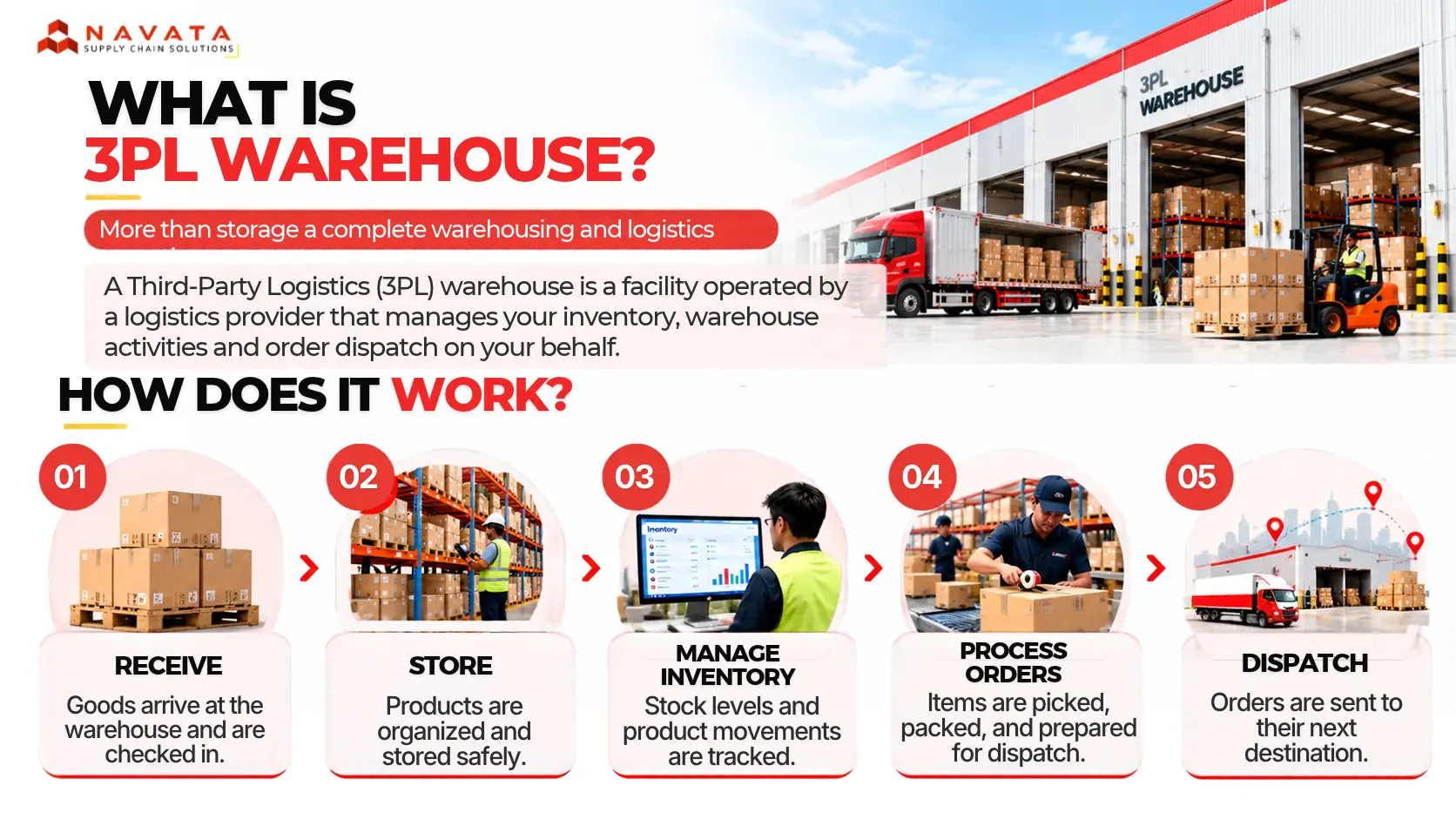
How 3PL Warehousing Works: From Receiving to Dispatch
Whatever the industry, 3PL warehousing follows a consistent operational cycle. Each step is recorded in the provider’s warehouse management system (WMS), which is what gives you inventory visibility without being on-site.
-
1
Inbound receiving. Your supplier or factory ships goods to the 3PL warehouse against an advance shipping notice or purchase order. The provider checks quantities and condition against the document, records discrepancies, and books the stock into the system.
-
2
Put-away and storage. Received goods are assigned storage locations. Fast-moving SKUs are usually slotted close to the packing area, while slow movers go to bulk storage. Location-level records help the system locate each unit later.
-
3
Inventory management. Stock levels, batch and expiry data where relevant, and inventory movements are maintained in the warehouse management system (WMS). Cycle counts verify system records against physical stock. You can view available inventory through reports or a portal.
-
4
Order processing. Orders arrive from your ERP, order management system, marketplace, or distributor network. The WMS allocates stock and releases picking tasks.
-
5
Picking and packing. Staff pick the ordered items, verify them (often by barcode scanning), pack them to the agreed specifications, and label them for dispatch.
-
6
Dispatch and transportation. Packed orders are consolidated by destination or carrier and handed over for transportation. Depending on the order profile, this may involve full truckload (FTL), part truckload (PTL), surface express, or last-mile delivery.
-
7
Returns management. Returned goods are received and inspected, then restocked, quarantined, or disposed of according to your rules. The inventory record is updated accordingly.
The cycle is the same for a single dedicated facility and for a national network of shared warehouses. What changes is how much of the network, staffing and system you share with other clients.
3PL Warehouse Services: What Is Included
Providers package their services differently, and not every 3PL warehouse offers every item below. The typical menu of 3PL warehouse services covers:
- Storage: racked, floor, bulk or temperature-controlled space, charged by pallet position, square foot or cubic volume.
- Receiving and put-away: unloading, checking, labelling and booking stock in.
- Inventory management: location control, cycle counting, batch and expiry tracking, stock reporting.
- Order fulfilment: picking, packing, kitting, bundling and labelling for B2B dispatch or e-commerce orders.
- Value-added services: repackaging, relabelling, quality checks, light assembly, price ticketing.
- Dispatch and transportation coordination: carrier booking, consolidation, documentation.
- Returns management: receipt, inspection, grading, and restocking of returned goods.
- Reporting and visibility: inventory, order status, fill rate and accuracy reports through a WMS portal or integration.
- Warehouse management system access: the provider’s WMS, connected to your systems where needed.
When comparing quotes, ask providers to map their proposal against this list so you can see which items are included in the base rate and which are priced per activity.
Types of 3PL warehousing: dedicated, multi-client and flexi
The right model depends on how stable your volumes are and how much control you need.
3PL Warehousing Models Compared
| Model | How it works | Best suited to | Trade-off |
|---|---|---|---|
| Dedicated warehouse | A facility or a defined area run exclusively for one client, usually on a multi-year contract | Large, stable volumes; specialised handling; strict process control | Higher fixed commitment; less flexibility if volumes fall |
| Multi-client (shared) warehouse | Several clients share one facility, staff and systems; each pays for the space and activity it uses | Mid-size and growing businesses; seasonal volumes; entry into new regions | Less customisation; capacity is shared at peak |
| Flexi warehousing | Short-term or on-demand space and handling, scaled up or down with little notice | Launches, promotions, overflow, market tests | Usually a higher per-unit cost than committed space; availability varies |
Two related facility types often appear alongside these models. A fulfillment center is a warehouse configured for high-volume order picking and packing, usually for e-commerce; many are operated by 3PLs. A distribution center is configured for receiving bulk stock and redistributing it to stores, dealers or regional hubs. Many 3PL networks run both. For a focused explanation of the on-demand model, see flexi warehousing.
Third Party Warehousing vs Running Your Own Warehouse
The decision between third-party warehousing and an in-house facility is less about which is cheaper in the abstract and more about where capital, management attention, and risk should sit.
Own Warehouse vs 3PL Warehouse
| Factor | Own warehouse | 3PL warehouse |
|---|---|---|
| Capital and fixed cost | Lease or purchase, fit-out, racking, equipment, systems, all funded upfront | Little or no capital; costs are largely variable with volume |
| Scalability | Adding or releasing space takes months and renegotiation | Space and labour flex with demand within the contract terms |
| Control over process | Complete; you set every procedure | Defined by the service agreement and KPIs; less day-to-day control |
| Expertise and systems | Must be built and retained in-house | Provided; WMS, trained staff and process discipline come with the service |
| Geographic reach | One facility unless you invest in more | Access to the provider's network of locations |
| Management attention | A logistics operation to run alongside your core business | Vendor management and performance review |
| Risk | Carried entirely by you: labour, compliance, damage, obsolescence of systems | Shared and contractually defined |
An in-house warehouse makes sense when volumes are large and predictable, handling is highly specialised, or warehousing is genuinely core to how you compete. Third party warehousing makes sense when volumes fluctuate, you are expanding into new regions, or management time is better spent elsewhere. For the wider outsourcing decision, see 3PL vs in-house logistics, and for keeping stock lean in either model, see inventory management strategies.
3PL Warehousing Cost: What Drives Pricing
3PL warehousing cost is usually a combination of recurring storage charges and activity-based handling charges, plus set-up and optional services. Providers structure rate cards differently, so compare the components rather than the headline figure.
- Storage: charged per pallet position, per square foot or per cubic metre per month. Temperature control, hazardous goods and high-security storage cost more.
- Inbound handling: a charge per pallet, carton or unit received and put away.
- Outbound handling: a charge per order, per line or per unit picked and packed, often with separate rates for B2B carton picking and e-commerce piece picking.
- Value-added services: priced per activity (relabelling, kitting, quality checks, returns processing).
- Set-up and integration: one-time charges for onboarding, system integration and process design.
- Minimums and commitments: minimum monthly billing, minimum storage volumes or contract terms, especially for dedicated space.
- Transportation: billed separately or bundled, depending on whether the provider also moves the goods.
The main cost drivers are the volume and turnover of your inventory (slow stock occupies space longer), the handling intensity of your orders (many small orders cost more to pick than few large ones), product characteristics (size, fragility, regulation) and the level of service you require. Published price figures vary widely by market and by provider, and figures from other countries do not transfer to India, so request itemised quotes against your own volume profile rather than relying on benchmarks.
When a 3PL warehouse makes sense (and when it doesn't)
A 3PL warehouse is usually the right choice when:
- Your volumes are growing or seasonal and you do not want to commit to fixed space.
- You are entering new regions and need storage near customers quickly.
- You lack in-house warehousing expertise, systems or management bandwidth.
- Order profiles are changing, for example a shift from bulk dealer dispatch to smaller, more frequent B2B or e-commerce orders.
- You want inventory visibility and process discipline without building both yourself.
It is usually the wrong choice when volumes are very large and stable enough to justify a dedicated in-house operation, when handling requires proprietary equipment or processes no provider can replicate, or when you are not prepared to manage a vendor relationship through clear service levels and regular review.
How to evaluate a 3PL warehouse partner in India
Evaluate the operation, not the brochure.
- Locations and network. Confirm facilities near your customers and suppliers, and whether the provider can add locations as you grow.
- Industry fit. Ask for experience with your product category, for example FMCG, consumer durables, apparel, pharma or building materials, and the compliance that goes with it.
- Systems. Review the WMS, how it integrates with your ERP or order systems, and what visibility you get in practice.
- Service levels. Agree measurable KPIs: inventory accuracy, order accuracy, dock-to-stock time, dispatch cut-offs and on-time dispatch.
- Scalability. Understand how peak volumes are handled and what notice is needed to add or release space.
- Transportation integration. Check whether outbound movement is coordinated by the same provider and how handovers are controlled.
- Commercial terms. Insist on an itemised rate card, clear minimums, and defined charges for value-added work.
- References and site visits. Visit the facility you would actually use and speak to current clients with a similar profile.
For a structured selection process, see our steps to choose a 3PL provider.
3PL warehousing with Navata Supply Chain Solutions
Navata Supply Chain Solutions provides 3PL services and warehousing services as part of an integrated, technology-enabled logistics model. The warehousing offer includes managed warehousing, flexi warehousing, a WMS service for inventory visibility, and the option to rent a warehouse, with transportation arranged through the same operating model. NSCS operates as an asset-light B2B logistics company through a vendor and partner ecosystem, an operating model intended to scale warehousing with a client’s volume rather than fix it in advance. Businesses evaluating a 3PL warehouse for FMCG, agro, consumer durables, apparel, pharma or building-materials distribution across India can discuss their requirement with the NSCS team.
Evaluating a 3PL warehouse for distribution across India? The Navata Supply Chain Solutions team can discuss warehousing models and your distribution requirement.
Explore 3PL Services or discuss your requirementFAQs
What is a 3PL warehouse?
A 3PL warehouse is a storage and fulfilment facility operated by a third-party logistics provider. The provider receives, stores, picks, packs and dispatches your inventory and handles returns, and you pay for the space and activity you use.
How does 3PL warehousing work?
Goods are received against a purchase order, booked into the provider's WMS, stored, picked and packed as orders arrive, dispatched through the agreed transport mode and, where relevant, received back as returns. Each step is recorded so you can see inventory and order status remotely.
What services does a 3PL warehouse provide?
Typically storage, receiving and put-away, inventory management, order fulfilment, value-added services such as kitting and relabelling, dispatch coordination, returns management, reporting and WMS access. The exact menu varies by provider.
What is the difference between a 3PL warehouse and a fulfilment centre?
A fulfilment centre is a warehouse configured for high-volume order picking and packing, often for e-commerce, and is frequently run by a 3PL. A 3PL warehouse is the broader category and may focus on bulk storage, B2B distribution or a mix.
How much does 3PL warehousing cost?
Costs combine storage charges (per pallet, square foot or cubic metre per month), handling charges (per pallet, carton, order or unit), value-added service fees, set-up charges and any minimums. The drivers are inventory volume and turnover, order handling intensity, product characteristics and service level. Ask for itemised quotes against your own profile; figures from other markets do not transfer to India.
When should a business use a 3PL warehouse instead of its own?
When volumes are growing or seasonal, when entering new regions, when in-house expertise or systems are lacking, or when management time is better spent on the core business. A very large, stable, highly specialised operation may still justify an in-house facility.
How is inventory tracked in a 3PL warehouse?
Through the provider's warehouse management system, which records every receipt, movement, pick and dispatch at location level, supported by cycle counts. Clients usually access stock and order data through a portal, reports or a system integration.