

Table of Contents
Add a header to begin generating the table of contents
What is fulfillment center?
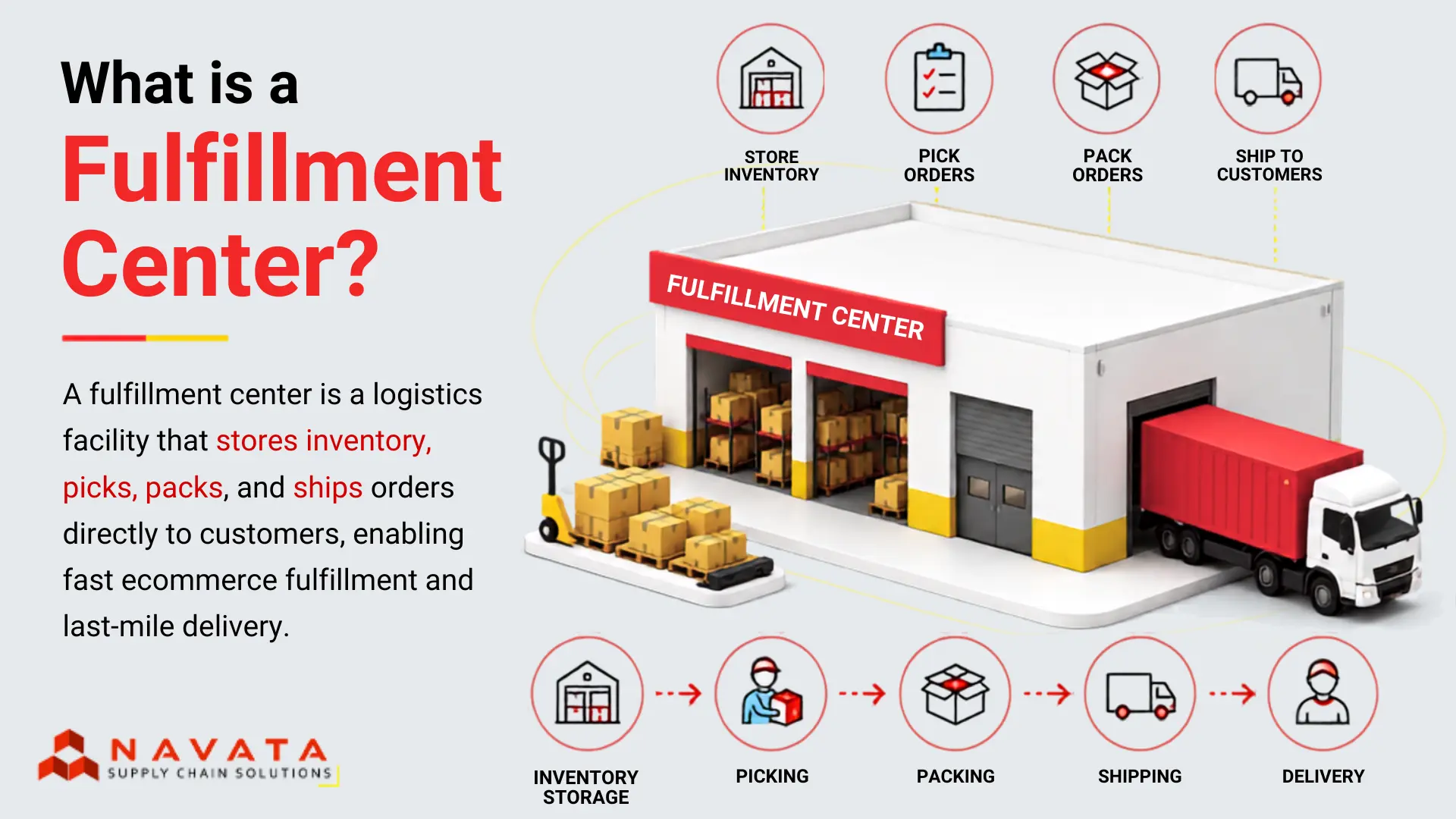
A fulfillment center is a facility where inventory is stored, and where incoming customer orders are received, picked, packed, and shipped out to their final destination. Unlike a traditional warehouse, which is built primarily for longer-term storage, a fulfillment center is built around order-level throughput moving individual units out the door quickly and accurately, order after order.
For any business selling online (whether direct-to-consumer, marketplace, or B2B), the fulfillment center is the operational layer that sits between “order placed” and “order delivered.” Understanding how a fulfillment center works, where it differs from a warehouse, what types of fulfillment centers exist, and what fulfillment center technology actually does is useful whether you’re outsourcing fulfillment for the first time or reassessing an existing setup.
How a Fulfillment Center Works
A fulfillment center runs on a repeatable operational cycle. The exact steps vary by provider and by order volume, but the core sequence is consistent:
1. Receiving
Inbound stock arrives from a manufacturer, brand, or supplier. It’s checked against the purchase order or advance shipping notice, inspected for damage or discrepancy, and logged into inventory.
2. Storage
Received stock is put away into a storage location (a bin, shelf, pallet position, or automated storage unit) based on product size, turnover rate, and picking strategy. Fast-moving SKUs are typically positioned for faster retrieval than slow-moving ones.
3. Order Processing
When a customer places an order, it flows into the fulfillment center’s system, usually integrated directly with the seller’s e-commerce platform or marketplace channel, and is queued for picking.
4. Picking
A picker (or an automated system) retrieves the ordered items from their storage locations. Order volume determines the picking method used. See the Technology section below for how single-order, batch, zone, and cluster picking differ in practice.
5. Packing
Picked items are packed into an appropriately sized box or mailer, with packing materials suited to the product (protective wrap for fragile items, poly mailers for soft goods, insulated packaging for temperature-sensitive items).
6. Shipping
The packed order is labeled, handed off to a carrier, and a tracking number is generated and typically pushed back to the seller’s system and the customer automatically.
7. Returns Handling (Where Offered)
Returned items are received back into the facility, inspected, and either restocked, refurbished, or routed for disposal, depending on condition and the seller’s returns policy.
This cycle is what separates a fulfillment center from a facility that simply holds inventory: every step is built around getting an individual order out the door correctly and on time, not around long-term storage efficiency alone.
Fulfillment Center vs Warehouse vs Distribution Center
These three terms are used interchangeably, but they describe different operational roles. The comparison below reflects how each is actually used, not just how the name sounds.
Fulfillment Center vs Warehouse vs Distribution Center: Comparison
| Dimension | Fulfillment Center | Warehouse | Distribution Center |
|---|---|---|---|
| Primary Purpose | Pick, pack, and ship individual customer orders | Store inventory for longer periods | Move bulk inventory between locations |
| Typical Order Unit | Single units / small parcels | Pallets / bulk quantities | Cases / pallets |
| Speed of Movement | High: inventory turns quickly | Low to moderate | Moderate to high |
| Customer-Facing | Yes: ships directly to end customers | No: internal storage only | Sometimes: depends on network design |
| Order Frequency | Continuous, order-by-order | Infrequent, bulk movements | Scheduled, batch movements |
| Technology Emphasis | Order management, real-time inventory, picking optimization | Storage/space utilization | Transportation and cross-dock coordination |
| Typical User | E-commerce brands, D2C sellers, marketplaces | Manufacturers, retailers holding stock | Retail chains, multi-location businesses |
| Returns Handling | Commonly built in | Rarely applicable | Occasionally, at scale |
In practice, many facilities blend these functions. A single site can operate as a warehouse for bulk stock and as a fulfillment center for the portion of that stock allocated to direct e-commerce shipping. The fulfillment center vs warehouse distinction matters most when you’re evaluating what a facility actually needs to be able to do for your business: bulk storage economics and per-order fulfillment economics are genuinely different problems.
Types of Fulfillment Centers
Not every fulfillment center is built the same way, and the right type depends on order volume, product category, and how much control a business wants over the process.
In-House Fulfillment
The business owns or leases the facility, hires and manages the staff, and runs the entire pick-pack-ship process itself. This gives full operational control and direct visibility into every order, but it also means carrying the fixed costs of space, labor, and systems regardless of order volume, a model that tends to make more sense once volume is high and predictable enough to justify it.
3PL-Operated Fulfillment Center
A third-party logistics provider runs the facility on behalf of multiple businesses, sharing infrastructure, technology, and staff across clients. This is the most common model for growing e-commerce brands because it converts fixed operational costs into a more variable, volume-linked cost, and it lets a business go live without building a facility from scratch.
Dropship Fulfillment
Orders are routed directly from a manufacturer or supplier to the end customer, without the seller holding inventory in a fulfillment center at all. This isn’t a fulfillment center in the traditional sense, but it’s worth naming because businesses evaluating fulfillment options are often comparing it directly against outsourced or in-house fulfillment.
Cold Chain / Temperature-Controlled Fulfillment
Built for products that require refrigeration or climate control throughout storage and shipping: perishable food, certain pharmaceuticals, and some cosmetics. These facilities add temperature monitoring and specialized packaging to the standard fulfillment workflow, and they’re relevant only when the product category genuinely requires it.
Dark Store / Micro-Fulfillment
A smaller, hyperlocal facility (sometimes a converted retail space) positioned close to end customers specifically to support fast, local delivery. It trades the scale efficiency of a large centralized facility for shorter last-mile distances.
Distributed Fulfillment Network
Rather than one large facility, inventory is split across multiple fulfillment centers positioned in different regions, and each order is routed to whichever location gets it to the customer fastest and most cost-effectively. This model reduces average shipping distance and transit time as order volume grows across a wider geography, at the cost of managing inventory allocation across more than one location.
Which of these types of fulfillment centers (or combination of types) makes sense depends on order volume, product mix, geographic spread of customers, and how much operational control the business wants to retain versus hand off.
Fulfillment Center Technology
Modern fulfillment centers run on a layer of technology that directly determines how accurately and how fast orders move through the facility.
Warehouse Management System (WMS)
This is the operational backbone: a warehouse management system tracks every SKU’s location, quantity, and movement in real time, and it’s what makes accurate picking possible at any meaningful order volume. Without a WMS, inventory accuracy and pick accuracy both degrade as order volume grows.
Real-Time Inventory Visibility
A fulfillment center with real-time inventory tracking gives the seller (and, indirectly, the customer) an accurate view of what’s actually in stock, rather than a batch-updated snapshot. This matters directly for avoiding overselling and for keeping listings accurate across multiple sales channels.
Order Management Integration
Fulfillment centers connect to the seller’s e-commerce platform, marketplace accounts, and any other sales channel so that orders flow into the picking queue automatically rather than through manual entry, reducing both processing time and manual-entry error.
Picking Strategy
How orders are picked changes with volume:
- Single-order picking: one picker completes one order at a time; simple, but inefficient at higher volumes.
- Batch picking: a picker collects items for multiple orders in a single pass through the facility, sorting them afterward.
- Zone picking: the facility is divided into zones, and a picker is responsible only for items within their zone, passing the order along to the next zone.
- Cluster picking: a picker gathers items for several orders simultaneously using a multi-slot cart, combining the throughput advantage of batching with less post-pick sorting.
Dimensional Weight Pricing
Most carriers price shipments based on the greater of actual weight or dimensional (volumetric) weight. Fulfillment centers that account for this when selecting packaging can materially reduce shipping cost per order, which is one of the more overlooked levers in fulfillment cost control.
Together, this is what fulfillment center technology is actually for: maintaining order accuracy while processing high order volumes the core operational challenge that distinguishes fulfillment from general storage.
Benefits of Using a Fulfillment Center
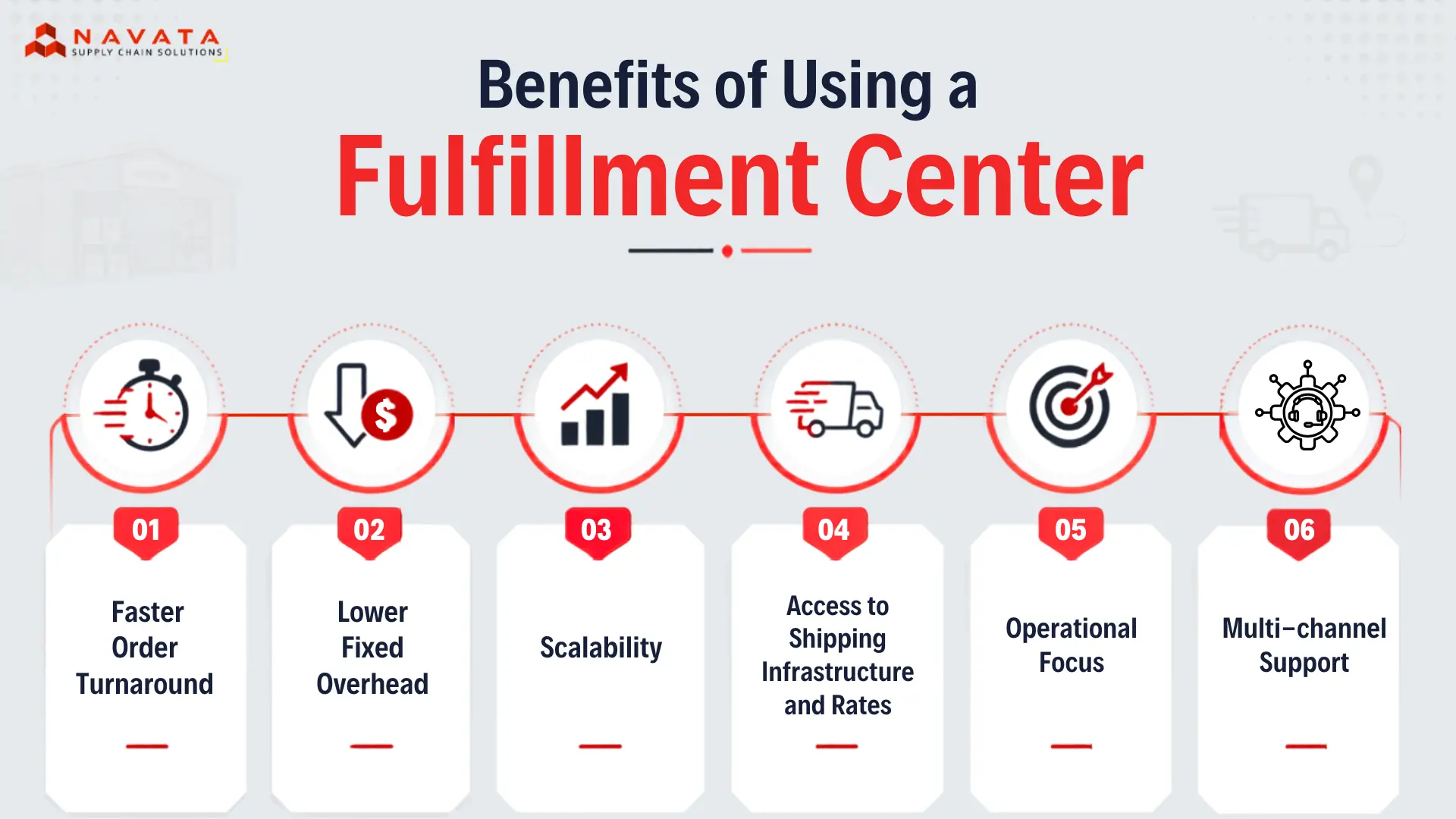
- Faster order turnaround. A facility built specifically around order-level throughput generally processes and ships orders faster than a general-purpose storage setup.
- Lower fixed overhead. Outsourcing to a 3PL-operated fulfillment center avoids the fixed costs of leasing, staffing, and equipping a facility directly.
- Scalability. Order volume can flex up or down (around seasonal peaks, for example) without the business having to resize its own physical footprint.
- Access to shipping infrastructure and rates. Fulfillment providers that ship high volumes typically have negotiated carrier rates that would be difficult for an individual business to secure independently.
- Operational focus. Handing off pick-pack-ship operations frees a business to focus on product, marketing, and customer relationships rather than warehouse logistics.
- Multi-channel support. A fulfillment center integrated across sales channels can fulfill orders from a website, marketplaces, and retail simultaneously from shared inventory.
Common Fulfillment Center Challenges
- Inventory visibility gaps. Without real-time integration between the fulfillment center’s systems and the seller’s sales channels, stock counts can drift out of sync, leading to overselling or stockouts.
- Cost transparency. Fulfillment pricing often includes storage fees, per-order pick-and-pack fees, and shipping costs that can be difficult to compare directly across providers without a clear breakdown.
- Peak-season capacity. Demand spikes around major sales periods can strain picking and shipping capacity if the facility hasn’t planned for the volume in advance.
- Returns complexity. Returns processing adds operational steps (inspection, restocking, and disposal decisions) that not every fulfillment setup handles equally well.
- Geographic coverage. A single fulfillment center serving a wide, spread-out customer base means longer average shipping distances and transit times than a distributed setup.
How to Choose the Right Fulfillment Center Partner
Selecting a fulfillment center (or deciding whether to build one in-house) comes down to matching the facility’s capabilities to actual order volume, product characteristics, and growth plans. The table below is a starting reference point, not a fixed rule.
Fulfillment Center Decision Matrix by Order Volume
| Order Volume | Likely Fit | Key Consideration |
|---|---|---|
| Low, early-stage (a few dozen orders/month) | In-house or dropship | Fixed fulfillment infrastructure is usually not yet justified |
| Growing (hundreds of orders/month) | 3PL-operated fulfillment center | Variable cost structure supports growth without large upfront investment |
| High volume, single region | 3PL or in-house, single facility | Focus shifts to picking efficiency and technology integration |
| High volume, multi-region | Distributed fulfillment network | Reducing shipping distance/time becomes the priority as geography widens |
| Temperature-sensitive products | Cold chain fulfillment | Product requirements narrow the provider pool significantly |
Beyond volume, the practical questions worth asking a prospective fulfillment partner include: What systems do they use for inventory and order management, and how do those integrate with your sales channels? How is pricing structured (storage, pick-and-pack, and shipping), and how transparent is that breakdown? What’s their track record on order accuracy and on-time shipping? And how do they handle demand spikes and returns?
If fulfillment is one part of a wider operational question (how storage, transportation, and order execution fit together across your supply chain), that’s the kind of integrated question a 3PL partner is built to help work through.
FAQs
Is a fulfillment center the same as a warehouse?
Not exactly. A warehouse is generally built for longer-term bulk storage, while a fulfillment center is built around receiving, picking, packing, and shipping individual customer orders. A single facility can perform both functions, but the operational focus is different.
What is the difference between a fulfillment center and a distribution center?
A fulfillment center ships directly to end customers, order by order. A distribution center typically moves larger case or pallet quantities between locations (for example, from a manufacturer to a retail store) rather than shipping individual customer orders.
Does a business need multiple fulfillment centers?
It depends on order volume and how geographically spread out customers are. A single facility is usually sufficient at lower volumes or when customers are concentrated in one region; a distributed network becomes more relevant as both volume and geographic spread increase, since it can reduce average shipping distance and delivery time.
What is a dark store, and how is it different from a fulfillment center?
A dark store is a smaller, hyperlocal facility (sometimes a converted retail location) used to support fast, local delivery. It functions similarly to a fulfillment center on a smaller scale, positioned closer to customers to shorten delivery distance rather than to maximize storage efficiency.
What does "fulfillment center operations" actually involve day to day?
Day-to-day operations center on the receiving-storage-picking-packing-shipping cycle described above, along with the systems that support it inventory tracking, order management integration, and returns processing where offered. The specific mix of manual and automated steps varies by facility size and technology.
How is pricing typically structured for outsourced fulfillment?
Most 3PL-operated fulfillment centers price around a combination of storage fees (based on space or unit count), per-order pick-and-pack fees, and shipping costs. Because these components vary by provider and by product characteristics, a direct breakdown from the provider is the most reliable way to compare options.