
There are two useful ways to sort the types of warehouses: by who owns and runs the building, and by the job it does in a supply chain. A third group covers special-purpose sites, such as customs bonded and temperature-controlled warehouses, where the law or the product sets the rules. This guide explains the main types of warehouses in India, what each is good for, and how to choose a warehouse that fits your stock, your order pattern and your compliance needs.
Two Ways to Classify Warehouses
Most lists of warehouse types mix two different questions, which is why the same building can appear under two labels. A public warehouse, for example, describes who operates the site, while a distribution centre describes what the site does. One facility can be both.
- Ownership and operation: who controls the site and who pays for it. This gives private, public, cooperative and contract (3PL) warehouses.
- Function: what the site mainly does with stock. This gives storage warehouses, distribution centres and fulfilment centres.
- Special purpose: rules that come from the law or the product. This covers customs bonded warehouses, warehouses registered to issue warehouse receipts, cold storage and automated sites.
Keeping the questions separate makes the choice easier. First decide how much control and fixed cost you want to carry, then decide what the site has to do, then check whether a special requirement applies.
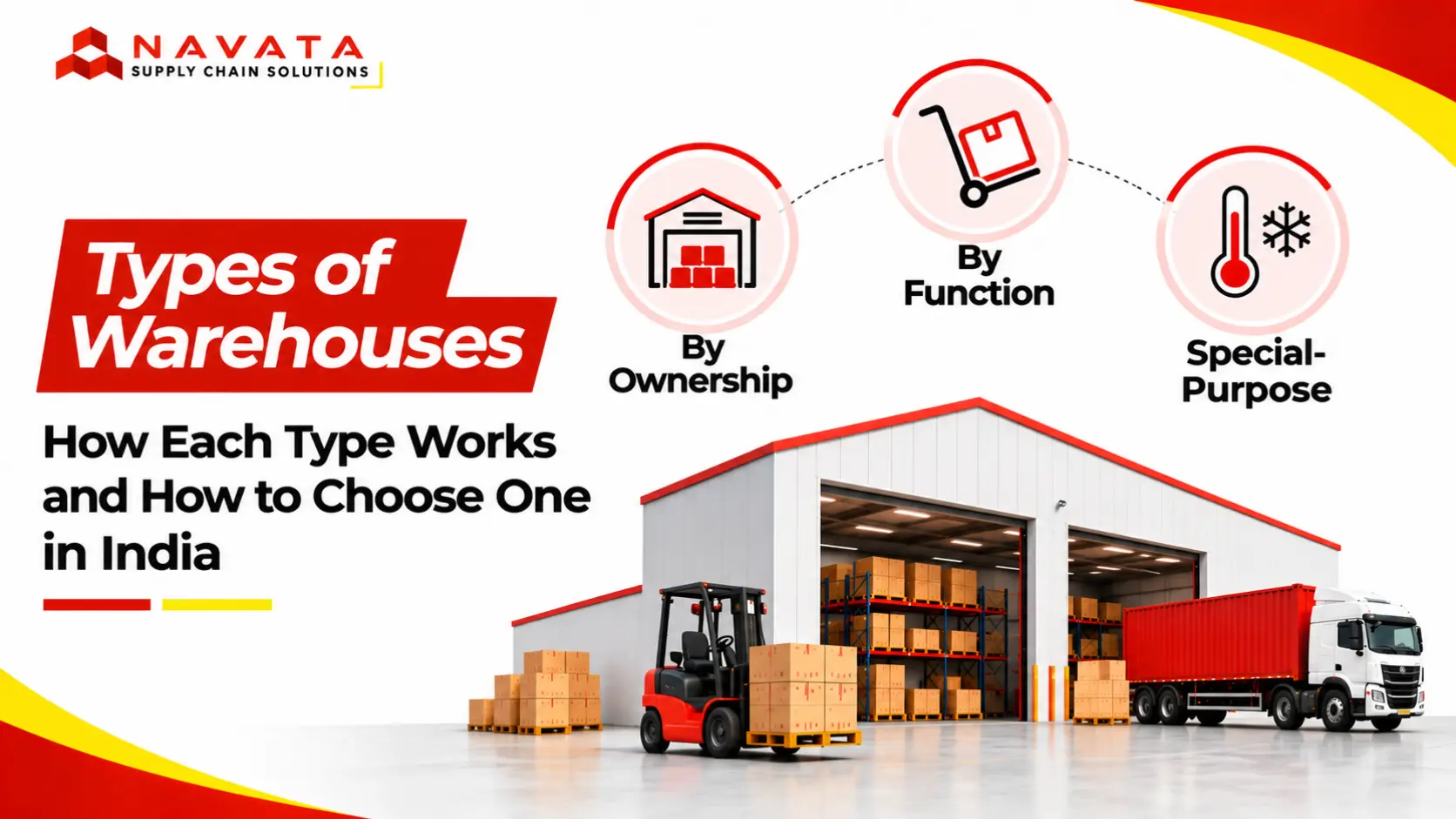
Types of Warehouses in India by Ownership
Ownership decides control, cost structure and how quickly you can grow or shrink. The differences between public and private warehouses matter most here, with contract warehousing sitting between them.
Private warehouses
A private warehouse is owned or long-leased by a manufacturer, distributor or retailer to hold its own goods. The business sets every process and keeps full control of stock, staff and layout. The trade-off is fixed cost: rent or capital, people and systems are paid for whether the space is full or not.
Public warehouses
A public warehouse offers space and handling to many depositors for a fee. In India, public-sector operators include the Central Warehousing Corporation, a statutory body set up under the Warehousing Corporations Act, 1962, under the Ministry of Consumer Affairs, Food and Public Distribution. Private operators also run shared, multi-client space. The user pays for what it stores and has less control over how the site is run.
The term also has a narrower legal meaning. Under the Customs Act, 1962, a public warehouse is one licensed under section 57 to hold imported goods before duty is paid, which is covered under bonded warehouses below.
Cooperative warehouses
Many classification guides also list cooperative warehouses: storage that a group of members, such as farmers or traders, owns jointly and shares instead of each running a site of its own.
Contract and 3PL warehouses
In a contract warehouse, a logistics provider runs dedicated or shared space for a client under an agreement, usually charging for storage and for handling work. The client avoids building and staffing a site but agrees service levels with the provider instead of running the floor. This is the model behind 3PL and integrated logistics services.
| Type | Who runs it | How you pay | Control | Usually suits |
|---|---|---|---|---|
| Private | Your own business | Fixed: rent or capital, staff, systems | Full | Large, steady volumes or special handling |
| Public | A warehousing corporation or private operator | For space and handling used | Low | Seasonal, short-term or overflow storage |
| Cooperative | Members who share the site | Shared costs among members | Shared | Groups of small producers or traders |
| Contract / 3PL | A logistics provider under an agreement | Storage plus handling charges, set in the contract | Through service levels | Growing or changing volumes, new regions |
The table is our practical reading of how these models usually work, not survey data. Actual terms vary by operator and contract.
Types of Warehouses by Function
Function describes what happens to stock inside the building. It matters for layout, staffing and systems.
| Type | Main job | How stock moves |
|---|---|---|
| Storage warehouse | Holds goods for longer periods | In bulk, at intervals |
| Distribution centre | Receives stock and sends it on to stores, dealers or regional hubs | In cases and pallets, on a schedule |
| Fulfilment centre | Picks, packs and ships individual customer orders | Order by order, continuously |
A distribution centre is built for throughput rather than long holding, and comes in several forms of its own, such as retail, regional and cross-docking centres. A fulfilment centre is built around single orders, often for e-commerce. In both, a warehouse management system can direct receiving, put-away, picking and dispatch.
Special-Purpose Warehouses
Some sites are defined by a rule rather than by owner or function. These matter most for importers, commodity businesses and products that need controlled conditions.
Bonded warehouses
A customs bonded warehouse holds imported goods before customs duty is paid, so duty is deferred until the goods are cleared. Under the Customs Act, 1962, a warehouse means a public warehouse licensed under section 57, a private warehouse licensed under section 58 or a special warehouse licensed under section 58A. Carrying out manufacturing or other operations inside a bonded warehouse needs separate permission under section 65.
Licensing follows the Warehouse Licensing Regulations, 2016 issued by the Central Board of Indirect Taxes and Customs (CBIC), and CBIC has added a Warehouse Module on ICEGATE for online licence applications. If you import regularly and do not need goods cleared at once, a bonded warehouse is worth assessing with your customs adviser.
WDRA-registered warehouses
Under the Warehousing (Development and Regulation) Act, 2007, a warehouse that wants to issue negotiable warehouse receipts must register with the Warehousing Development and Regulatory Authority (WDRA). A registered warehouse can also issue non-negotiable receipts. WDRA describes its mission as building a negotiable warehouse receipt system in India, and electronic receipts are issued through registered repositories. These warehouses matter mainly for commodities stored by depositors.
Cold storage and temperature-controlled warehouses
Cold storage and temperature-controlled sites keep perishable goods, such as food and some pharmaceuticals, within a set temperature range. They need specialised infrastructure and monitoring, so choose one only when the product requires it.
Automated and smart warehouses
Some guides group warehouses by technology level, from manual sites to automated ones where equipment and software move and track much of the stock. Automation describes how work is done, not who owns the site, so an automated warehouse can be private, public or contract.
How to Choose a Warehouse Type
Knowing how to choose a warehouse is mostly about answering a few questions in order. The sequence below is our practical guide, not a formal standard.
- 1Check special rules first. Imported goods waiting for clearance point to a bonded warehouse; perishable goods point to temperature control; commodities whose depositors need negotiable warehouse receipts point to a WDRA-registered warehouse.
- 2Decide what the site must do. Long holding suggests a storage warehouse, onward supply to dealers or stores suggests a distribution centre, and single customer orders suggest a fulfilment centre.
- 3Decide how much control and fixed cost you want. Large, steady volumes can justify a private site; changing or seasonal volumes usually favour public, shared or contract space.
- 4Check location and growth. Place stock near the customers or plants it serves, and confirm that space can be added or released as volumes change.
- 5Confirm systems and service levels. Ask how inventory is tracked, what visibility you get and which measures the operator will report against.
Many businesses end up with a mix, for example a private site for core stock and contract or rented space for seasonal peaks. Short-term needs can also be met by renting warehouse space rather than committing to a long lease.
Warehousing With Navata Supply Chain Solutions
Navata Supply Chain Solutions (NSCS) is a technology-enabled, asset-light B2B logistics company. Its warehousing services include managed warehousing, flexi warehousing, warehouse rental and a WMS service for inventory visibility, delivered through a vendor and partner ecosystem alongside 3PL services and transportation.
Working out which type of warehouse fits your stock and order pattern? The NSCS team can discuss your warehousing requirement.
Explore Warehousing Discuss Your RequirementThanks For Reading: Types of Warehouses: How Each Type Works and How to Choose One in India
Powered By 360Presence
What are the main types of warehouses?
+
By ownership: private, public, cooperative and contract (3PL) warehouses. By function: storage warehouses, distribution centres and fulfilment centres. Special-purpose sites include customs bonded warehouses, WDRA-registered warehouses, cold storage and automated warehouses.
What is the difference between public and private warehouses?
+
A private warehouse is owned or long-leased by one business for its own goods, so it gives full control at a fixed cost. A public warehouse serves many depositors for a fee, so costs follow use but control is lower.
What is a bonded warehouse?
+
A customs bonded warehouse stores imported goods before duty is paid. Under the Customs Act, 1962, it can be a public warehouse (section 57), a private warehouse (section 58) or a special warehouse (section 58A).
Is a distribution centre a type of warehouse?
+
Yes. A distribution centre is a warehouse built for moving stock on to stores, dealers or hubs rather than holding it for long periods.
How do I choose a warehouse for a small business?
+
Start with any special rule (imports, temperature), then decide what the site must do, then weigh control against fixed cost. Smaller or changing volumes usually suit shared, contract or rented space over a private site.