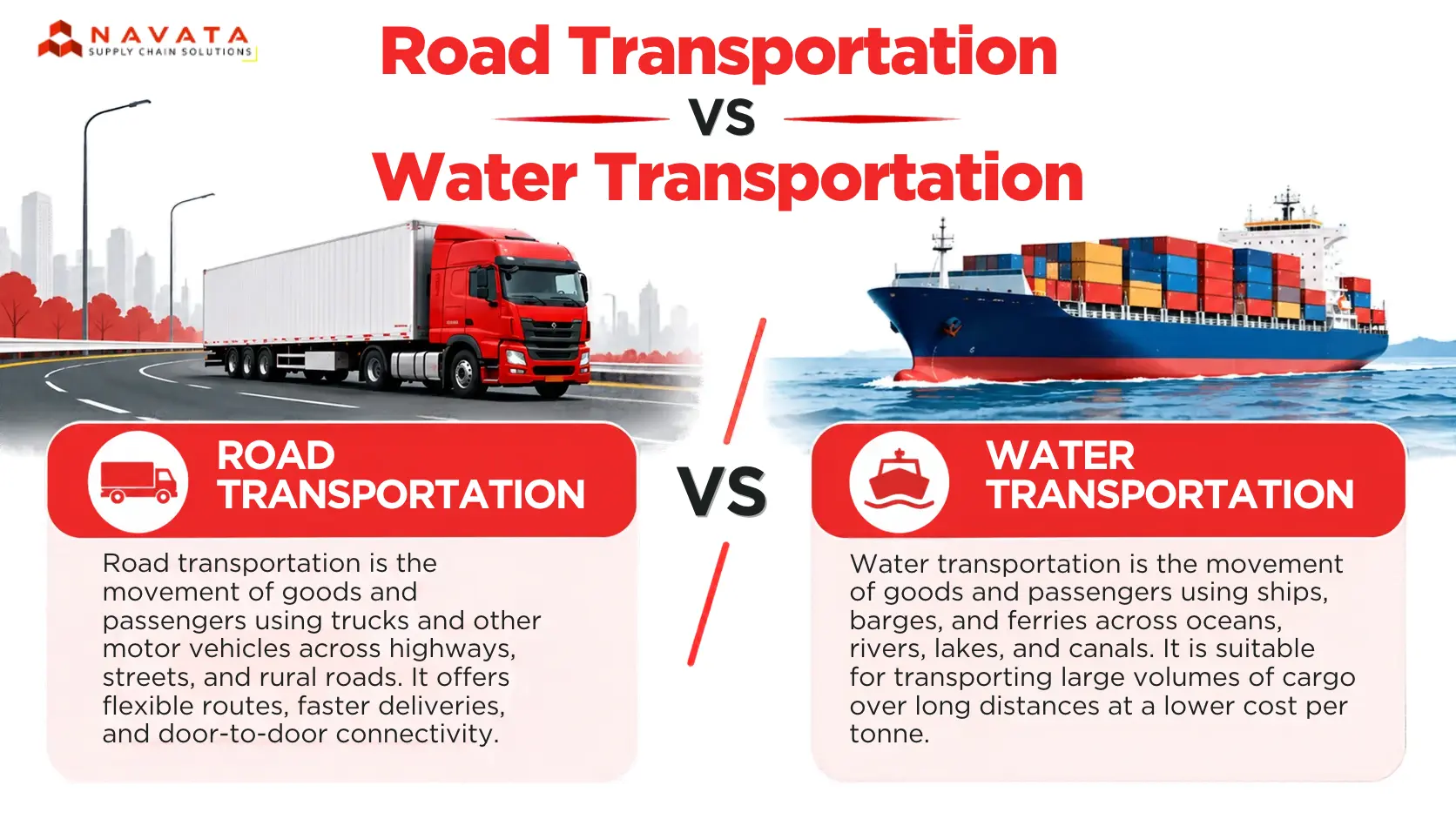
Road transportation vs water transportation is mainly a trade-off between speed and reach on one side and cost per tonne on the other. Road is faster over short and medium distances and can deliver door to door. Water is cheaper per tonne for large volumes over long distances, but it is slower and limited to places with port or waterway access.
Many businesses need both. This guide compares the two modes on cost, speed, capacity and reach, explains why the lower freight rate on water does not always mean a lower total cost, and shows when each mode fits.
Difference Between Land Transport and Water Transport
The difference between land transport and water transport starts with where the freight can go. Land transport here means road freight: trucks and vans moving goods on roads and highways. Water transport means ships and barges moving goods across oceans, coasts, rivers and canals. The table shows the main differences.
| Factor | Road transportation | Water transportation |
|---|---|---|
| Freight cost in India | About Rs 2.50 per km for one tonne | About Rs 1.06 per km for one tonne (inland waterways) |
| Speed | Faster over short and medium distances | Slower; port procedures and weather can add time |
| Capacity | Limited per vehicle | Very large per vessel; suits bulk cargo |
| Reach | Urban, rural and remote areas | Ports and usable waterways only |
| Door-to-door delivery | Yes, on one vehicle | Usually needs road at one or both ends |
| Fuel use per tonne | Higher | Generally lower |
| Environmental impact | Higher emissions; adds to traffic congestion | Lower emissions; risk of oil spills and marine pollution |
| Best for | Urgent, perishable and regional freight | Bulk and long-distance or international freight |
Cost figures: CRISIL, October 2024. They compare per-km cost by mode; road legs and port handling can add to the total.
Overview of Road Transportation
Road transportation is the movement of goods using vehicles on roads and highways. It plays a central role in logistics because of its accessibility, flexibility and ability to deliver directly without relying on ports or terminals. It is widely used for short and medium-distance shipments.
Common Vehicles Used in Road Transport
- Trucks: used for long-haul freight, with variations such as container trucks, refrigerated trucks and tankers for different cargo.
- Vans: suited to small shipments, courier services and last-mile deliveries.
- Light commercial vehicles: used for lighter goods movement.
Key Industries Relying on Road Transport
- E-commerce and retail: quick last-mile delivery.
- FMCG and food: perishable and packaged goods.
- Manufacturing and construction: raw materials, machinery and finished products moving to distribution centres or sites.
- Pharmaceuticals: timely delivery of medicines and medical supplies.
Overview of Water Transportation
Water transportation moves goods across oceans, coasts, rivers and lakes using ships, barges and ferries. It is central to global trade: UNCTAD’s Review of Maritime Transport 2025, as reported by the World Ports Organisation, says shipping carries over 80% of the world’s traded goods. It is slower than road but well suited to bulk shipments and international supply chains.
Water also moves freight within India. The inland waterways India operates carried a record 145.5 million tonnes of cargo in FY 2024-25, up from 18.1 million tonnes in FY 2013-14, according to the Ministry of Ports, Shipping and Waterways. The number of National Waterways rose from 5 to 111, and the operational length grew from 2,716 km in 2014-15 to 4,894 km in 2023-24. Even so, CRISIL noted in 2024 that much of the infrastructure, such as canals and shipping channels, is not usable, and that cargo transportation depends heavily on roads and railways.
Types of Vessels Used in Water Transport
- Cargo ships: carry containerised freight, dry bulk such as coal and grain, and liquid bulk such as oil and chemicals.
- Barges: flat-bottomed vessels suited to inland waterways and heavy cargo.
- Ferries: carry passengers and vehicles across short water routes.
Key Industries Dependent on Water Transport
- International trade: raw materials and finished goods moving between countries.
- Oil and gas: crude oil, LNG and petroleum products.
- Mining and agriculture: bulk commodities such as coal, iron ore and grain.
- Automotive: vehicles shipped on roll-on/roll-off vessels.
Advantages of Water Transportation Over Road
These are the main advantages of water transportation over road. For the wider view of this one mode, see the pros and cons of water transportation.
Lower Cost For Large Volumes
Ships and barges can move very large loads at a lower cost per tonne than trucks, which makes water a strong fit for bulk commodities such as coal, minerals and agricultural products.
Higher Carrying Capacity
Trucks and vans have limited capacity, while vessels can carry heavy or oversized cargo in far larger quantities on a single trip.
Lower Fuel Use Per Tonne
Water is generally more fuel-efficient than road for long-distance freight. One US study found barges moved a ton of cargo 647 miles per gallon, against 145 miles for trucks. That figure covers US inland routes from 2001 to 2014, so treat it as an indication of the gap, not an Indian benchmark.
Suited to Long-Distance and International Trade
Water connects continents as well as coastal and river routes, so businesses can move large volumes over distances where road alone is impractical or impossible.
Advantages of Road Transportation Over Water
Road has its own clear strengths. For the wider view, see the pros and cons of road transportation.
Faster Over Short and Medium Distances
Road suits regional and domestic deliveries, without the port handling that water transport involves. That makes it the usual choice for perishable and time-sensitive goods.
Door-to-Door Delivery
A truck can collect from the shipper and deliver to the consignee on one vehicle. Water usually needs additional handling at ports and a road leg at either end.
Wider Reach
Road can serve urban, rural and remote areas with no dependence on waterways or terminals, which is why it matters for last-mile connectivity.
Shipment Tracking
Vehicles fitted with GPS and fleet management systems allow a shipment to be followed in transit, which helps with route decisions and delivery planning.
Limitations of Each Mode
Limitations of Road Transportation
- Higher running costs: fuel, tolls and vehicle maintenance add up, particularly on long-distance freight.
- Congestion and delays: road conditions, accidents and urban traffic can make delivery times unpredictable.
- Less suited to bulk: limited vehicle capacity makes heavy or oversized cargo harder to move economically.
Limitations of Water Transportation
- Slow transit: long distances, port procedures and weather can extend shipping times, which rules water out for urgent deliveries.
- Limited access: it reaches only places with port or waterway access, so inland destinations need road or rail as well.
- Port and handling costs: port fees, customs duties on international cargo and container handling all add to the overall bill.
Why Water Transport Cost Per Tonne Km Is Lower, but Total Cost May Not Be
On freight rate alone, water wins, because one vessel carries far more cargo per trip than a truck and generally uses less fuel per tonne. CRISIL put the cost of moving one tonne of freight at about Rs 1.06 per km by waterways, against Rs 1.36 by rail and Rs 2.50 by road (October 2024). That is the water transport cost per tonne km advantage people usually mean when they call waterways the cheapest mode.
Total cost can look different. The Ministry of Ports, Shipping and Waterways itself notes that although waterway transport is cheaper, overall logistics costs can be higher because of multimodal handling. Unless the origin and destination both sit on the water, goods usually need a road or rail leg to and from the port, plus loading and unloading, and each step adds cost and time.
So compare total door-to-door cost, including road legs, port handling and the inventory tied up during a longer transit, rather than the rate per km alone.
How to Choose Between Road and Water Transport
Choice usually depends on the cargo, the distance and how much time the supply chain can absorb. The questions below cover the main decision points. If speed is the deciding factor, it may also be worth comparing road transportation vs air transportation.
Road or water: which fits?
| Question | Choose road when | Choose water when |
|---|---|---|
| How urgent is delivery? | The date is tight or the goods are perishable | Transit time is flexible |
| How much are you moving? | Part or full truck volumes | Bulk or very large volumes |
| How far is it going? | Short to medium distance | Long distance or overseas |
| Where are origin and destination? | Away from ports and usable waterways | Close to a port or a usable waterway |
A starting point only. Confirm with total door-to-door cost on the actual route.
Using Road and Water Together
The two modes are often partners rather than rivals. A water movement often begins or ends on a truck, which is a form of multimodal shipping.
How a Road and Water Movement Fits Together
-
1
Road Pickup A truck collects the cargo from the shipper.
-
2
Port Loading The cargo is handled at the origin port or terminal.
-
3
Water Leg A ship or barge carries the cargo on the main long-distance stretch.
-
4
Port Unloading The cargo is handled at the destination port or terminal.
-
5
Road Delivery A truck delivers the cargo to the consignee.
Navata Supply Chain Solutions transportation services cover full truckload, part truckload, and surface express movement across India, which can support the road legs of a wider supply chain.
Planning the road legs of your supply chain? See how Navata Supply Chain Solutions approaches transportation across India.
Explore TransportationConclusion
Road and water each play a distinct role in logistics. Road suits short and medium distances, urgent goods and door-to-door delivery. Water suits bulk cargo over long distances, where its lower cost per tonne can justify the slower transit. Assess speed, access, handling and total cost together, and consider combining the two where the route allows it.
Thank You For Reading: Road Transportation Vs Water Transportation