Road transportation vs air transportation comes down to a trade-off between cost, reach and speed. Road transport moves goods by truck over short and medium distances, reaches almost any address and usually costs less per shipment. Air transport moves goods by aircraft, delivers fastest over long distances and suits urgent, high-value or perishable cargo, but at a much higher cost and with tighter limits on size and weight.
This guide explains how each mode works, how the two compare on speed, cost, cargo fit, safety and environmental impact, and how businesses choose between them or combine them.
Understanding Road Transportation
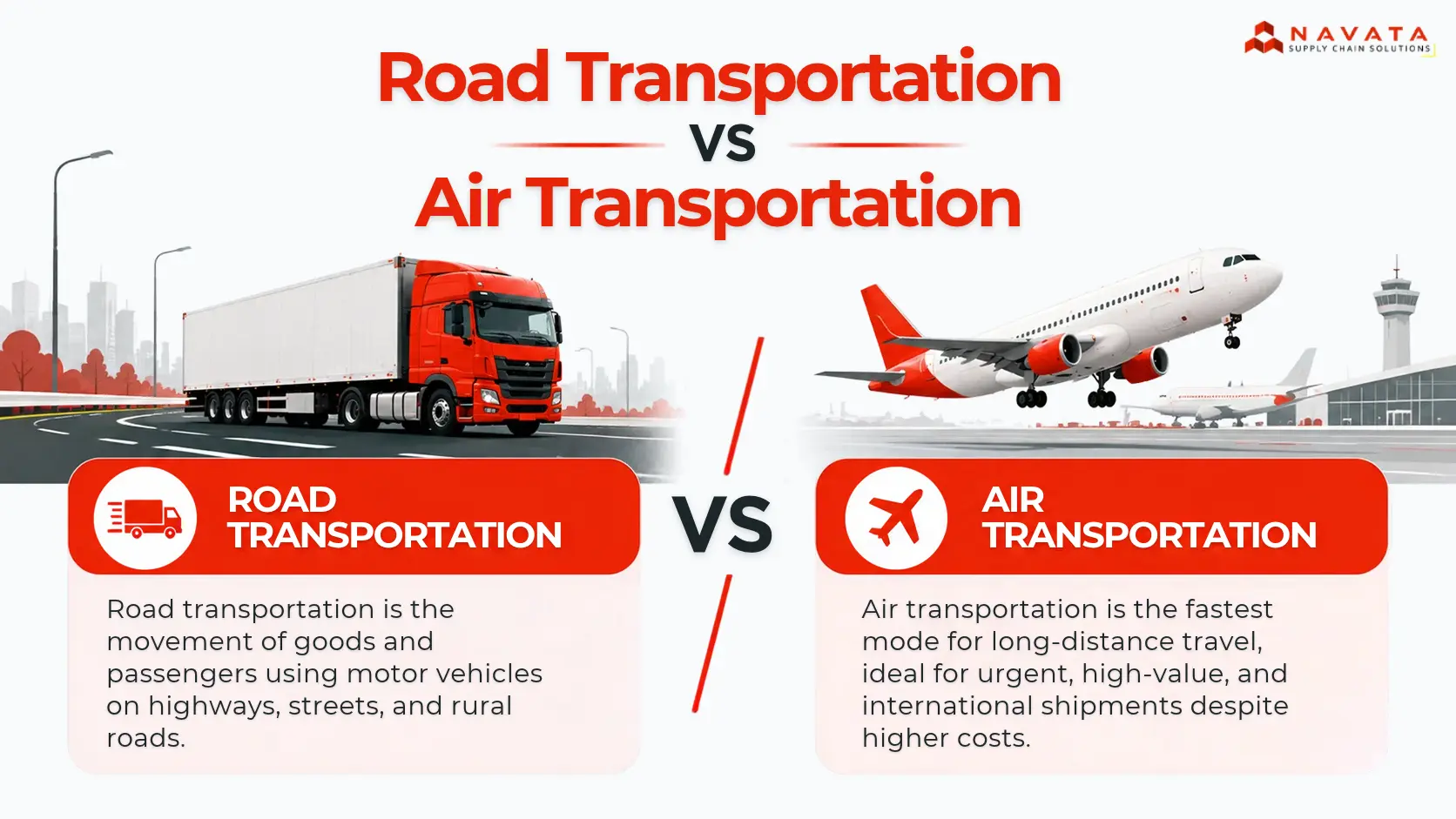
Road transportation moves goods and people by trucks, buses and cars. Because roads connect almost every town, warehouse and store, road transport gives direct access to locations that railway stations and airports do not reach, which makes it the default choice for short- and medium-range movement.
For business freight, road transport is usually booked in one of three ways. With a Full Truck Load (FTL), one shipper uses the whole vehicle; with a Partial Truck Load (PTL), a shipment shares vehicle space with other loads; and surface express services offer a third road option. Across India, road networks link manufacturing clusters, warehouses and distribution points in cities and rural markets, so road transport suits a wide range of domestic B2B lanes, from inter-city FTL movements to multi-drop regional distribution.
Common Uses
- Freight movement: Trucks connect factories, warehouses, distribution centres and retail stores, keeping day-to-day supply chain operations moving.
- Passenger transport: Buses, taxis and private vehicles provide mobility for business and personal travel.
- Last-mile delivery: Road vehicles take goods to the customer’s door, which retail and distribution networks rely on for the final delivery step.
Advantages of Road Transport
- Cost-effective for short distances: Operating costs are lower than air transport for regional and domestic distances.
- Flexible and accessible: Road networks reach urban and rural areas, so shipments do not depend on an airport or railway terminal.
- Door-to-door service: Goods move directly from pickup to delivery point with fewer handovers, which suits online orders, perishable goods and medical supplies.
- Suited to heavy and bulky loads: Trucks carry large, heavy, and oversized cargo that aircraft cannot take economically.
Challenges of Road Transport
- Traffic congestion and delays: Congestion, peak-hour traffic and road accidents add delivery time and operating cost, especially in urban areas.
- Changing fuel costs: Fuel prices change frequently, and those changes feed into freight rates.
- Weather and road conditions: Heavy rain, landslides and poor road infrastructure can delay shipments and cause vehicle breakdowns.
You May Also Like to Read: Road Transportation vs Rail Transportation
Understanding Air Transportation
Air transportation moves goods and passengers by aircraft, including passenger planes that carry cargo in their holds and dedicated cargo planes. It is the fastest of all transport modes, which makes it valuable for time-critical and international shipments.
Common Uses
- International shipping: Air freight lets businesses reach overseas markets in days rather than weeks.
- High-value and perishable goods: Pharmaceuticals, electronics, luxury products and perishable food often travel by air to protect quality and keep transit time short.
Advantages of Air Transport
- Speed over long distances: Air is the fastest option for long-distance moves and urgent deliveries.
- Scheduled services: Scheduled flights avoid road traffic, although weather and capacity can still delay air cargo.
- Secure handling for valuable cargo: Air cargo moves through secured, access-controlled airport areas, which lowers theft risk for valuable and time-sensitive shipments.
Challenges of Air Transport
- High shipping costs: Fuel, airport charges, handling and security fees make air freight considerably more expensive than road.
- Limited capacity for bulky goods: Weight and dimension limits rule out many heavy or oversized items.
- Dependence on airport connectivity: Shipments still need road legs to and from airports, which adds cost, handling, and possible delays.
You May Also Like to Read: Pros and Cons of Road Transportation
Differences Between Road and Air Transportation
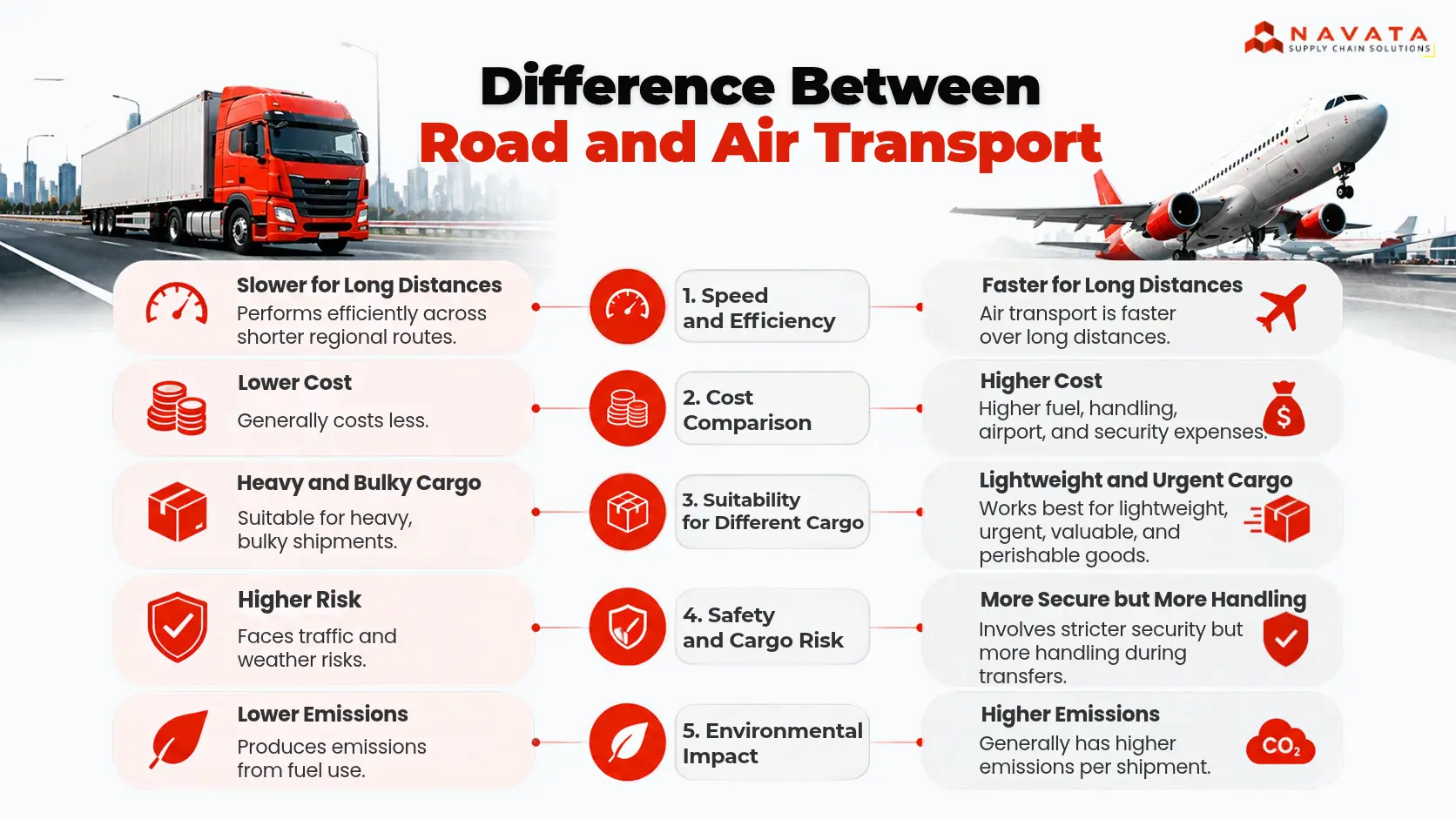
The main difference between road and air transport is the balance of speed against cost and capacity. The table below compares the two modes on the factors businesses weigh most often.
Road Transport and Air Transport Compared
| Factor | Road Transport | Air Transport |
|---|---|---|
| Speed | Slower over long distances; efficient on short and medium routes | Fastest mode over long distances |
| Cost | Lower cost per shipment, especially for regional moves and bulk loads | Considerably higher, driven by fuel, airport and security charges |
| Capacity | Carries heavy, bulky and oversized cargo | Limited by aircraft weight and dimension restrictions |
| Reach | Door to door, including rural and remote areas | Airport to airport; needs road legs at both ends |
| Best-fit Cargo | Bulk, heavy, non-urgent and regional shipments | Urgent, lightweight, high-value or perishable shipments |
| Main Risks | Traffic, road conditions, weather and multiple stops | Cost, capacity limits, weather delays and multiple handling points |
| Environmental Impact | Fuel use and congestion add emissions, especially on long hauls | Jet fuel use gives a high environmental impact |
Speed and Efficiency
Air is the fastest mode once cargo is in the air, but total transit time also includes the road legs to and from airports and cargo acceptance cut-offs. On shorter routes, a direct truck can match or beat air on door-to-door time, because it carries goods straight to the destination without transfers.
Cost Comparison
Road freight is priced mainly by distance, vehicle size and whether the load is full or shared, which is why a part load can lower the cost of a smaller consignment. Air freight is usually charged on the greater of actual weight and volumetric weight, so light but bulky cargo becomes expensive to fly.
Suitability for Different Cargo
Beyond size and weight, check how the goods must be handled. Temperature-controlled, fragile and hazardous goods have specific requirements on each mode, and dangerous goods face stricter restrictions by air than by road.
Safety and Cargo Risk
Safety depends on whether the question is about people or cargo. For passenger travel, US data favours air: the National Safety Council reports that, over the most recent 10-year period it covers, the death rate per 100 million passenger miles for passenger vehicles in the United States was 1,200 times higher than for scheduled airlines.
For cargo, the picture is more mixed. Air cargo moves through secured, access-controlled airport areas, which suits valuable goods, but it typically passes through more handling points between pickup and delivery. Road cargo is exposed to traffic, road-condition and weather risks, but it usually stays on one vehicle, and a truck is often GPS-tracked and can be rerouted. Sound packing, secure loading and shipment tracking reduce risk on either mode.
Environmental Impact
Road transport adds carbon emissions through fuel consumption, congestion and long-haul trucking. Air transport has a significant environmental impact because of jet fuel use, which makes sustainability a major challenge in aviation logistics.
Air Freight vs Road Freight: Which Mode Fits Your Shipment?
Deciding on air freight vs road freight is easier when you start from the shipment rather than the mode. These questions settle most decisions:
- How far is it going? For regional and most domestic routes, road freight usually delivers in good time at a lower cost. Air freight earns its premium on long-distance and international moves.
- How urgent is it? If a delay would stop a production line, miss a launch or spoil goods, the speed of air freight can justify its cost.
- How heavy and large is it? Heavy and bulky loads suit trucks. Small, light consignments fit within air cargo limits.
- What is it worth? Compact, high-value goods such as electronics or pharmaceuticals can absorb air freight costs; low-value bulk goods rarely can.
- Where does it need to go? If the destination is far from an airport, road transport is needed for the final leg in any case.
Road or air for a domestic shipment? A quick decision path
- Is the shipment urgent, so that a delay would stop a production line, miss a launch or spoil goods?
- NoRoadRoad freight usually delivers in good time at a lower cost on regional and most domestic routes.
- If it is urgent: is it heavy or bulky?
- YesRoadHeavy and bulky loads suit trucks: weight and dimension limits rule out many oversized items by air.
- If it is urgent and small: is it a long-distance route?
- NoRoadOn shorter routes, a direct truck can match or beat air on door-to-door time, at a lower cost.
- If it is urgent, small and going far: can the goods absorb air freight costs?
- YesAirCompact, high-value goods such as electronics or pharmaceuticals usually can. Plan the road legs to and from the airports.
- NoCompareWeigh the cost of air against the cost of a delay: low-value bulk goods rarely absorb air freight costs.
Many businesses use both. A manufacturer might plan road freight for regular stock transfers between Indian cities and use air only for an urgent consignment, such as critical spare parts.
Combining Road and Air Transport
Road and air transport are often used together rather than as alternatives. A typical air shipment starts with a truck collecting goods from a factory or warehouse, moves by air between airports, and finishes with a road delivery to the customer. Road transport also links airports with distribution centres and handles last-mile delivery once air cargo arrives.
How road and air transport work together on one shipment
- 1Factory or warehouseGoods are packed and handed over
- 2Road pickupRoadTruck to the departure airport
- 3Departure airportCargo acceptance and security screening
- 4Air legAirFlight between airports
- 5Arrival airportCargo is handed back to road transport
- 6Road deliveryRoadLast-mile delivery by truck
- 7Customer or distribution pointDelivery complete
Planning both legs together, with pickups timed to flight schedules and delivery routes planned in advance, keeps the time saved in the air from being lost on the ground.
Road vs Air Transport: Key Arguments at a Glance
Here are the main advantages of road transport over air transport, and where air has the edge.
Where Each Mode Has the Edge
| Factor | Road | Air |
|---|---|---|
|
Cost
Lower cost for most domestic and regional shipments
|
Edge | |
|
Door-to-door reach
Pickup to delivery point with fewer handovers
|
Edge | |
|
Heavy, bulky and oversized goods
Oversized cargo that aircraft cannot take economically
|
Edge | |
|
Rural and remote areas
No airport or rail terminal needed
|
Edge | |
|
Speed over long distances
Fastest mode once cargo is in the air
|
Edge | |
|
International markets
Overseas markets in days rather than weeks
|
Edge | |
|
Scheduled services
Flights avoid road traffic; weather and capacity can still delay
|
Edge | |
|
Theft control for valuable cargo
Secured, access-controlled airport areas
|
Edge | |
|
Perishable goods over long distances
Short transit time helps protect quality
|
Edge |
Summary of the key arguments. Road leads on cost, capacity and reach; air leads on speed over distance.
Conclusion
Choosing between road and air transportation depends on cost, speed, cargo type and destination. Road transport is cost-effective, flexible and suited to bulk, regional and last-mile deliveries, while air transport leads on speed for urgent, high-value and perishable goods. Both have limits: road faces congestion and fuel costs, and air is expensive and capacity-limited.
Businesses get the best result by matching each shipment to the mode that fits it, and by planning road and air legs as one chain when both are needed. For road freight, compare Full Truck Load, Partial Truck Load and surface express transportation options.
Moving freight by road across India? Navata SCS provides Full Truck Load, Partial Truck Load and surface express transportation for businesses.
Explore TransportationThanks For Reading: Road Transportation vs Air Transportation