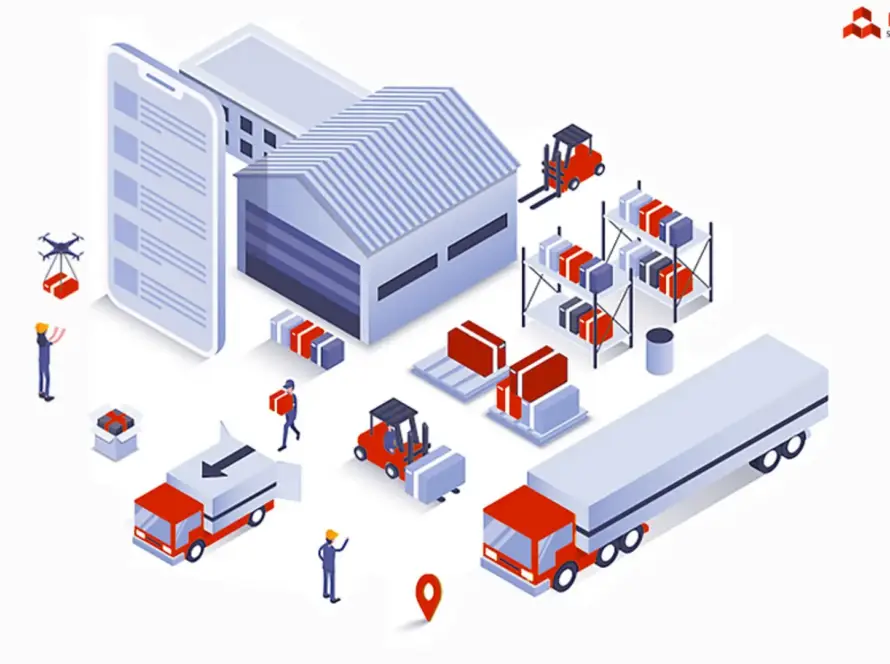
Agentic AI in Logistics: The New Engine
Logistics and supply chains are entering a phase where efficiency is no longer enough. Markets move faster, customers expect instant delivery, disruptions hit without warning, and traditional automation—RPA, rule engines, BI dashboards—cannot keep up.
This is where Agentic AI becomes a breakthrough.
Instead of simply predicting or recommending, Agentic AI in logistics can actually act, plan, and self-orchestrate end-to-end operations. It behaves like a digital workforce of autonomous agents capable of coordinating fleets, optimizing warehouses, managing orders, avoiding disruptions, and stabilizing supply chain flows in real time.
In other words:
- Traditional AI automates tasks.
- Agentic AI automates decisions and actions.
And that shift is redefining logistics performance, cost structures, and delivery reliability at scale.
Read More About:| The Role of Artificial Intelligence in Supply Chain Optimization
What Is Agentic AI in Logistics?
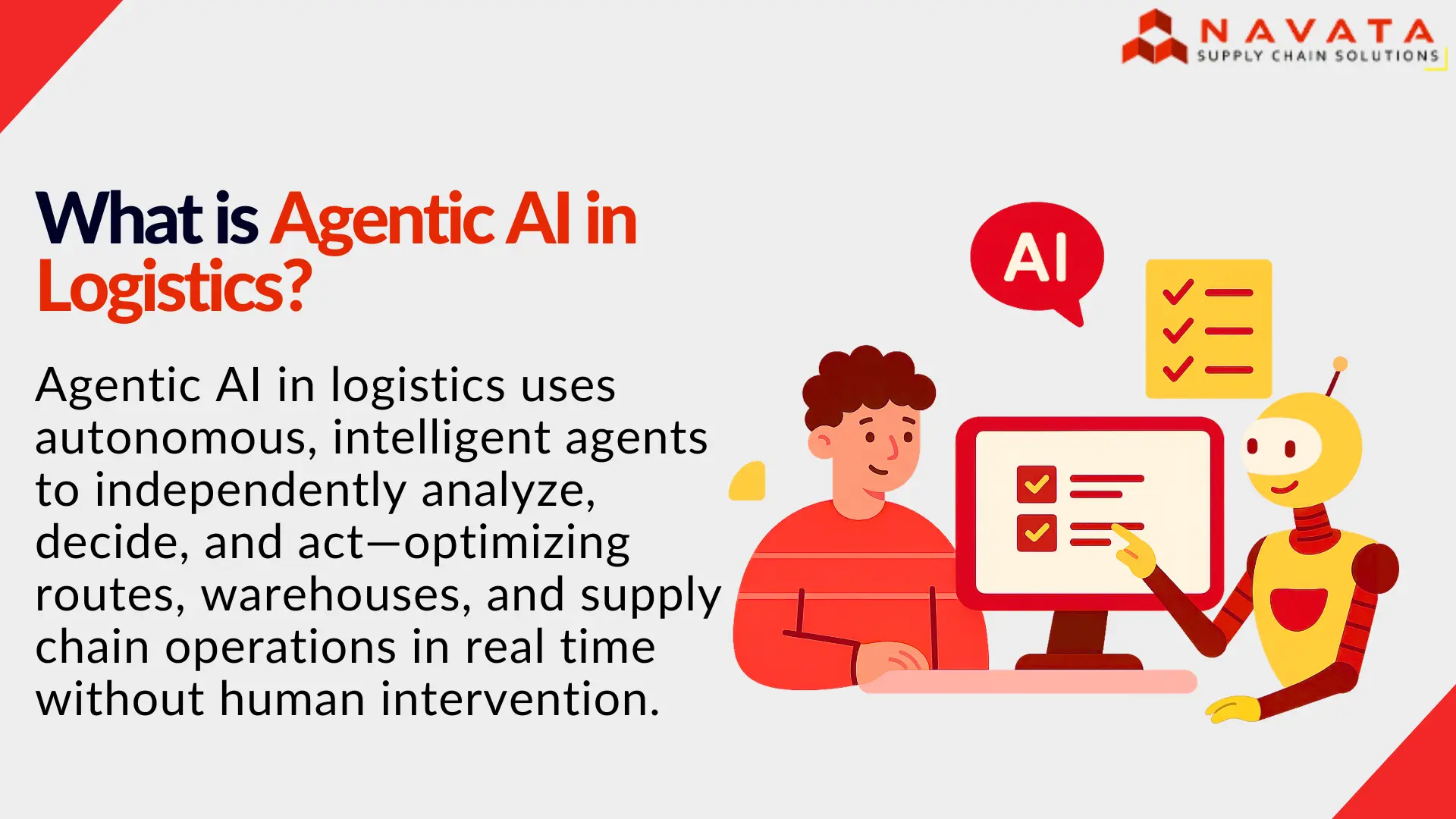
Agentic AI refers to AI systems built from multiple intelligent agents that can independently analyze situations, make decisions, and take actions inside complex operational environments like supply chains, warehouses, and transport networks.
Each “agent” behaves like a specialized digital operator—one may manage fleet routing, another may handle inventory balancing, another may solve delivery exceptions.
Together, they create a self-driving supply chain layer that continuously optimizes the movement of goods, people, and resources.
Core capabilities of Agentic AI in logistics include:
Autonomous fleet and route optimization
End-to-end order fulfillment orchestration
Predictive and adaptive warehouse management
Real-time disruption mitigation
Dynamic transportation planning
Multi-agent coordination across nodes
Self-improving workflows and automated decision loops
This transforms the supply chain from reactive to predictive, proactive, and self-correcting.
Importance of Agentic AI
Global supply chains have become too complex for humans and rules-based systems to manage manually:
Volatile demand patterns
Driver shortages
Faster SLAs and same-day delivery growth
Increasing compliance and documentation requirements
Real-time visibility expectations
Cost pressure from fuel, labor, fleet maintenance
Weather disruptions and geopolitical uncertainty
Legacy systems struggle because they still require humans to interpret data and take action.
Agentic AI removes this bottleneck.
It gives logistics companies something they’ve never had before: autonomous decisioning at scale.
How Agentic AI Works Inside Logistics Operations
Below is a practical, high-depth view of how agent-based AI systems transform everyday logistics functions.
1. Autonomous Fleet & Route Optimization
Instead of dispatch teams building routes, Agentic AI agents:
Study real-time traffic
Predict congestion
Evaluate fuel consumption
Analyze vehicle conditions
Consider customer SLAs
Balance workloads across drivers and hubs
Then they generate and execute the optimal plan, adjusting every few minutes as conditions change.
This reduces fuel spend, improves ETAs, and dramatically boosts delivery consistency.
2. Intelligent Warehousing & Inventory Flow Control
Agentic AI inside warehouses acts like a 24/7 digital supervisor.
It:
Predicts demand surges
Optimizes pick–pack–ship workflows
Prioritizes urgent orders
Auto-assigns tasks to workers or robots
Balances load across zones
Prevents bottlenecks before they occur
It also synchronizes inventory across eCommerce, retail, and B2B channels, ensuring real-time accuracy.
3. Self-Healing Supply Chain Operations
In traditional workflows, when exceptions happen—vehicle breakdowns, address issues, inventory mismatches—teams scramble to fix them.
Agentic AI does the opposite.
It detects issues early, diagnoses the root cause, chooses the best response, and takes corrective action automatically:
Reroutes deliveries
Replaces vehicles
Reassigns drivers
Updates customer ETAs
Adjusts warehouse picking priorities
Balances inventory across hubs
This keeps fulfillment smooth even when disruptions strike.
4. Dynamic Workforce & Asset Allocation
Agentic AI continuously optimizes how people and assets are deployed:
Reassigns drivers based on workload
Suggests labor shifts inside warehouses
Improves dock scheduling
Plans maintenance windows
Reduces empty miles and idle time
Every resource becomes more productive without overworking the workforce.
5. Autonomous Decision Loops Across the Entire Value Chain
The biggest advantage of Agentic AI is closed-loop automation:
Sense → Analyze → Decide → Act → Learn → Improve
This eliminates human dependency for repetitive decisioning and creates a self-improving engine for logistics performance.
Keywords integrated: closed-loop automation, self-orchestrating supply chain systems, intelligent logistics automation.
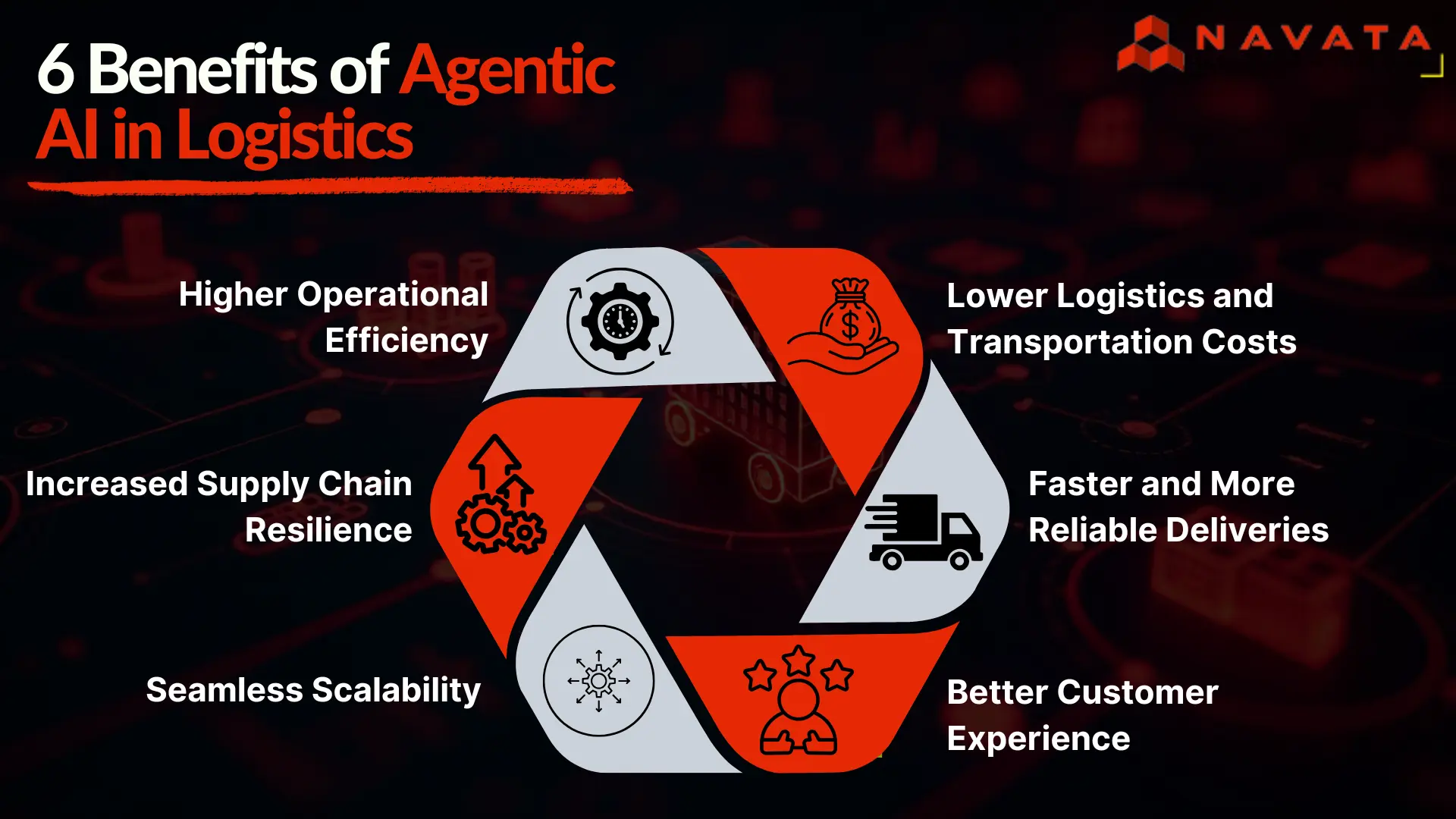
Benefits of Agentic AI for Logistics & Supply Chains
1. Higher Operational Efficiency
Agentic AI automates daily logistics decisions—from routing to warehouse task allocation—eliminating manual coordination and reducing process delays. By constantly optimizing workflows in real time, it increases throughput, reduces idle time, and ensures every resource operates at peak efficiency. This creates a faster, leaner, and more synchronized supply chain.
2. Lower Logistics and Transportation Costs
With autonomous routing, demand forecasting, and predictive maintenance, Agentic AI directly reduces fuel expenses, labor inefficiencies, empty miles, and vehicle downtime. It minimizes waste across fleet and warehouse operations, resulting in substantial cost savings. Businesses gain tighter cost control and improved margins without compromising service levels.
3. Faster and More Reliable Deliveries
Agentic AI continuously reacts to real-time conditions—traffic, delays, inventory gaps—and autonomously adjusts routes, tasks, and priorities. This ensures tighter SLA adherence, quicker issue resolution, and highly accurate ETAs. Deliveries become faster, more predictable, and more resilient to variability across first-mile, mid-mile, and last-mile operations.
4. Better Customer Experience
Customers benefit from accurate ETAs, proactive notifications, and fewer delays. Agentic AI ensures smoother fulfillment by predicting issues early and reassigning resources instantly. This reduces failed deliveries, enhances transparency, and creates a more reliable post-purchase experience. Over time, brands see stronger customer trust and higher repeat orders.
5. Seamless Scalability
As order volumes grow, Agentic AI automatically scales operational capacity without requiring more planning staff or larger control rooms. It rebalances workloads across fleets, warehouses, and delivery hubs to handle demand spikes effortlessly. This software-driven scalability is ideal for fast-growing eCommerce, retail, and 3PL logistics networks.
6. Increased Supply Chain Resilience
Agentic AI anticipates disruptions—weather events, congestion, demand shifts, supplier delays—and autonomously takes preventive action. By analyzing risks ahead of time and adjusting plans instantly, it keeps operations running smoothly even in volatile conditions. This improves service reliability and protects businesses from costly operational breakdowns.
You May Also Like to Read: Role of Artificial Intelligence and Machine Learning in Supply Chain
Where Agentic AI Will Have the Biggest Impact
Here are the highest-impact use cases already gaining traction:
Urban last-mile delivery networks
Fleet and fuel optimization for transporters
Quick commerce dark store orchestration
Predictive warehouse automation
International freight coordination
Cold-chain logistics stability
B2B manufacturing supply chains
High-volume eCommerce fulfillment
Companies that adopt Agentic AI early will shape the next generation of logistics performance.
Conclusion
Agentic AI is rapidly evolving into the core operating system of modern logistics—moving the industry from simple automation to truly autonomous, self-optimizing systems. Instead of merely supporting human teams, it becomes a digital command layer that drives faster decisions, reduces operational costs, enhances accuracy, and adapts in real time to disruptions.
As logistics competition increasingly depends on speed, predictability, and efficiency, Agentic AI will define the next generation of high-performance supply chains. The question now isn’t whether companies will adopt it, but how quickly they can transition to fully autonomous logistics to stay competitive.
Thanks For Reading: Agentic AI in Logistics: The 2026 Guide to Autonomous Supply Chains
Powered By 360Presence