Artificial Intelligence and Machine Learning (AI and ML) in supply chain use algorithms trained on operational data to forecast demand, plan transportation routes, automate warehouse tasks, predict equipment failures, and flag operational anomalies before they become costly disruptions. Applied well, AI and ML shift supply chain planning and execution from reactive, manual decision-making toward pattern-based, data-driven operations, covering demand forecasting, route optimisation, warehouse automation, predictive maintenance, and risk detection.
What Is Artificial Intelligence in Supply Chain?
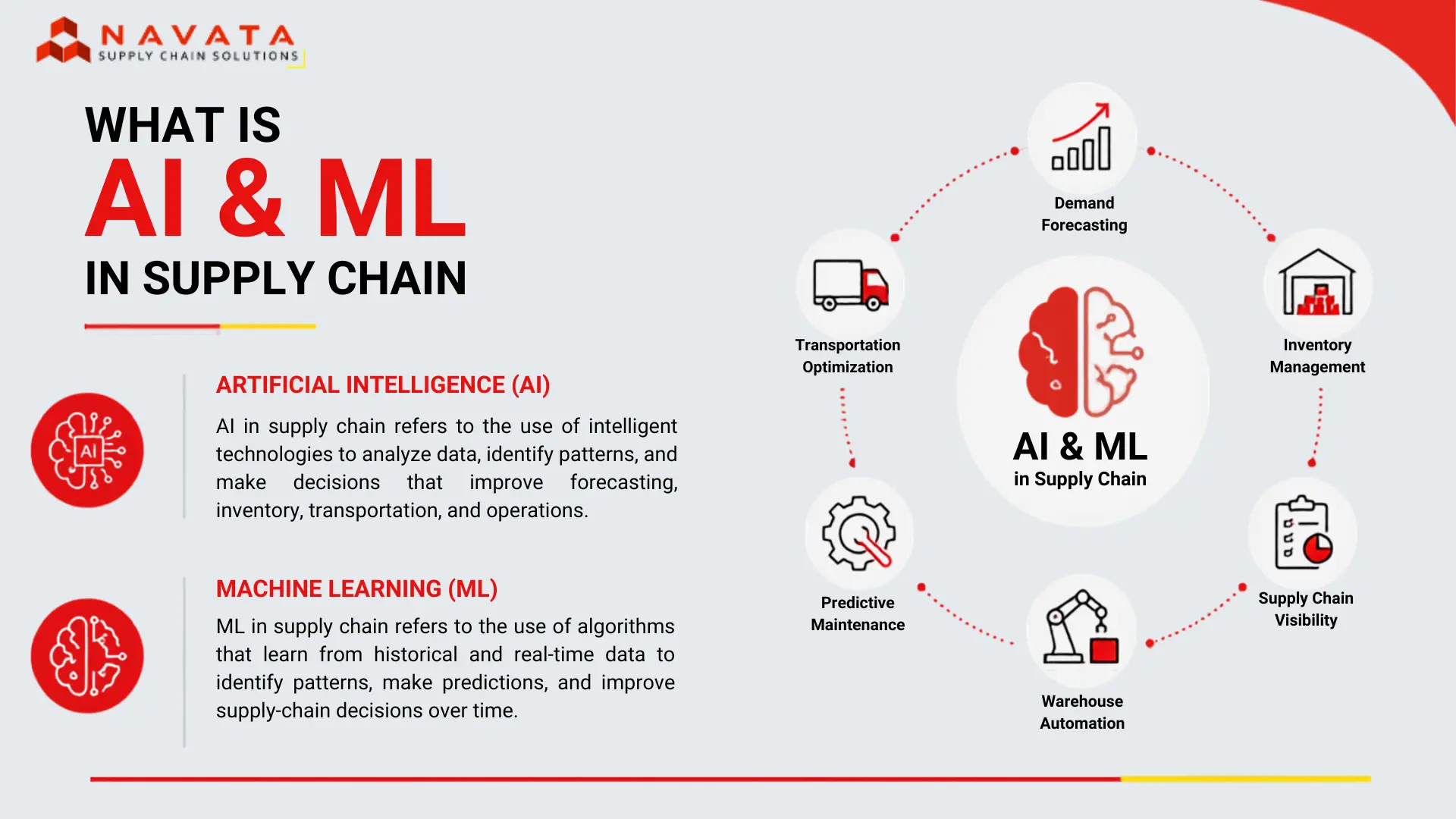
Artificial Intelligence in Supply Chain refers to software systems that can analyse large volumes of operational data (orders, inventory levels, transportation records, vendor performance) and support or automate decisions that would otherwise depend on manual review. Rather than following a fixed set of rules, AI systems are built to recognise patterns in historical and real-time data and apply them to new situations, such as anticipating a demand spike or identifying an under-performing vendor.
What Is Machine Learning in Supply Chain?
Machine Learning in Supply Chain is the specific mechanism within AI that improves its own accuracy as more data becomes available. An ML model trained on past order volumes, seasonal patterns, and delivery outcomes gets more precise over time. For example, it can refine a demand forecast as new sales data arrives, or improve a route-time prediction as more delivery outcomes are logged. AI is the broader capability; Machine Learning is what lets supply chain systems get measurably better with use.
Key Applications of AI and ML in Supply Chain
The most common Applications of AI and ML in Supply Chain fall into five categories, covered below.
Demand Forecasting and Inventory Management
AI-driven forecasting models combine historical sales data, seasonality, and external signals to predict future demand at a SKU or category level, which in turn drives inventory positioning decisions: how much stock to hold, and where. A business using pattern-based forecasting instead of manual, spreadsheet-based projections can reduce both stockouts (lost sales) and overstock (tied-up working capital and warehousing cost) at the same time, because the model is reacting to actual demand signals rather than a fixed monthly estimate. For a closer look at applying this operationally, see Inventory Management Strategies.
Route Optimization and Logistics
Route optimisation models evaluate live traffic conditions, delivery windows, vehicle capacity, and driver availability to recommend transportation routes that reduce distance, fuel consumption, and delivery delays. Instead of a dispatcher manually sequencing stops, the system continuously re-evaluates the most efficient path as conditions change, which matters most in dense urban delivery networks and in mixed urban-rural distribution, where road conditions and delivery-point density vary widely. See Benefits of Route Optimization Software for a deeper breakdown of the operational gains involved.
Warehouse Automation and Robotics
AI and ML support warehouse automation in two connected ways: robotics systems (for picking, sorting, and moving inventory) that use computer vision and sensor data to operate safely alongside people, and software-side automation: a Warehouse Management System that uses historical throughput data to optimise storage layout, slotting, and pick-path sequencing. The result is faster order fulfilment and fewer manual handling errors. For a broader look at how automation is applied across warehouse operations, see What Is Warehouse Automation?
Predictive Maintenance
Predictive maintenance models monitor equipment data (from warehouse machinery to fleet vehicles) to flag early signs of wear or failure before a breakdown happens. Instead of maintenance on a fixed calendar schedule (which can mean servicing equipment too early or too late), the system flags the specific asset that needs attention based on its actual condition, reducing unplanned downtime and the cascading delays it causes further down the supply chain.
Anomaly and Risk Detection
AI-based anomaly detection compares live operational data against expected patterns to surface irregularities early: an unusual order volume, an inventory count that doesn’t reconcile, or a shipment pattern that deviates from historical norms. Catching these signals early allows a business to investigate before a small discrepancy becomes a larger operational or financial problem. This is a genuinely useful application area industry-wide; the maturity of anomaly-detection tooling varies significantly by provider and use case, and results depend heavily on data quality.
How Navata Supply Chain Solutions Applies AI and ML
Navata Supply Chain Solutions describes its own logistics platform, GamanIQ, as an AI-driven, self-optimising B2B logistics platform. In practical terms, Navata Supply Chain Solutions applies the AI and ML concepts discussed above to route optimisation, vendor performance evaluation and performance-backed vendor selection, and broader logistics decision support spanning orders, vendors, billing, documents, and tracking. It’s a concrete example of the applications described above being used inside a live, operating logistics ecosystem rather than only in theory. As with any technology deployment, though, the specific outcomes depend on the operational context it’s applied to.
Challenges of Implementing AI and ML in Supply Chain
High Implementation Costs
AI and ML systems require investment in data infrastructure, integration work, and often specialised talent (a real barrier for many mid-sized operators), and a reason phased adoption (starting with the highest-value use case rather than a full-stack rollout) is often more realistic than attempting everything at once.
Data Privacy and Security Concerns
Supply chain AI systems typically process sensitive operational and vendor data. Data governance, access control, and vendor-security review are not optional add-ons. They need to be part of the implementation plan from the outset, not addressed after a system is already live.
Integration with Legacy Systems
Many supply chain operations still run on older warehouse, transportation, or ERP systems that were not built with AI/ML integration in mind. Connecting new AI-driven tools to these systems is frequently the most time-consuming part of an implementation, more so than the AI model itself.
Future of AI and ML in Supply Chain
The direction of travel across the industry is toward more autonomous, continuously-learning systems: forecasting that updates in near real time rather than on a monthly cycle, routing that adjusts mid-journey rather than only at planning time, and decision support that flags exceptions for a human to review rather than requiring a human to find them manually. AI and ML in Supply Chain adoption is no longer experimental. Businesses that build the underlying data discipline now, with clean and consistent operational data, are better positioned to adopt these capabilities as they mature, regardless of which specific vendor or platform they eventually use.

Conclusion
Artificial Intelligence and Machine Learning are no longer experimental additions to supply chain management. They’re increasingly the mechanism behind accurate forecasting, efficient routing, automated warehouse operations, and early risk detection. The businesses getting the most value are the ones treating adoption as a staged, data-first process rather than a single technology purchase.
Thanks For Reading: Role of Artificial Intelligence and Machine Learning in Supply Chain
Related Reading
This article is a broad overview of AI and ML applications across supply chain operations. For more specific angles, see:
- 7 Benefits of AI and ML in Supply Chain (a business-impact-focused view of the same technology area)
- AI-Driven Predictive Supply Chains (a closer look at predictive-specific applications)
- Agentic AI in Logistics: The 2026 Guide to Autonomous Supply Chains (where autonomous AI agents fit into supply chain operations)
- What Is RFID Technology & How It Is Revolutionizing Supply Chain Visibility
- What Is Landed Cost in Supply Chain? A Real-World Explanation