

Per pallet
How it is charged
A rate per pallet position per month
May suit
Palletised goods moved in full pallets
Flexi warehousing is a way of renting warehouse space and services for the amount of space and the length of time a business actually needs, instead of signing a long lease for a fixed facility. It is also called flexible warehousing or on-demand warehousing. This guide explains how the model works, how providers price it, how it compares with a leased warehouse and a 3PL contract, and when it is the right or wrong choice for a B2B supply chain.
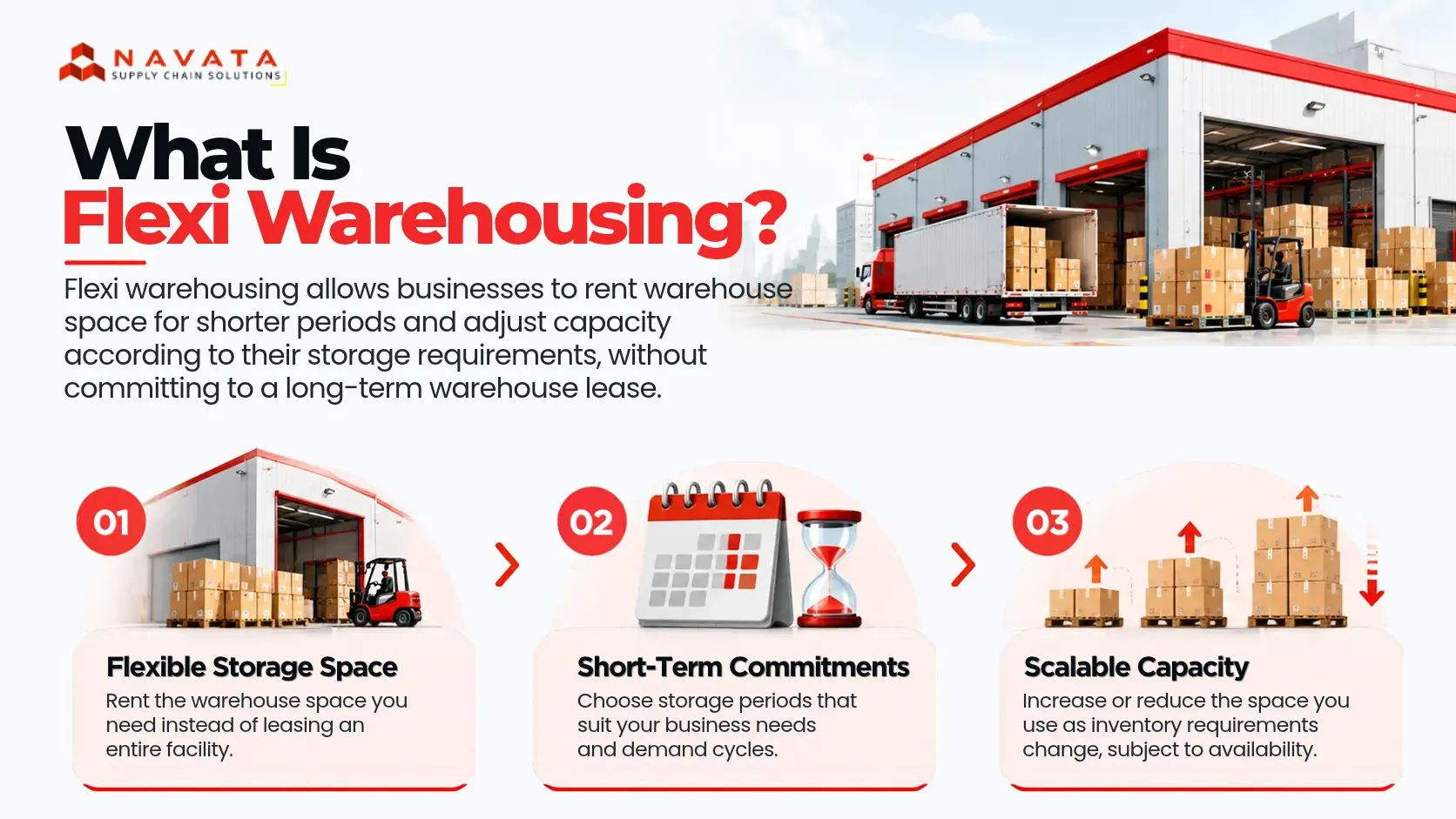
In a traditional setup, a business leases a warehouse for several years, fits it out, staffs it, and carries that cost whether the space is full or half empty. Flexi warehousing changes the commitment. The business books capacity inside a warehouse that is already built and operated, uses it for weeks or months, and pays for the space and services it consumes.
In effect, storage becomes a variable cost that can follow demand rather than a fixed cost that has to be absorbed. For supply chain teams, that means capacity decisions can be made closer to the moment the inventory arrives, not years in advance.
Terms you will see used for the same idea:
The mechanics differ by provider. A typical on-demand warehousing arrangement runs through these steps.
What, how much, where, how long and which handling.
Space in a suitable facility and location.
Rates, minimums, notice period and service levels.
Receive, count, put away and connect data.
Dispatch, report and add or release space.
Step four is where many of the practical risks sit. If stock is not visible in a warehouse management system or a connected inventory report, the business saves on rent but loses control over what it holds and where.
Flexible warehousing solutions are often priced on a storage unit such as the ones below.
| Pricing unit | How it is charged | May suit |
|---|---|---|
| Per pallet | A rate per pallet position per month | Palletised goods moved in full pallets |
| Per square foot | A rate for floor area reserved | Bulky or irregular goods, or a dedicated area |
| Per cubic foot | A rate for the volume occupied | Goods that stack high or vary in size |
| Per bin | A rate per bin location | Small, high-frequency items picked by unit |
A rate per pallet position per month
Palletised goods moved in full pallets
A rate for floor area reserved
Bulky or irregular goods, or a dedicated area
A rate for the volume occupied
Goods that stack high or vary in size
A rate per bin location
Small, high-frequency items picked by unit
Storage is rarely the whole bill. Handling charges for pallet moves in and out, plus access fees, may be billed separately, so two quotes with the same storage rate can result in very different monthly costs. Short contracts and low volumes can also carry higher unit rates, while longer terms and larger volumes can qualify for lower ones.
When comparing providers, ask for the full rate card: storage unit and rate, inbound and outbound handling charges, any minimum commitment, the notice period for releasing space, and what reporting is included. For ideas on controlling the rest of the storage costs, see how to reduce warehouse costs.
Flexible warehousing sits between running your own leased facility and outsourcing a wider logistics scope to a third-party logistics provider.
| Factor | Flexi warehousing | Leased warehouse | 3PL contract |
|---|---|---|---|
| Commitment | Weeks to months, scalable | Multi-year lease | Service agreement, term set by contract |
| Cost structure | Mostly variable, pay for space and services used | Mostly fixed rent, fit-out and staff | Agreed rates for an outsourced scope |
| Who operates the warehouse | The provider | The business | The provider |
| Customisation | Limited to what the facility offers | High, the site can be built around the process | Moderate to high, depending on the agreement |
| Speed to add capacity | Fast, where space is available | Slow, needs a site and fit-out | Moderate, depends on onboarding |
| Best suited to | Variable or temporary demand | Stable, high-volume, specialised operations | Businesses outsourcing warehousing and related logistics together |
Weeks to months, scalable
Multi-year lease
Service agreement, term set by contract
Mostly variable, pay for space and services used
Mostly fixed rent, fit-out and staff
Agreed rates for an outsourced scope
The provider
The business
The provider
Limited to what the facility offers
High, the site can be built around the process
Moderate to high, depending on the agreement
Fast, where space is available
Slow, needs a site and fit-out
Moderate, depends on onboarding
Variable or temporary demand
Stable, high-volume, specialised operations
Businesses outsourcing warehousing and related logistics together
In practice the lines blur. Some providers offer both flexible space and a full 3PL scope, and a business can combine models: a leased or managed core site for steady volume, with flexible space added in the regions or seasons where demand spikes. If you are weighing outsourcing more broadly, the comparison of 3PL versus in-house logistics covers that decision.
Flexible capacity helps most when demand, geography or timelines are uncertain.
The same flexibility has limits, and it is not the cheapest or safest option for every operation.
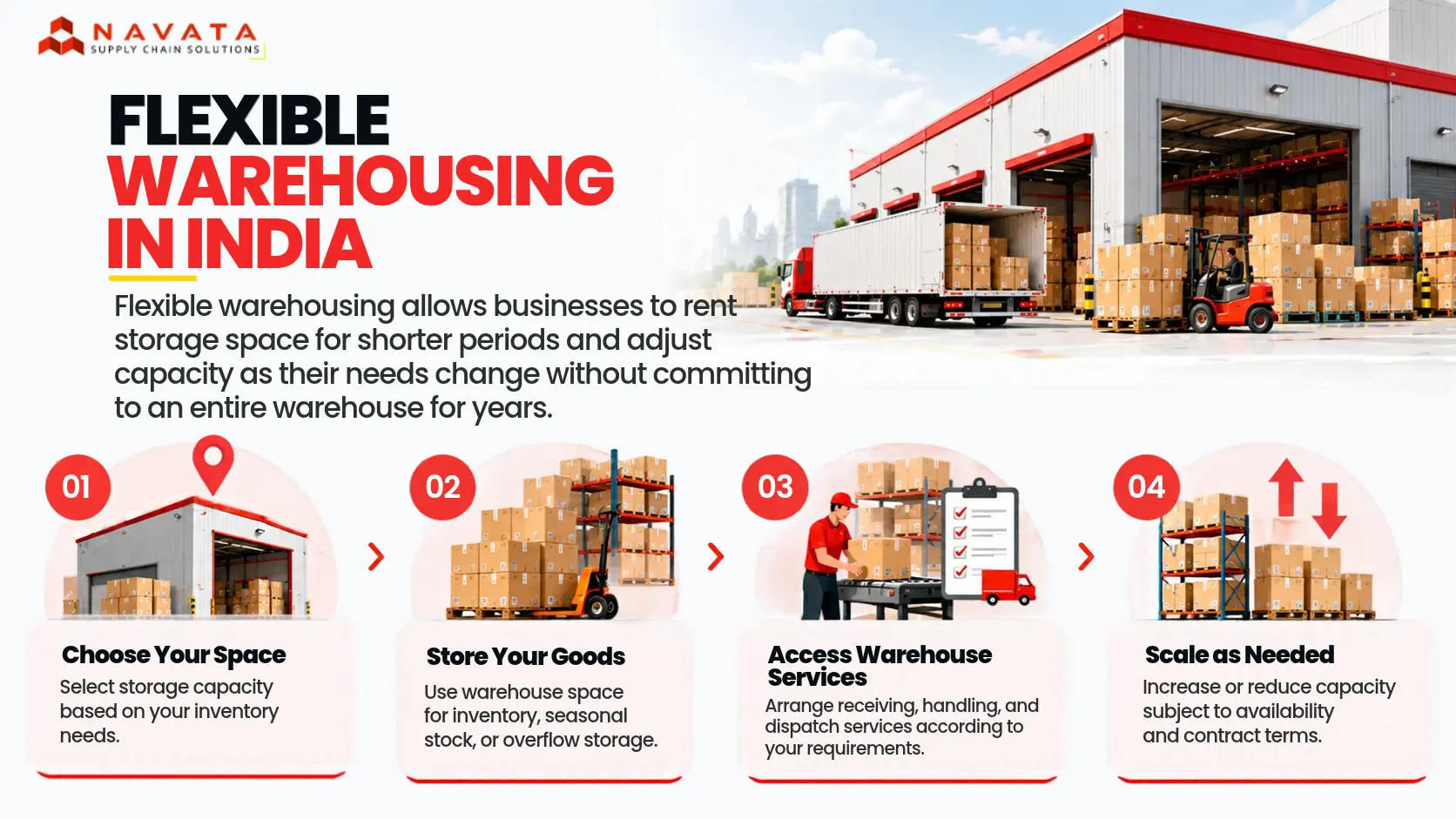
For Indian B2B supply chains, flexible warehousing in India can be useful where a business serves several regional markets with different demand patterns, or where volumes rise sharply around seasons and promotions. Brands, manufacturers and distributors can use flexible capacity to hold stock closer to regional demand while keeping the core network stable.
The practical questions are the same everywhere, but they matter more across a large geography:
All four questions come back to visibility. Flexible space only reduces risk when the business can still see and control its inventory.
Navata Supply Chain Solutions offers Flexi Warehousing as part of its warehousing services. Businesses can rent space for short periods based on their requirement, such as a seasonal peak or temporary storage need, and pay for the space and duration they use rather than committing to a long-term lease. NSCS also offers warehouse rental, managed warehousing and a WMS offering for inventory tracking and visibility, and can combine warehousing with 3PL services where a wider logistics scope is needed.
If you are planning seasonal capacity or testing a new market, explore warehouse rental and flexible storage options with Navata Supply Chain Solutions.
Explore Warehouse RentalA flex warehouse is warehouse space that a business rents on flexible terms, usually for a shorter period and a variable amount of space, instead of leasing a whole facility for several years.
The terms are largely interchangeable. On-demand warehousing is often used when space is booked through a provider network or platform, while flexible warehousing and flexi warehousing are broader terms for the same short-term, scalable model.
Providers commonly charge storage per pallet, per square foot, per cubic foot or per bin, with handling such as pallet moves in and out sometimes charged separately. Unit rates can be higher for short terms and low volumes, so compare full rate cards rather than storage rates alone.
It depends on volume and stability. For variable, seasonal or temporary demand it usually avoids paying for idle space. For consistent, high-volume inventory, a long-term lease or dedicated arrangement can be more cost-effective.
Yes. A business can keep a core leased or managed site for steady volume and add flexible space in specific regions or seasons. The key requirement is a single view of inventory across all locations.
To discuss warehousing requirements, explore options with Navata Supply Chain Solutions.