

Table of Contents
Add a header to begin generating the table of contents
Reverse logistics is the movement of goods backwards through the supply chain, from customers or channel partners to the retailer, distributor or manufacturer, so that products can be returned, repaired, resold, recycled or disposed of properly. This guide covers the types of reverse logistics that B2B supply chains handle, the reverse logistics process stage by stage, the metrics used to manage it, reverse logistics examples by sector and why reverse logistics in India matters for manufacturers and brands.
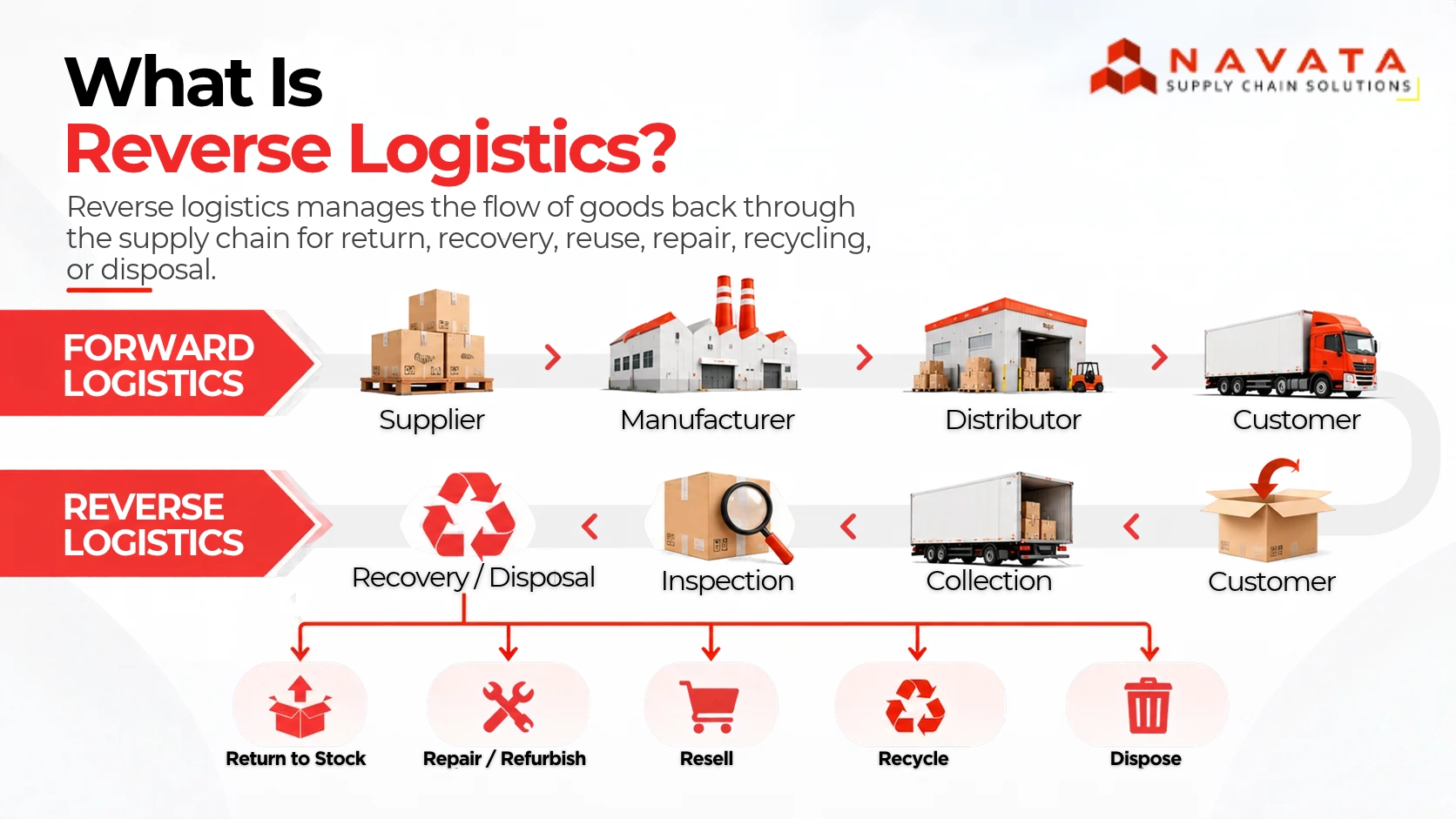
What Is Reverse Logistics?
Forward logistics moves goods from supplier to manufacturer to distributor to customer. Reverse logistics runs the other way. It starts when a product has to come back, whether because it was returned, could not be delivered, did not sell, reached the end of its useful life or needs repair, and it ends when that product has been given its next destination.
The aim is to decide quickly what each returned item should become, recover whatever value remains and dispose of the rest responsibly.
Forward and Reverse Logistics Flows
Forward logistics moves new goods toward the customer, while reverse logistics brings returned or recovered goods back through the supply chain.
Forward logistics — planned movement toward the customer
Supplier
Manufacturer
Distributor
Customer or
Channel Partner
Channel Partner
Reverse logistics — movement back through the supply chain
Reverse logistics handles returns, undelivered or unsold goods, recalls, repairs and end-of-life products. Unlike forward logistics, these flows can involve unpredictable volumes and products in different conditions.
Next destination for each returned item
- Return to stock
- Repack and resell
- Repair or refurbish
- Recycle
- Dispose
Forward logistics moves goods toward the customer; reverse logistics brings them back through the supply chain until each item reaches its next destination.
| Factor | Forward Logistics | Reverse Logistics |
|---|---|---|
| Direction | Supplier to customer | Customer or channel partner back up the chain |
| Volume | Planned against forecasts | Less predictable, driven by returns and exceptions |
| Condition of Goods | New, known quality | Mixed: resaleable, repairable, recyclable or scrap |
| Key Decision | Where and when to deliver | What each item should become next |
| Main Objective | Service and cost of delivery | Value recovery, compliance and cost control |
In consumer e-commerce logistics, returns are usually single parcels from individual buyers. In B2B supply chains, reverse flows can be larger and more varied: pallets of unsold stock from distributors, batches pulled back from the market, reusable packaging and equipment at the end of a rental or service life.
Types of Reverse Logistics in B2B Supply Chains
The main types of reverse logistics differ by why the goods are coming back.
- Returns management. Handling returns from customers and channel partners against a documented return policy applied consistently at every site, and reducing avoidable returns in the first place.
- Unsold goods. Stock returned from retailers or distributors to the manufacturer or distributor because of poor sales, obsolescence or delivery refusal.
- Expired stock. Products that have passed their expiry and need to be withdrawn and disposed of in line with the applicable rules, so that they do not find their way back into the market.
- Recalls. Batches withdrawn from the market because of a quality or safety issue, where speed and traceability protect the brand.
- Remanufacturing and refurbishment. Repairing, rebuilding or reconditioning returned products, or recovering usable parts, so they can be sold or used again.
- Repair and maintenance. Products sent back for warranty work or repair and then returned to service.
- Packaging management. Recovering and reusing packaging such as crates and containers to reduce waste.
- End of life. Products returned when they are no longer useful, so the manufacturer can manage recycling or disposal.
- Delivery failure. Goods that could not be delivered and come back to a facility, where the issue may be corrected and the goods resent.
- Rental and leased equipment. Assets returned at the end of a term for redeployment, recycling or disposal.
The Reverse Logistics Process, Step by Step
The exact reverse logistics process depends on the business and the type of return. The supply chain association ASCM describes it in five stages, adapted here for B2B flows.
- Initiate the return. A standard procedure starts the return, records the reason and arranges collection. Capturing the reason at this point, for example damaged, wrong item, unsold or expired, lets the receiving site plan before the goods arrive.
- Inspect and categorise. On arrival, goods are checked and assigned a disposition: return to stock, repack and resell, repair or refurbish, recycle or dispose. Using the return reason captured at initiation to categorise goods before they arrive speeds up this step.
- Keep goods moving. Returned stock that waits in a corner loses value and ties up space. Each disposition should have a defined destination and a time limit, which is easier when returns are tracked in a warehouse management system.
- Repair or refurbish. Items routed to repair are fixed and put back into inventory, or broken down so usable components can be recovered.
- Recycle or dispose. Items that cannot be repaired or resold are recycled or disposed of in a compliant and environmentally responsible way.
1
Initiate the return
Record the reason and arrange collection
2
Inspect and categorise
Check goods and assign a disposition
3
Keep goods moving
Each disposition should have a destination and a time limit
4
Repair or refurbish
Fix and restock, or recover usable parts
5
Recycle or dispose
Compliant and environmentally responsible handling
Dispositions assigned at stage 2:
return to stock, repack and resell, repair or refurbish,
recycle or dispose.
The five stages ASCM describes, adapted for B2B flows. Capturing the return reason at stage 1 lets the site plan the stage 2 disposition before goods arrive.
Two things make these stages work across a network: consistent grading rules at every site, and supply chain visibility that shows returned stock by location, condition and disposition alongside forward inventory.
The 5 Rs of Reverse Logistics
The 5 Rs are one common way to structure and measure reverse logistics. Sources group them differently, and some describe 7 Rs, but a widely used set is:
| R | What it covers | Example metric |
|---|---|---|
| Returns and exchanges | Taking goods back and issuing credit or replacement | Return rate |
| Repackaging and reselling | Restoring saleable items to stock | Share of returns resold |
| Repairs | Fixing or refurbishing returned products | Total repair or refurbishment cost |
| Recycling and disposal | Handling items that cannot be reused | Share recycled versus sent to disposal |
| Replacements | Supplying a replacement product | Replacement cost and time |
A high return rate can point to product quality, description or delivery problems upstream, so the same metrics also help diagnose problems in the forward supply chain.
Reverse Logistics Examples by Sector
These reverse logistics examples show how the same principles look in different operations.
- FMCG. Distributors and retailers return unsold and expired stock to the brand. The brand has to consolidate these returns, verify quantities for credit and ensure expired goods are disposed of as per the norms so they do not re-enter the market.
- Electronics and appliances. Returned or end-of-life products flow back for repair, refurbishment, parts recovery or recycling, and producers of covered electrical and electronic equipment in India operate under an Extended Producer Responsibility regime.
- Reusable packaging. Returnable crates and containers are collected, checked and put back into circulation, turning packaging into a reusable asset.
- Apparel. Retailers can send customer and store returns back for inspection, repacking and redistribution to where they can sell.
- Equipment rental. Rented or leased equipment comes back at the end of its term and is redeployed, recycled or disposed of.
- Distribution networks. Goods that could not be delivered return to a distribution centre, where the issue is corrected and the order is resent or the stock is returned to inventory.
Reverse Logistics in India: Why It Matters
Reverse logistics in India matters to manufacturers and brands for two practical reasons.
The first is regulation. The E-Waste (Management) Rules, 2022 have been in force since 1 April 2023 with an Extended Producer Responsibility regime, and manufacturers, producers, refurbishers and recyclers are required to register on the portal developed by the Central Pollution Control Board, according to a December 2023 Government of India release. Businesses that make or sell covered electrical and electronic equipment should confirm what these Rules require of them.
The second is brand protection. Brands need expired products and scrap to be disposed of in line with the applicable rules. Expired FMCG products finding their way back into the market is a direct risk to brand equity, which makes controlled collection, verification and disposal a business priority.
Reverse flows also connect to sustainability goals. Recovering, reusing, and recycling returned goods is one of the building blocks of green supply chain management.
How to Evaluate a Reverse Logistics Partner
Businesses can outsource some or all of their reverse flows. When evaluating a partner, look at:
- Industry experience with the product types and return reasons you actually handle.
- Service scope: collection, consolidation, inspection and grading, storage, refurbishment coordination, and routing to recycling or disposal.
- Technology integration: whether return status, disposition and inventory can flow into your own systems.
- Network reach and scalability across the regions your channel partners serve.
- Cost against recovered value, measured alongside cost per return.
- Communication and reporting, including visibility of each return from collection to final disposition.
- Sustainability practices for recycling and disposal.
How Navata Supply Chain Solutions Supports Reverse Logistics
Navata Supply Chain Solutions provides reverse logistics as part of its transportation services for businesses, alongside warehousing and 3PL services. For brands, manufacturers and distributors, that means reverse flows can be planned together with forward distribution and storage rather than handled as a separate exception.
To plan returns, recalls or channel-partner take-backs as part of your wider logistics operation, explore Navata Supply Chain Solutions transportation services.
Explore TransportationFAQs
What are the 5 Rs of reverse logistics?
A widely used set is returns and exchanges,
repackaging and reselling, repairs, recycling and
disposal, and replacements. Each can be tracked with
its own metric, such as return rate or the share of
returns resold.
What is the difference between forward and reverse logistics?
Forward logistics moves goods from the supplier
towards the customer. Reverse logistics moves goods
back from the customer or channel partner so they can
be returned, repaired, resold, recycled or disposed of.
What is the difference between reverse logistics and returns management?
Returns management is one type of reverse logistics.
Reverse logistics also covers unsold and expired stock,
recalls, repairs, reusable packaging, end-of-life
products and returned rental equipment.
Why is reverse logistics important for B2B businesses?
It recovers value from returned and unsold stock,
protects the brand by controlling expired and recalled
goods, and supports compliance where disposal or
Extended Producer Responsibility obligations apply.
How do you measure reverse logistics performance?
Common measures include return rate, the share of
returns resold, repair and refurbishment cost, the
share of goods recycled versus disposed of, and
replacement cost and time.
To talk through a reverse logistics requirement, discuss your requirement with Navata Supply Chain Solutions.