

Table of Contents
Add a header to begin generating the table of contents
Surface express transportation is time-definite road freight: shipments are collected, consolidated at an origin hub, moved by truck through a scheduled hub-and-spoke network and delivered within a committed window, without the cost of air cargo. In India, surface express sits between ordinary surface transport (where speed is not committed) and air express (where speed is paid for at a premium). This guide explains what surface express is, how a shipment actually moves, how a surface courier differs from a B2B surface express service, how surface vs air express compares on cost, transit time and coverage, what drives transit time and pricing, and how to decide when surface express is the right mode for your business.
What is Surface Express
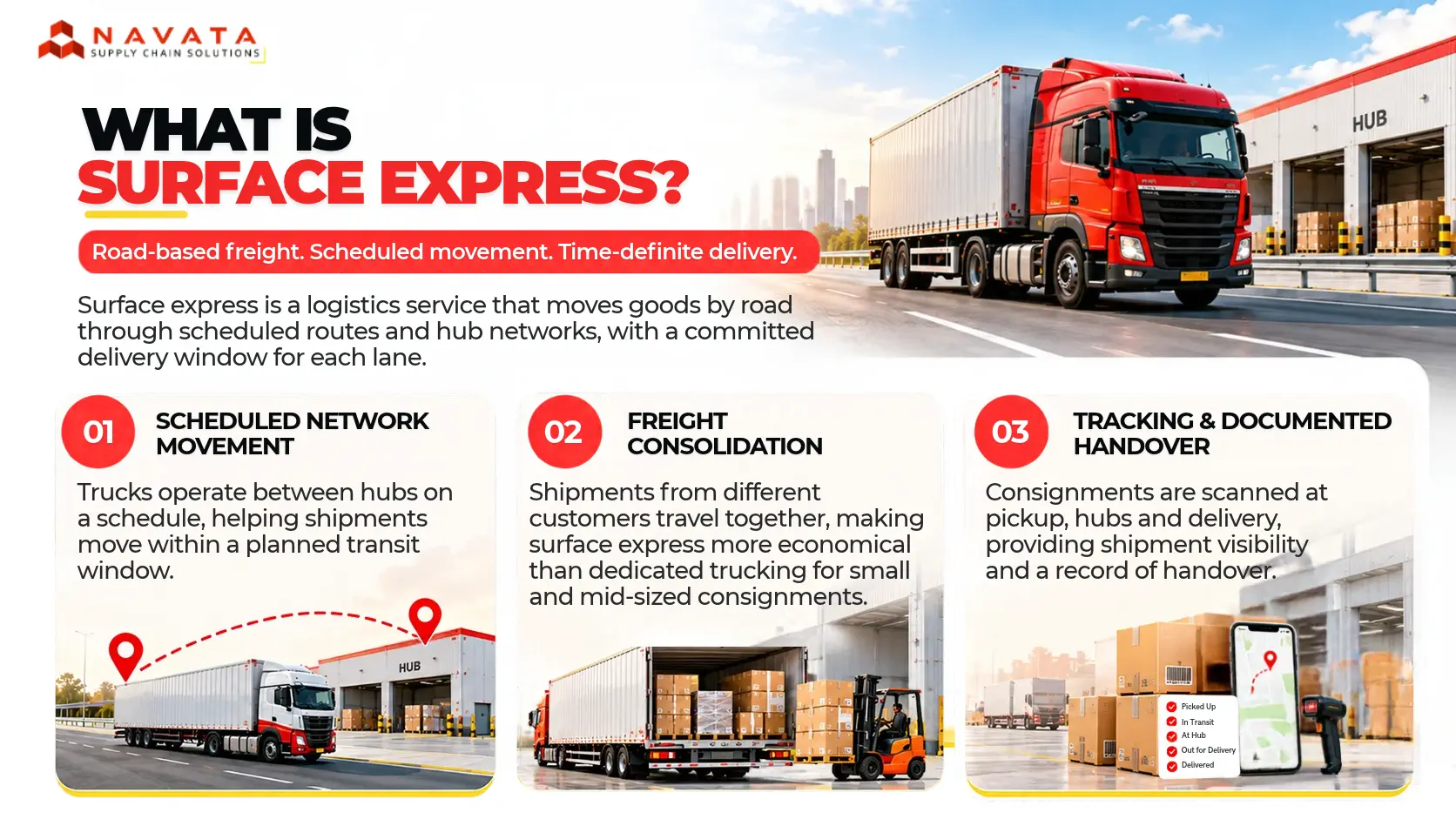
Surface express is a road-based logistics service with a committed delivery window. The word “surface” means the freight moves over land rather than by air. The word “express” means the movement is scheduled and time-definite: fixed pickup cut-offs, fixed line-haul departures between hubs and a promised delivery day for each lane.
Three features separate it from general road freight:
- Scheduled network movement. Trucks run on fixed routes between hubs on a timetable, so a shipment’s transit is predictable rather than dependent on when a vehicle fills up.
- Consolidation. Shipments from many customers travel together in the same vehicle, which is what keeps surface express cheaper than dedicated trucking for small and mid-size consignments.
- Tracking and documented handover. Each consignment is scanned at pickup, at each hub and at delivery, so the shipper sees where it is and when it was handed over.
Surface express is not rail transport. Rail is a separate mode with its own terminals and schedules. Where a B2B provider describes “surface” services, it is normally describing a road network, and a shipper should confirm the mode if it matters for the consignment.
Surface express vs ordinary surface transport, PTL and FTL
Surface transport is the broad category: any movement of goods over land. Surface express is a specific product within it. The practical differences show up in how the service is sold and run.
Surface Express vs PTL vs FTL Compared
| Mode | What you book | Typical consignment | Transit commitment | Pricing basis |
|---|---|---|---|---|
| Surface express | Time-definite movement through a scheduled network | Small to medium parcels and cartons; per-piece and per-booking limits vary by provider | Committed delivery day per lane | Weight or volumetric weight, per lane |
| Part truck load (PTL) | Shared space in a truck for larger consignments | Pallets and multi-carton loads that do not need a full vehicle | Scheduled, usually less tightly committed than express | Weight, volume and lane |
| Full truck load (FTL) | A dedicated vehicle | Loads that fill a truck or need exclusive handling | Point-to-point, depends on the trip | Per vehicle, per trip |
Important: Transit commitments and consignment limits vary by provider and lane; confirm the delivery commitment and pricing basis before booking.
The boundary between surface express and PTL is drawn differently by different providers. A useful rule: if the consignment is small enough to move through a sorting hub on a scheduled departure, it is an express candidate; if it needs a pallet position and a planned load, it is a part truck load (PTL) services question. Larger, exclusive movements belong to full truck load (FTL) services. For a closer look at the shared-truck options, see LTL vs PTL.
How a surface express shipment moves
A surface express network runs on a hub-and-spoke pattern. The steps below describe the standard movement; the names of each stage vary by operator, but the sequence does not.
-
1
Serviceability and booking. The shipper confirms that the destination PIN code is serviceable, shares the consignment details (pieces, weight, dimensions, declared value and documents), and books a pickup before the lane's cut-off time.
-
2
Pickup and origin processing. The consignment is collected, scanned, weighed and measured. Volumetric weight is calculated, and the higher of actual and volumetric weight is normally used for billing.
-
3
Consolidation at the origin hub. Consignments bound for the same destination region are sorted and loaded together. This is freight consolidation at network scale, helping make surface express transportation more efficient.
-
4
Line-haul transportation. Containerised trucks move consolidated loads between hubs on scheduled departures. Transit may involve overnight or multi-day journeys, depending on the route.
-
5
Destination processing. The load is de-consolidated at the destination hub, scanned and sorted into delivery routes for the relevant destinations.
-
6
Final delivery and proof of delivery. The consignment is delivered to the consignee, and the handover is recorded through a signed or digital proof of delivery.
Documents travel with the freight. For movements covered by the e-way bill rules, the e-way bill is generated electronically before dispatch, and the invoice or delivery challan accompanies the goods. Which documents apply depends on the goods, value and route, so shippers should confirm requirements with their tax advisor and the provider.
Surface Courier vs Surface Express: Are They the Same?
In everyday Indian usage “surface courier” and “surface express” overlap, and search behaviour reflects that: people searching for a surface courier are often looking for exactly the service a B2B surface express network provides. The distinction is one of scale and customer type rather than of transport mode.
- A surface courier service is usually sold for documents and small parcels, often to individual senders or small businesses, with pricing per piece or per slab.
- A surface express service is usually sold to businesses shipping repeat volumes: multi-carton consignments, dealer and distributor replenishment, spare parts, apparel and FMCG cartons, with contracted rates, pickup schedules and account-level tracking.
Both run on road networks and both commit to a delivery window. If your shipments are regular, multi-piece and go to business addresses, you are in surface express territory even if the provider calls it a courier.
Surface vs Air Express: Cost, Speed, Coverage and Shipment Profile
The surface vs air express decision is the one most shippers actually face. Published comparisons from Indian logistics platforms give a consistent picture, with the exact numbers depending on the network.
Surface vs Air Express in India
| Factor | Surface express | Air express |
|---|---|---|
| Transit time | Published ranges of 2 to 5 days or 3 to 7 days, depending on lane and provider. | Published ranges of 1 to 3 days, with next-day delivery between major metros. |
| Cost | Lower; one Indian platform reports surface as typically 30 to 50% cheaper than air on the same lane, and a 2026 industry report cited by ITLN describes ground transport as four to six times cheaper than air cargo. | Higher; billed on the greater of actual and volumetric weight. |
| Coverage | Broader PIN-code reach, including smaller towns and rural destinations. | Strongest between airports and metro catchments. |
| Shipment profile | Cartons, multi-piece consignments, heavier or bulkier goods; parcel weight limits of roughly 25 to 30 kg per piece on some networks, with heavier loads routed to PTL. | Urgent, high-value, lightweight consignments. |
| Predictability | Depends on corridor quality and weather; scheduled networks reduce variance. | Generally more predictable, subject to flight capacity and cut-offs. |
Note: Transit times, pricing and serviceability vary by provider, route and consignment. Confirm the applicable terms before booking.
Two points of context. First, according to the Aviral Consulting “Winning on Speed” report (2026), as reported by ITLN, surface express handles roughly 75 to 80% of India’s domestic express volumes, with air at about 18 to 20%. Second, the same report describes deliveries that took three to five days by road now taking one to two days on many major corridors. Neither figure is a promise for any individual lane, but both explain why surface express is the default mode for most domestic express movement in India. For the underlying mode comparison, see road transportation vs air transportation.
What affects surface express transit time in India
Transit time is lane-specific. Providers that publish a national range are describing their network average, not your route. The factors that move a specific lane’s transit time are:
- Distance and corridor quality. Metro-to-metro corridors with expressway access move faster than routes into tier-2 and tier-3 towns.
- Pickup cut-off. A pickup booked after the day’s cut-off joins the next departure.
- Departure frequency between hubs. Daily line-hauls shorten the wait at the origin hub; alternate-day lanes add a day.
- Number of hub touches. A direct hub-to-hub lane is faster than one that transits a third hub.
- Destination density. Dense delivery areas get daily runs; remote pin codes may be served on fixed days.
- Seasonal and weather disruption, and festival-period volume peaks.
Shippers who need hour-level commitments are usually looking at same-day delivery or air, not surface express. Surface express is designed for planned, day-level delivery.
How surface express pricing is assessed
Surface express pricing is normally built from four inputs:
- Chargeable weight: the higher of actual weight and volumetric weight (length x breadth x height divided by a divisor the provider specifies).
- Lane: origin and destination zones or pin codes. Longer and less dense lanes cost more per kilogram.
- Service level: standard versus priority or appointment delivery, where offered.
- Surcharges and value-added services: fuel, handling for oversized pieces, insurance or risk cover, proof-of-delivery requirements, address correction and reattempts.
Because volumetric weight drives the bill for light but bulky cartons, packaging decisions directly affect surface logistics cost. Shippers that standardise carton sizes and reduce void fill often see the chargeable weight drop without changing what they ship. Ask providers to show both weights on the rate card so you can see which one is driving the charge.
When surface express is the right choice
Surface express fits when all or most of the following hold:
- Delivery is needed within a few days, not within hours.
- Consignments are repeat B2B movements: distributor replenishment, dealer shipments, spare parts, retail store supply, e-commerce B2B stock transfers.
- Pieces are cartons or small multi-carton lots rather than pallets.
- Destinations include towns beyond the main metros.
- Freight cost matters more than the last day of speed.
Air express is the better fit for urgent, high-value or production-critical consignments where a one-day difference has a business cost. PTL or FTL is the better fit when the consignment needs a pallet position, exclusive handling or a vehicle of its own. Many shippers run all three, with rules that route each order by urgency, weight and destination.
How to evaluate a surface express partner
Treat the evaluation as an operations review, not a rate comparison.
- Lane-level commitments. Ask for committed transit days on your actual origin-destination pairs, not the national average.
- Serviceability. Check your destination pin codes against the provider’s serviceable list, including delivery-day restrictions for remote areas.
- Network and schedule. Understand hub locations, departure frequency and how your freight will be routed.
- Tracking and exceptions. Confirm what tracking shows, how delays and non-deliveries are communicated and how reattempts are handled.
- Documents and compliance. Confirm how e-way bills, invoices and proof of delivery are handled and stored.
- Packaging and handling. Agree carton standards, labelling and any handling requirements for fragile or regulated goods.
- Returns. If your business handles returns or rejections, ask how reverse logistics is integrated with the forward network.
- Reporting. Agree the service-level reports you will receive and how performance will be reviewed.
Where surface express fits in Navata Supply Chain Solutions transportation services
Navata Supply Chain Solutions is a technology-enabled, asset-light B2B logistics company that operates through a vendor and partner ecosystem. Surface Express is one of its transportation services, alongside full truck load, part truck load, last-mile and reverse logistics. For businesses moving repeat B2B consignments across India, the practical value is being able to route each movement to the right mode within one integrated logistics relationship, with operational visibility across them. If you are mapping surface express into a wider distribution plan, the Surface Express transportation services page describes the NSCS service, and the transportation team can discuss lane-specific requirements.
Mapping surface express into a wider B2B distribution plan? The NSCS transportation team can discuss lane-specific requirements across surface express, PTL, FTL and last-mile movements.
Explore Surface Express or discuss your requirementFAQs
What is surface express transportation?
Surface express transportation is a road-based freight service with a committed delivery window. Consignments are consolidated at hubs and moved between them on scheduled truck departures, then delivered within a promised number of days for the lane.
Is surface express the same as rail transport?
No. Surface express in India normally means a road network. Rail is a separate mode with its own terminals, schedules and handling. If the mode matters for your consignment, confirm it with the provider.
How long does surface express delivery take in India?
It depends on the lane. Indian logistics platforms publish national ranges of roughly 2 to 7 days. Metro-to-metro corridors are at the short end; remote pin codes and multi-hub routes are at the long end. Ask for a committed transit time for each origin-destination pair you ship on.
What is the difference between surface courier and surface express?
Both move freight by road with a committed delivery window. "Surface courier" usually refers to documents and small parcels, often for individuals or small senders. "Surface express" usually refers to a B2B service for repeat, multi-carton business consignments with contracted rates and account-level tracking.
Is surface express cheaper than air express?
Generally yes. One Indian platform reports surface as typically 30 to 50% cheaper than air on the same lane, and a 2026 industry report cited by ITLN describes ground transport as four to six times cheaper than air cargo. The exact difference depends on the lane, weight and service level.
How is surface express freight charged?
On chargeable weight, which is the higher of actual and volumetric weight, applied to the lane rate, plus any surcharges or value-added services. Packaging that reduces volume lowers the volumetric weight and often the bill.
Can surface express handle heavy consignments?
Networks set their own per-piece limits; one Indian platform cites roughly 25 to 30 kg per piece for parcel services. Heavier or palletised consignments are usually routed to part truckload or full truckload services instead.