A warehouse rarely breaks down all at once. It starts small: a stock count that doesn’t match what’s actually on the shelf, a picker walking the wrong aisle, an order that ships a day late because nobody caught the backorder in time. None of these look serious on their own. Add them up across a few hundred orders a week, and they turn into missed deliveries, tied-up working capital, and a warehouse team that spends more time firefighting than fulfilling.
The benefits of warehouse management system adoption come from replacing that guesswork with a system that tracks stock, directs work, and reports on what’s actually happening on the floor. A warehouse management system, or WMS, ties every SKU to a location, updates that record the moment stock moves, and gives receiving, picking, packing, and dispatch teams a shared, accurate view of inventory. Used well, it improves inventory accuracy, speeds up order fulfilment, makes better use of available space, and gives operations leaders the visibility to make decisions on data instead of assumptions.
This guide covers what a WMS actually does inside a warehouse, the specific advantages of warehouse management system adoption, how it compares to running a warehouse manually, who tends to benefit most, and the questions that come up most often when businesses evaluate one.
The Role of Warehouse Management System in a Modern Warehouse
Before looking at individual benefits, it helps to be clear about what a WMS is actually responsible for if you’re looking for a fuller introduction first, see what a warehouse management system is. The role of warehouse management system software is to control and coordinate the physical movement of inventory through a facility, from the moment goods arrive at the dock to the moment they leave as part of a shipped order.
In practice, that means a WMS typically manages:
- Receiving: checking inbound stock against purchase orders and putting it into the system the moment it’s unloaded, rather than after a manual count later in the day.
- Put-away: directing where a pallet or case should go based on available space, product velocity, and storage rules, instead of leaving placement to whoever is free.
- Storage and slotting: keeping track of what’s in every bin and periodically recommending better placement as demand patterns shift.
- Picking: generating pick paths and pick lists (wave, batch, or zone picking, depending on the operation) so workers move efficiently instead of walking the floor looking for items.
- Packing and dispatch: confirming the right items and quantities are packed, and handing shipment data off to transportation planning.
- Exception handling: flagging mismatches, damaged stock, or short shipments as they happen rather than after a customer complains.
A WMS is not the same thing as an ERP or a Transportation Management System, though it’s designed to work alongside both. The ERP handles the business side: orders, finance, procurement. The WMS handles what physically happens inside the four walls of the warehouse, and the TMS takes over once goods are ready to move. When these systems are connected, data moves between them automatically instead of being re-entered by hand at every handoff.
Warehouse Management Software Benefits: 12 Ways a WMS Improves Operations
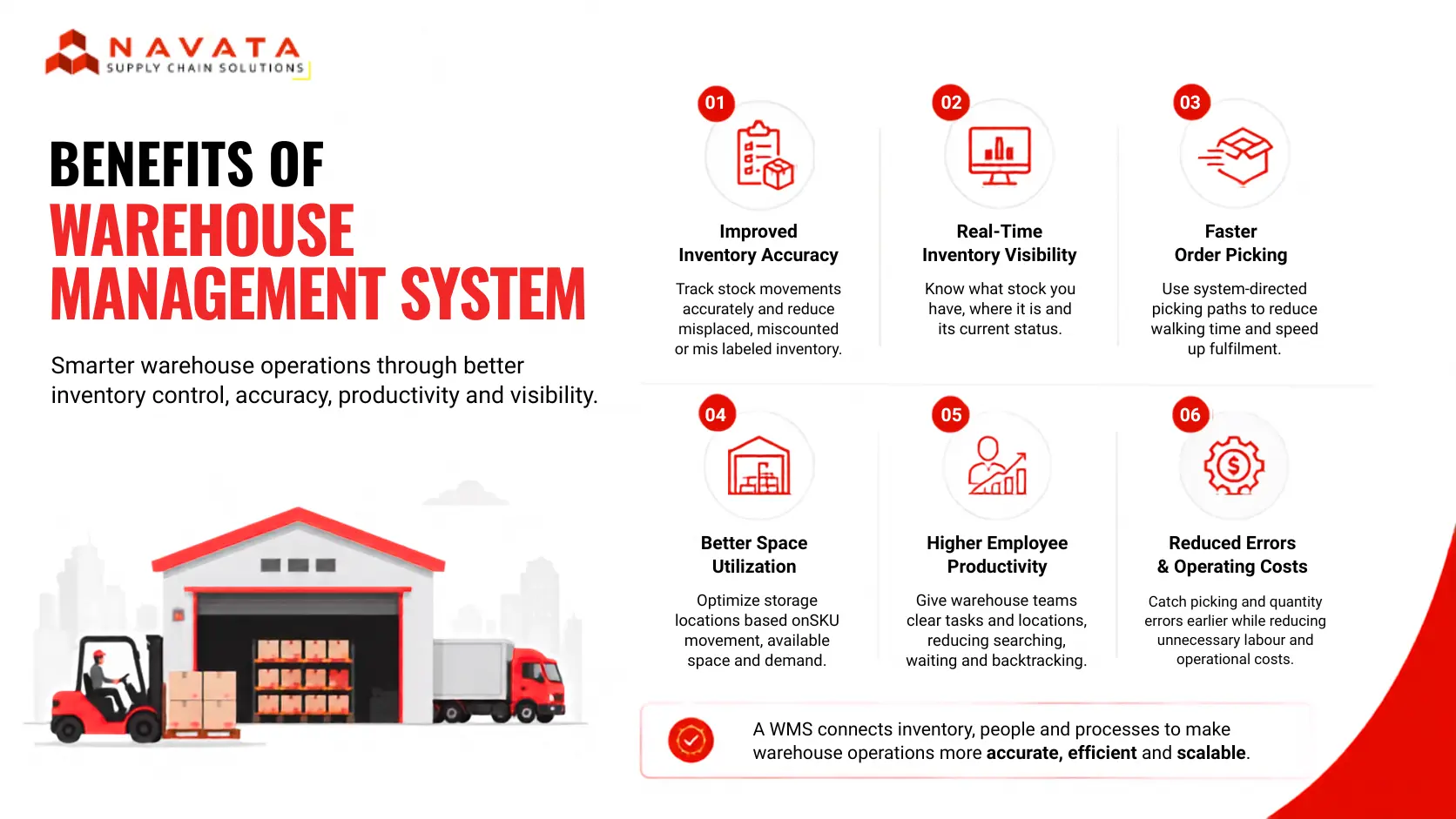
Warehouse management software benefits tend to show up in a fairly consistent pattern, whether the warehouse is running FMCG, apparel, pharma, or general B2B distribution. The advantages of warehouse management system adoption break down into twelve practical areas.
1. Improved Inventory Accuracy
Manual inventory tracking drifts from reality over time. Stock gets miscounted, misplaced, or mislabeled, and nobody notices until an order can’t be fulfilled. A WMS ties every unit to a location and updates that record the moment stock moves, whether it’s arriving from a supplier, shifting between bins, or going out the door.
This is usually where a WMS delivers its single biggest improvement. Independent research from Nucleus Research has found WMS adoption improves inventory accuracy by roughly 20% on average, though the actual gain depends heavily on how disorganized the starting point was.
2. Real-Time Inventory Visibility
Instead of checking a count that was last updated yesterday, a warehouse manager can see current stock levels, location, and status the moment they’re needed. This matters most during peak season or promotional spikes, when the gap between what a system says is in stock and what’s physically there can cost real sales.
It also means customer service teams can answer stock questions with confidence instead of guessing, and purchasing can reorder based on current numbers rather than a stale count.
3. Faster Order Picking
A WMS designs picking routes instead of leaving pickers to find their own way around the floor. Wave picking, zone picking, and batch picking logic all reduce the distance a worker walks per order, which is usually the biggest single factor in picking speed.
Warehouses that move from paper pick lists to a WMS-directed process typically see a meaningful drop in picking time per order, which translates directly into more orders shipped per shift without adding headcount.
4. Better Warehouse Space Utilization
A WMS tracks which bins, shelves, and zones are underused and which are overloaded, then recommends slotting changes based on how fast a SKU actually moves. Fast movers get placed closer to packing stations; slow movers get pushed to less convenient space.
The result is more inventory fitting into the same footprint, which for a growing operation can delay or remove the need for a costly facility expansion.
5. Increased Employee Productivity
When a system tells a worker exactly where to go and what to do next, less time is lost to searching, backtracking, or waiting on a supervisor for direction. That extra capacity gives a business room to absorb order growth before it needs to add headcount, which is a meaningful advantage in a tight labour market where warehouse hiring isn’t always fast or easy.
6. Reduced Human Errors
Barcode or RFID scanning built into a WMS catches mistakes before they leave the building: the wrong SKU, the wrong quantity, the wrong destination. Every scan acts as a checkpoint, flagging a mismatch immediately instead of letting it travel all the way to a customer.
Preventing an error at the point it happens is consistently cheaper than fixing one after a customer has already complained or returned a shipment.
7. Better Compliance and Traceability
For sectors like pharma, food, and FMCG, a WMS provides batch and lot tracking, expiry date management, and traceability from receiving through to shipment. In regulated categories this isn’t optional. It’s what makes audits pass and recalls manageable instead of chaotic.
Even outside regulated industries, the same traceability helps resolve customer disputes and quality issues faster, because there’s a clear record of where a batch has been.
8. Lower Operating Costs
Labour is typically the largest cost line in a warehouse, and every efficiency gain above (faster picking, fewer errors, better space use) translates into fewer labour hours per order shipped. Combined with lower carrying costs from tighter inventory control, a WMS implementation is often judged on how quickly it pays back its cost, with the payback period depending heavily on order volume and how inefficient the starting operation was. Lower operating costs are consistently one of the benefits operations leaders cite first when justifying the investment.
9. Improved Customer Satisfaction
Orders that ship correctly and on time are the foundation of customer trust. A WMS reduces the mis-picks and delays that generate complaints, refunds, and lost repeat business- the kind of downstream cost that rarely shows up on a warehouse budget line but hits revenue directly. In a market where a single bad delivery experience can push a customer to a competitor, this benefit compounds over time.
10. Data-Driven Decision Making
Dashboards built into a WMS turn day-to-day warehouse activity into KPIs a manager can actually act on: order accuracy, pick rate, dock-to-stock time, inventory turns. Instead of finding out about a problem during a quarterly review, a manager can spot a slowdown or an accuracy dip while it’s still small enough to fix quickly.
11. Scalability for Business Growth
A warehouse running on manual processes hits a ceiling fast. Adding volume usually just means adding more people making more mistakes. A WMS is built to absorb growth: more SKUs, more order volume, even additional locations, without the operational chaos that normally comes with scaling up. For a fast-growing business, this is often the benefit that matters most, because it removes the warehouse as a bottleneck to expansion.
12. Smoother Integration Across the Supply Chain
Many of these benefits only reach their full value once the WMS is connected to the rest of the business. A WMS typically sits between the ERP and the Transportation Management System, receiving order data from the ERP and passing shipment-ready data to the TMS for carrier selection and routing.
This connected flow removes the double data entry and delays that come from running disconnected systems, which is a large part of why WMS adoption keeps climbing among mid-size and enterprise warehouses alike. See also our guide to what warehouse automation is and its related warehouse automation benefits for how automation compounds these gains further.
Optimize Your Warehouse Operations!
Warehouse Management System vs. Manual Warehouse Operations
The advantages of warehouse management system adoption become clearest when set directly against how a manually run warehouse typically operates.
| Area | Manual Warehouse Operations | Warehouse Management System |
|---|---|---|
| Inventory records | Spreadsheets or paper counts, updated periodically | Updated in real time as stock moves |
| Picking | Workers navigate the floor from memory or a printed list | System-directed pick paths and pick lists |
| Space planning | Based on habit or available space at the time | Based on SKU velocity and current utilization data |
| Error catching | Usually discovered after the order has shipped | Flagged at the point of scanning, before dispatch |
| Reporting | Manual counts and after-the-fact reviews | Live dashboards and exportable KPIs |
| Scaling to more volume | Requires proportionally more labour and supervision | Absorbs growth with the same core process |
This isn’t a claim that manual processes never work. Plenty of small, low-SKU operations run manually without major issues. The importance of warehouse management system adoption grows in direct proportion to order volume, SKU count, and the number of people involved in a shift. Past a certain size, the coordination overhead of a manual system starts to cost more than the software would.

Who Benefits Most from a Warehouse Management System?
A WMS tends to deliver the clearest return for:
- Growing 3PL and distribution operations managing inventory on behalf of multiple clients or brands, where accuracy and traceability directly affect client trust. Explore Navata Supply Chain Solutions’ 3PL services for how this works in practice.
- FMCG, pharma, and apparel businesses with high SKU counts, batch-tracking requirements, or seasonal demand spikes.
- Multi-location operations, including businesses running multiple distribution centers, that need a consistent process across more than one facility rather than each site running its own informal system.
- Businesses scaling order volume quickly, where manual processes are already starting to show cracks in accuracy or fulfilment speed.
Implementation is not instant. Moving from manual processes to a WMS typically involves data cleanup, staff training, and integration work with existing ERP or transportation systems, and operations leaders evaluating a WMS should plan for that transition period rather than expecting improvements from day one. The businesses that get the most value tend to be the ones that treat the rollout as an operational change, not just a software install.
Getting Started with a Warehouse Management System
The case for a warehouse management system rarely comes down to one benefit on its own. It’s the combination of better inventory accuracy, faster picking, lower operating costs, and real visibility into a part of the business that used to run on guesswork that makes the investment worthwhile. For a growing operation, a WMS stops being an optional upgrade and starts being basic infrastructure.
Navata Supply Chain Solutions supports warehouse operations with a technology-enabled Warehouse Management System built for accuracy, real-time visibility, and integration across the wider supply chain. If your warehouse is still relying on spreadsheets and manual counts to answer basic questions about stock, that’s usually the clearest sign it’s time to explore what a WMS can change.
Thanks For Reading: Benefits of Warehouse Management System: How a WMS Improves Warehouse Efficiency