Urban Micro-Hubs & 10-Minute Delivery
10-minute delivery isn’t magic — it’s a precision-engineered fulfillment model powered by dense dark store networks, micro-fulfillment workflows, real-time demand intelligence, and hyperlocal last-mile routing. For supply chain managers and Q-commerce operators, the shift from traditional warehouses to urban micro-hubs has radically compressed order-to-delivery cycles from hours to minutes.
This blog breaks down how micro-hubs actually work, the infrastructure behind ultra-fast fulfillment, and the core logistics levers that make 10-minute delivery operationally viable.
Know More About: What is Fulfillment Center and How it works?
1. Micro-Hubs Reduce Last-Mile Distance to 1–2 km
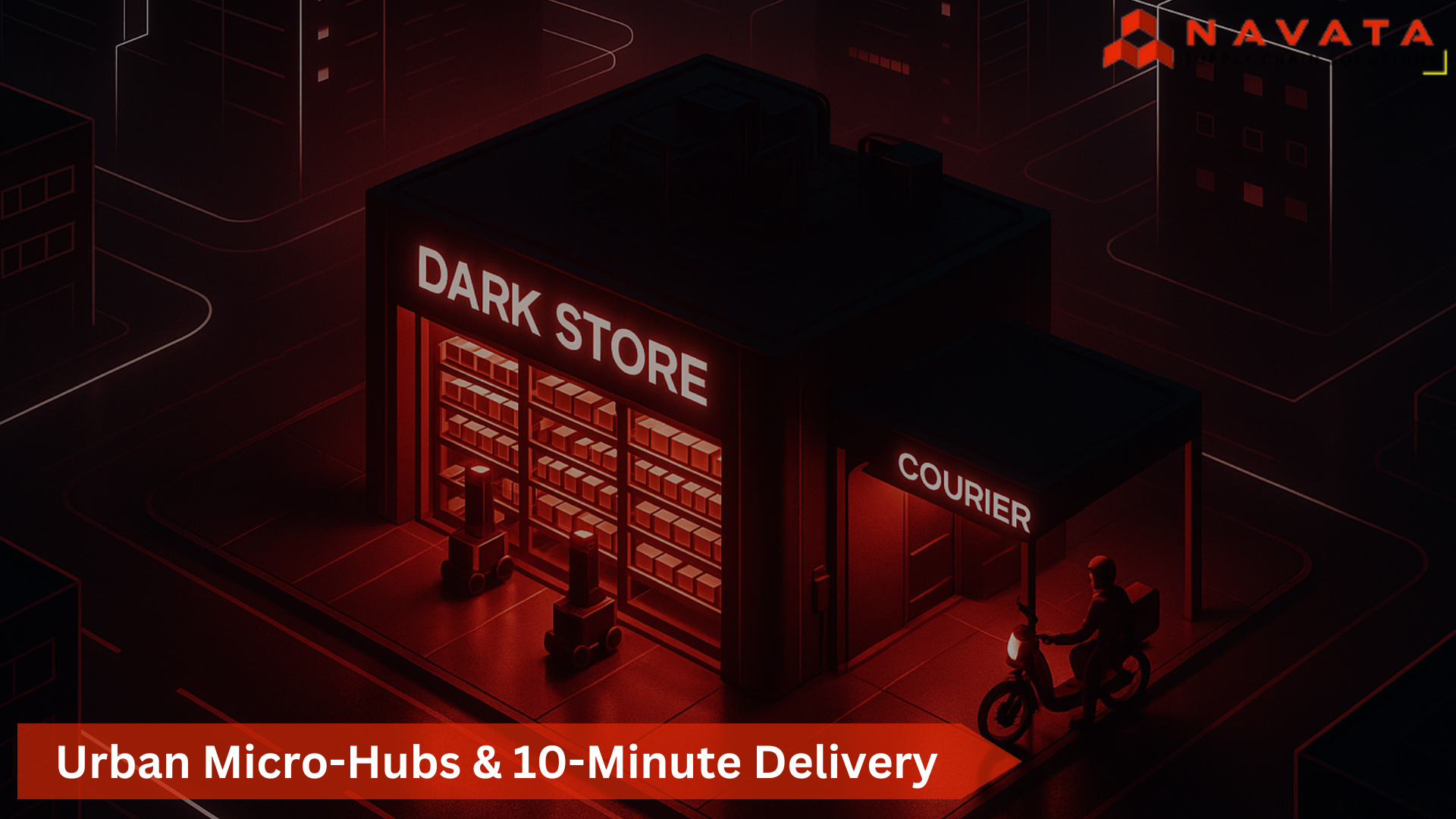
Traditional retail warehouses sit outside cities. Dark stores operate inside residential clusters, cutting the last-mile radius to just one or two kilometers.
Why this matters:
Delivery time is directly tied to distance density. A 2–3 km radius allows:
6–8 minute door-to-door travel
Higher drop density per hour
Lower fuel and rider cost per order
Faster order batching
2. Micro-Fulfillment Workflows Compress Pick-Pack Times to 90 Seconds
Dark stores use SKU velocity mapping, A-frame layouts, and narrow-aisle shelving to eliminate wasted movement.
Pickers operate inside zones designed for sub-2-minute pick-pack cycles.
Core enablers include:
ABC inventory classification (A-SKUs placed closest to pick paths)
Real-time replenishment to avoid stockouts
Guided picking via handhelds, voice systems, or wearable scanners
No customer footfall → zero friction
3. Real-Time Demand Forecasting Ensures 95%+ Fill Rates
Q-commerce breaks if availability slips. Dark stores depend on predictive analytics to keep high-velocity SKUs always stocked.
Systems analyze:
Time-of-day demand patterns
Weather-driven consumption spikes
Geo-cluster buying behavior
Rider capacity vs. order surge windows
This drives dynamic replenishment so orders never fail due to stock unavailability.
4. 60–90 Second Order Processing via Automated Dispatch Systems
Once the order is picked, the system uses AI dispatching to assign the nearest rider and optimize the travel path.
Logistics operators use:
Live rider heatmaps
Traffic-aware route planning
Auto-assignment based on ETA and route efficiency
Rider batching algorithms for high-density clusters
This cuts the order-to-dispatch window from 10 minutes (legacy) to under 90 seconds.
5. Rider Network Density Makes Delivery Predictable
10-minute delivery only works when the rider-to-zone ratio is high.
Urban micro-hubs maintain:
1 rider per 1.0–1.5 sq km
Independent backup riders for surge hours
High availability during evening peaks
Higher rider density = predictable SLA adherence, even during demand spikes.
6. Tech Stack Integration Enables End-to-End Visibility
The backbone of a 10-minute model is a unified system connecting:
OMS (Order Management System)
Rider apps
Store operations
Inventory forecasting engines
Analytics & reporting
This ensures every stakeholder sees:
Stock levels
Dispatch queues
Rider locations
Route ETAs
Exception alerts
Without tech-stack integration, micro-fulfillment breaks.
7. Urban Micro-Hubs Reduce Cost Per Delivery
Contrary to belief, micro-hubs lower operating cost by:
Cutting last-mile distance (fuel, time, rider cost)
Increasing order density per zone
Reducing failed deliveries
Minimizing cancellations with accurate ETAs
Eliminating retail overhead
Overall, cost per delivery drops by 20–35%, improving unit economics.
You May Also Like to Read: Role of Skilled Workers in Successful Supply Chain
Conclusion
Dark stores and urban micro-hubs enable 10-minute delivery through distance compression, micro-fulfillment precision, AI-driven dispatch, and hyperlocal rider networks. These hubs are engineered for speed, accuracy, and cost efficiency — making 10-minute delivery not a luxury, but a logistics model built on intelligent design, data, and proximity.
Thanks For Reading: The Dark Store Revolution: How Urban Micro-Hubs Enable 10-Minute Delivery
Powered By 360Presence