

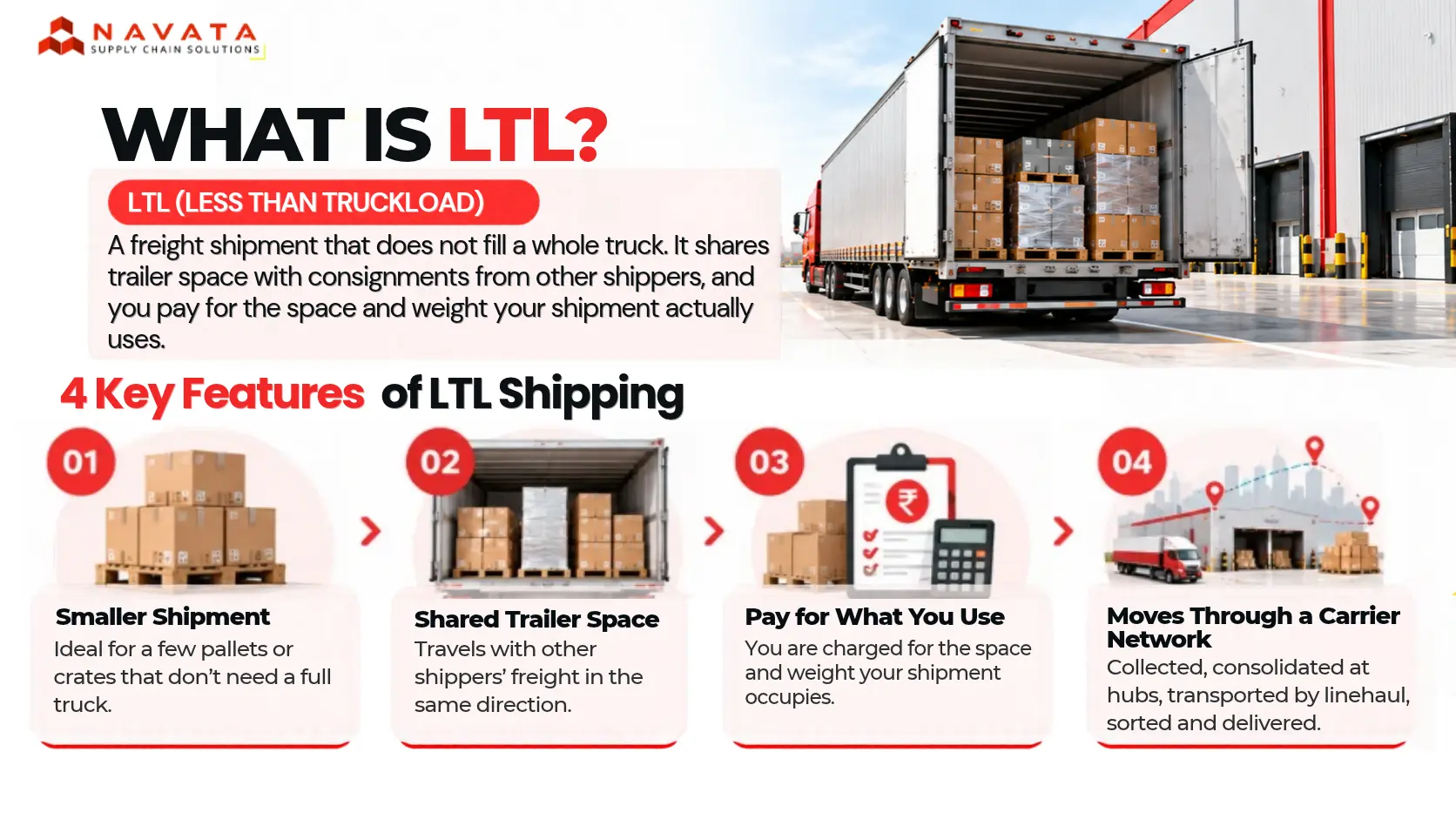
LTL stands for less than truckload: a freight shipment that does not need a whole truck, so it travels in shared trailer space with consignments from other shippers and is priced for the space and weight it actually uses. It sits between parcel courier at the small end and full truckload (FTL) at the large end, and in India it overlaps with what many carriers call part truckload (PTL).
This article explains what less than truckload means, how an LTL shipment moves through a carrier network, the benefits of LTL shipping for B2B businesses, where LTL fits in the supply chain, how it compares with FTL and PTL, and when it is the wrong choice.
What Does Less Than Truckload Mean?
A less than truckload shipment is one that occupies part of a truck rather than all of it. Instead of paying for a dedicated vehicle, the shipper pays for a share of the trailer, and the carrier fills the remaining space with other customers’ freight travelling in the same direction. The shipment is usually palletised or crated, handed to the carrier at pickup, and billed on a combination of weight, volume, distance and handling.
The term is common in North American and European freight and in logistics coursework, which is why searches for what LTL stands for come from supply-chain students and professionals alike. In India the same operating model is commonly sold as PTL, and some carriers use the two terms interchangeably. The distinction, where one is drawn, is covered in the comparison section below and in more detail in our LTL vs PTL explainer.
Sources disagree on exact size limits. One Indian industry guide describes LTL consignments as roughly 150 kg to 6,800 kg, while a global carrier’s India page frames LTL as partial loads of up to about six pallets. Treat these as examples, not a standard: the practical test is whether the consignment is too large for courier handling and too small to justify a dedicated truck.
How LTL Shipping Works
Less than truckload freight does not travel point to point. It moves through a hub network, and every extra stage is a point where cost, time and handling risk are decided. A typical LTL shipment passes through five stages.
How an LTL shipment moves
- 1PickupThe carrier collects the palletised consignment from the shipper.
- 2Origin hubFreight is sorted and consolidated with other shipments heading the same way.
- 3LinehaulA shared truck carries the consolidated load between hubs.
- 4Destination hubThe load is broken down and sorted by delivery area.
- 5DeliveryA local vehicle delivers the consignment to the consignee.
The economics come from freight consolidation: one linehaul truck carries freight for many shippers, so each pays a fraction of the vehicle cost. The trade-off is that the shipment is handled at each hub and waits for other freight to be consolidated, which is why LTL transit times are longer and less predictable than a dedicated truck.
Benefits of LTL Shipping for B2B Businesses
The benefits of LTL shipping all follow from the same fact: the shipper pays for what it uses. For a business that moves a few pallets at a time, that changes cost, inventory and distribution decisions.
Lower cost per shipment
Because the truck is shared, a small consignment costs a fraction of a dedicated vehicle. Fuel, driver time and tolls are spread across every shipper on the route. For a business looking to reduce freight costs on regional distribution, moving small loads from FTL or courier to LTL is often the first lever.
Smaller, more frequent shipments and leaner inventory
When shipping small quantities is affordable, you can ship more often. Distributors and retailers can order in shorter cycles instead of holding a month of stock to fill a truck, which lowers inventory levels, frees warehouse space and reduces the working capital tied up in goods waiting to move.
Flexible pickup and delivery windows
LTL carriers run scheduled networks, so pickup and delivery can be booked within standard business hours rather than around a single truck’s availability. For receiving sites with limited dock time, that predictability matters more than raw speed.
Shipment visibility and tracking
Each consignment carries its own documentation and is scanned at every hub, so carriers can report where a shipment is and when it is expected. Visibility is only as good as the carrier’s systems, which is why technology capability is one of the first questions to ask a less than truckload provider.
Reach into more locations
A hub-and-spoke network serves destinations that would never justify a dedicated truck: a few pallets to a Tier 2 or Tier 3 town can ride on the same linehaul as everyone else’s freight. For B2B distribution across India, this is how small volumes reach markets economically.
Lower emissions per consignment
A full shared trailer replaces several part-empty trucks on the same route. Emissions per consignment fall, and the same consolidation reduces empty running on the carrier’s network. This is an operational by-product of load sharing rather than a separate green programme.
The LTL Supply Chain: Where Less Than Truckload Fits
In an LTL supply chain, the transport mode shapes the inventory policy. Because a small replenishment is affordable, planners can run tighter stock levels at regional warehouses and distributor points, replenishing weekly or even more often instead of in monthly truckloads. Multi-location networks use LTL to move balancing stock between warehouses, to serve smaller distributors, and to handle returns and spares that never add up to a full load.
It also carries B2B movement behind e-commerce: inbound stock to fulfilment centres, inter-warehouse transfers and bulk replenishment to retail partners. We look at that flow separately in LTL shipping in e-commerce. The constraint planners must design around is transit-time variability: the LTL network’s hub schedule, not the shipper’s calendar, decides when a consignment moves.
LTL vs FTL vs PTL: Which Freight Model Fits Your Shipment?
Three freight models are the usual options for B2B road transport in India. They differ in how much of the truck you pay for, how many times the freight is handled, and how predictable the transit time is.
| Comparison | LTL (Less Than Truckload) | PTL (Part Truckload) | FTL (Full Truckload) |
|---|---|---|---|
| Who uses the truck | Many shippers share it | A few shippers share it | One shipper, dedicated |
| Typical load | A few pallets or crates | Mid-sized load, part of a truck | Fills the truck |
| What you pay for | Space and weight used | Space used | The whole vehicle |
| Handling | Several hub transshipments | Fewer consolidation stops | Loaded once, unloaded once |
| Transit time | Longest, least predictable | Faster than LTL | Fastest, direct |
| Best for | Small, regular, non-urgent loads | Mid-sized loads, Tier 2 and 3 reach | Large, urgent or fragile loads |
Important: Boundaries between LTL and PTL vary by carrier in India; ask how the consignment will be transshipped and whether transit time is committed.
The line between LTL and PTL is the least standardised of the three. Indian carriers generally use PTL for mid-sized loads that share a truck but move with fewer consolidation stops, and some use it for anything smaller than a full truck. When comparing quotes, ask how many times the consignment will be transshipped and whether the transit time is committed. For loads that fill a truck, full truckload (FTL) removes the handling question entirely.
When to Choose LTL Shipping (and When Not To)
LTL is the right model when the shipment is too small for a dedicated truck and the delivery date has some flexibility. It is the wrong model when the goods cannot tolerate handling or the schedule cannot tolerate variability. The decision usually turns on four questions.
| Question | Choose LTL / PTL when | Choose FTL when |
|---|---|---|
| How big is the shipment? | A few pallets; well short of a full truck | It fills, or nearly fills, a truck |
| How urgent is delivery? | A delivery window of a few days is acceptable | The date is fixed or the goods are time-critical |
| How fragile or valuable are the goods? | They can be palletised and handled at hubs | They must not be transshipped or mixed with other freight |
| How often do you ship? | Regular small consignments to several destinations | Occasional large consignments to one destination |
A shipment that answers “LTL / PTL” to all four questions is a strong candidate for shared-truck freight.
Drawbacks of LTL shipping
The drawbacks are the mirror image of the benefits. Transit times are longer and less predictable because freight waits for consolidation and moves on the hub schedule. Each transshipment is a handling event, so fragile or poorly packed goods face more risk than on a sealed dedicated truck. Pricing can be opaque, with surcharges for residential or difficult deliveries, and coverage thins out in remote areas where the network has fewer hubs. None of these rule LTL out; they define what to check before choosing it.
When evaluating less than truckload services, compare carriers on network coverage for your destinations, transit-time commitments, handling and packaging requirements, tracking capability, and the total landed cost after surcharges, not just the base rate.
If your consignments are too small for a dedicated truck, Navata Supply Chain Solutions partial truckload (PTL) service moves them on shared trucks across India.
Explore PTL →Conclusion
LTL stands for less than truckload, and the model is simple: share the truck, pay for the space you use, accept more handling and a network schedule in return. For B2B businesses moving a few pallets at a time, it lowers cost per shipment, allows leaner inventory and reaches markets a dedicated truck never could. Choosing between LTL, PTL and FTL comes down to shipment size, urgency, fragility and frequency, and the comparison and decision tables above are designed to settle that quickly.
FAQs
What does LTL stand for?
LTL stands for less than truckload. It describes a freight shipment that does not fill a whole truck and therefore shares trailer space with other shippers' consignments, with each shipper paying for the space and weight it uses.
How does LTL shipping work?
The carrier collects the consignment, consolidates it with other freight at an origin hub, moves it on a shared linehaul truck to a destination hub, sorts it there and delivers it on a local vehicle. Consolidation lowers the cost; the extra handling and waiting lengthen the transit time.
What is the difference between LTL, PTL and FTL?
FTL dedicates a whole truck to one shipper. LTL and PTL both share the truck; in India PTL is the common term and is usually applied to mid-sized loads that move with fewer consolidation stops than classic LTL. The exact boundary varies by carrier, so ask about transshipment and transit commitments.
What is the benefit of LTL?
The main benefit of LTL shipping is cost: a small consignment pays a share of the truck rather than the whole vehicle. That makes smaller, more frequent shipments affordable, which lowers inventory levels and warehouse space, and extends reach to locations that would never justify a dedicated truck.
How can LTL shipping reduce distribution expenses?
By consolidating smaller shipments onto shared trucks, fuel, driver time and tolls are spread across many shippers. For regional distribution of small loads, moving from dedicated trucks or courier to LTL typically lowers the transport cost per consignment, provided surcharges and packaging requirements are accounted for.
When should a business use LTL instead of FTL?
Use LTL when the shipment is too small to fill a truck, the delivery date has some flexibility, and the goods can tolerate handling at hubs. Use FTL when the load fills a truck, the schedule is fixed, or the goods are fragile or high value.
What are the drawbacks of LTL shipping?
Longer and less predictable transit times, more handling at hubs, surcharges that are easy to miss in a base-rate comparison, and thinner coverage in remote areas. Good packaging and a carrier with strong network coverage and tracking reduce these risks.
Does Navata Supply Chain Solutions offer LTL shipping?
Navata Supply Chain Solutions offers partial truckload (PTL) and full truckload (FTL) transportation across India. PTL is the Indian equivalent of the shared-truck model described in this article, for consignments that do not need a dedicated vehicle.
3 Comments