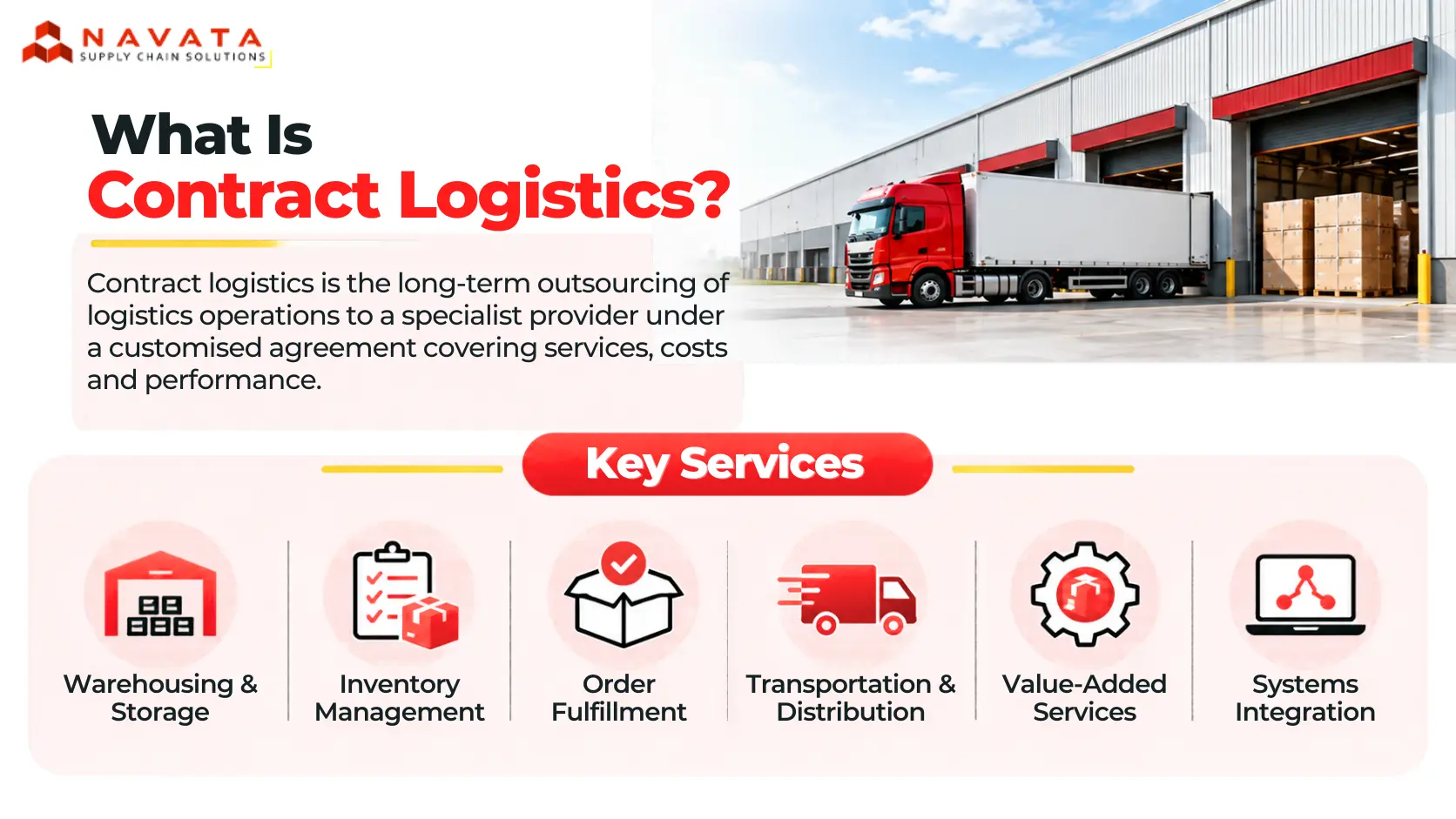
Contract logistics is the long-term outsourcing of a defined set of supply chain operations, usually warehousing, inventory management, order fulfilment and distribution, to a specialist provider under an agreement tailored to one client. Maersk and DP World describe it as a long-term, integrated or customised outsourcing arrangement, and GEODIS adds that the provider commits to service-level and cost targets under a multi-year agreement. The sections below cover the contract logistics services a scope usually includes, how a contract logistics agreement is structured and priced, how contract logistics compares with a typical 3PL arrangement, and what businesses in India should check before committing to one.
What Is Contract Logistics?
In its most common usage, contract logistics means handing a continuing operation, rather than individual shipments, to a logistics provider for a fixed term. In the GEODIS definition, the arrangement can include facility design, labour, IT systems and value-added services. DP World describes it as the strategic outsourcing of supply chain operations to a specialised provider under a long-term, customised contract.
Three features recur in provider definitions:
- Duration. The agreement runs for years rather than per shipment or per season.
- Tailoring. Processes and systems, and sometimes the facility itself, are set up around one client’s products and requirements.
- Mutual commitment. The client commits to a term and, where the contract stipulates them, to minimum volumes (DSV); the provider commits exclusive resources (Red Stag) or service-level and cost targets (GEODIS).
The term is not used consistently. ShipBob and WareIQ, both e-commerce fulfilment providers, use contract logistics for a narrower service centred on transport planning and freight coordination, without warehousing, while SEKO calls it a type of long-term third-party logistics partnership. Before comparing proposals, confirm which operations each provider includes when it uses the phrase. For the wider model it belongs to, see our guide to 3PL.
Contract Logistics Services: What the Scope Usually Covers
Providers describe a broadly similar menu of contract logistics services. The table below combines the scopes published by Maersk, DP World and GEODIS. No agreement has to include all of them; the scope is whatever the contract lists.
Typical contract logistics services
| Service | What it involves |
|---|---|
| Warehousing and storage | Running the facility where the client's stock is held, including temperature-controlled storage where the product needs it |
| Inventory management | Keeping stock records and tracking stock levels in real time |
| Order fulfilment | Picking, packing and shipping orders, including e-commerce orders |
| Transportation and distribution | Moving goods by road, rail, air or sea, including last-mile delivery |
| Returns (reverse logistics) | Handling returned goods, including refurbishment and recycling |
| Value-added services | Kitting, labelling, packaging, light assembly and testing |
| Systems integration | Implementing or connecting warehouse and transport management systems with the client's systems |
| Facility design and staffing | Designing the operation, recruiting and training staff, and running continuous improvement |
Where warehousing is in scope, ask whether the facility will be dedicated to your operation or shared with other clients; our explainer on the 3PL warehouse compares those models.
How a Contract Logistics Arrangement Works
A contract logistics arrangement is designed before it starts, so it moves through more stages than buying transport or storage by the load. The sequence below is a general pattern drawn from provider and legal guidance; stages and timings vary by provider and scope.
-
1
Define the requirement. The client sets out the operations in scope, volumes, products and service levels, described precisely enough that both sides read them the same way.
-
2
Design the solution. The provider designs the process and, where needed, the facility, systems, automation and staffing.
-
3
Agree the contract. Scope, term, pricing model, KPIs and exit terms are written into the agreement.
-
4
Transition and go-live. The operation moves to the provider under an implementation plan with standard operating procedures.
-
5
Run, measure and improve. The provider operates against the agreed KPIs, both sides meet at scheduled reviews (for example quarterly) and improvement work continues through the term.
-
6
Renew or exit. At the end of the term the agreement is renewed, renegotiated or ended under its notice and exit provisions.
Key Terms in a Contract Logistics Agreement
A contract logistics agreement turns the operating design into obligations. The terms below are drawn from contract guidance published by DSV, Inbound Logistics and the law firms Benesch and Lewis Silkin. Treat them as a checklist for negotiation; they are not legal advice.
Common terms in a contract logistics agreement
| Term | What it sets out | Point to settle | Source |
|---|---|---|---|
| Scope of services | The operations, sites and service levels the provider is responsible for | Describe each service precisely, since a word such as warehousing can mean different things to each party | DSV |
| Term and notice | Start date, duration, renewal and the notice period for ending the agreement | Longer terms favour the provider; shorter terms allow rates to be renegotiated more often | DSV, Inbound Logistics |
| Pricing model | How the provider is paid (see the pricing models below) | Set out the full pricing and payment terms before go-live | Inbound Logistics |
| Rate indexation | How rates change during the term | Rates are typically adjusted annually, with fuel usually indexed separately | DSV |
| KPIs and SLAs | The service measures, such as on-time delivery, and the consequences of missing them | State what happens when a target is missed; a bonus-malus clause can link payment to performance | DSV |
| Volume commitments | Minimum volumes or exclusivity, often expressed in pallets, movements or shipments | Write down how large rises or falls in volume change the rates | DSV |
| Liability and insurance | Who bears loss of or damage to goods | Providers usually cap liability for direct damage per kilogram or per incident and generally exclude indirect loss; higher limits need insurance and raise rates | DSV |
| Governance | Named contacts on each side and a review schedule | Hold regular process-improvement reviews, for example quarterly | Inbound Logistics |
| Change and extra work | How out-of-scope services or integrations are requested and priced | Document out-of-scope work separately in writing | Inbound Logistics |
| Termination and exit | Grounds for ending the agreement and how the operation is handed back | Agree in advance which failures allow termination; check lien and retention rights over goods, including where subcontractors hold them | DSV, Inbound Logistics |
Pricing models for outsourced logistics agreements
Kenco describes four pricing models used in 3PL and warehouse outsourcing agreements; Benesch covers transactional, cost-plus, and gainshare models and hybrids of them, and Lewis Silkin explains open-book pricing. The models can be combined in one agreement.
Pricing models for outsourced logistics agreements
| Model | How it works | What to watch |
|---|---|---|
| Transactional (unit rates) | A set rate per transaction or unit, or by product, service, lane or volume | Predictable for budgeting; penalties for underperformance and bonuses for meeting KPIs can be negotiated |
| Fixed-variable | Costs are split into a fixed part and a variable part | Both sides agree which costs sit in each part |
| Open book (cost-plus) | The client sees the provider's actual costs and pays them plus a management fee or margin | Needs active governance and invoice review; a fee set as a percentage of spend can reward higher costs |
| Gainshare (outcome-based) | Savings from improvements beyond an agreed baseline are shared between the parties | Needs a performance baseline, typically a year or more of operating data |
Lewis Silkin contrasts open book with closed-book pricing, in which the client pays a fixed price or rate without seeing the provider’s costs and the provider carries the cost risk. Red Stag Fulfillment, a US fulfilment provider, characterises contract logistics pricing as fixed and resource-based with performance incentives, against usage-based, transactional pricing for a typical 3PL, and GEODIS associates longer terms with gain-share models.
Contract Logistics vs 3PL
The two terms overlap. SEKO describes contract logistics as a type of long-term 3PL partnership, typically provided by a 3PL, so a useful comparison of contract logistics vs. 3PL sets a contract logistics arrangement against a typical, shorter 3PL arrangement. Where sources draw a line, it runs along duration, dedication of resources, tailoring, and integration.
Contract logistics vs 3PL, as commonly described
| Factor | Contract logistics | Typical 3PL arrangement | Sources |
|---|---|---|---|
| Duration | Multi-year; GEODIS gives 3 to 7 years as typical, Red Stag 3 to 5 years or more | Often short- or mid-term (Maersk); 1 to 3 years for standard contracts (Red Stag) | GEODIS, Red Stag, Maersk |
| Resources | Often dedicated to one client: a warehouse or routes | Usually shared across several clients | Red Stag, SEKO |
| Tailoring | Processes and systems built around the client | More standardised services | Maersk, Red Stag |
| Integration | Deep integration with the client's systems and operations | Often limited system connection | Maersk |
| Pricing | Often fixed and resource-based, with performance incentives | Usually usage-based and transactional | Red Stag |
Two neighbouring terms are easy to confuse with both. Freight forwarding, in SEKO’s description, is transactional and transport-focused, handling shipments individually, including customs. A fourth-party logistics (4PL) provider works at a strategic level, coordinating other providers across the supply chain.
If the underlying decision is whether to outsource at all, compare 3PL vs in-house logistics and the pros and cons of logistics outsourcing.
When Contract Logistics Makes Sense
The conditions below follow from how providers and contract guidance describe the model. Contract logistics tends to fit when:
- The operation is stable enough to plan several years ahead. GEODIS links longer terms with investment in automation.
- Products, order profiles or service levels need processes and systems set up for you, the tailoring Maersk and Red Stag describe as typical of contract logistics.
- You want the operation run for you without spending capital on facilities and systems, a benefit DP World lists.
- You have enough operating history to set a performance baseline, which a gainshare model needs.
A shorter or more flexible arrangement may be the better starting point when:
- Volumes are growing quickly or are hard to forecast. GEODIS notes that shorter terms suit fast-growing e-commerce brands that want flexibility.
- You want to renegotiate rates more often. DSV notes that shorter terms allow this, while longer terms favour the provider.
- You cannot yet describe the services and volumes precisely; DSV stresses that both need to be written down clearly.
For a structured way to compare providers, see our steps to choose a 3PL provider.
Contract Logistics in India
A 2018 feature in Indian Transport & Logistics News discussed contract logistics in India as part of the 3PL market: 3PL partners running outsourced supply chain operations and putting in place warehousing space, order fulfilment, and distribution. It expected GST to shift warehouse location decisions from tax considerations to logistics ones, encouraging hub-and-spoke networks, and named e-commerce, retail and automotive as growth sectors.
For a business in India weighing a long-term arrangement, three questions follow from the agreement terms above:
- Which assets are committed to you, and who owns them? SEKO’s comparison lists contract logistics providers as owning assets such as warehouses, fleets, and equipment, while 3PLs may or may not own their own assets. In either case, the agreement should name the capacity committed to your operation and state what happens to it, and to your goods, at exit.
- How the provider reaches your markets. If your distribution extends beyond metro cities to smaller towns and rural areas, ask how the provider covers them and through which partners.
- How performance will be reported. Agree which KPIs are measured, how often they are reported and through which system, so that reviews rest on shared data.
Integrated Logistics with Navata Supply Chain Solutions
Navata Supply Chain Solutions (NSCS) is a technology-enabled, asset-light B2B logistics company that operates through a vendor and partner ecosystem. Its services include 3PL services and integrated logistics, warehousing (including managed and flexi warehousing) and transportation. NSCS describes GamanIQ as its AI-driven, self-optimising B2B logistics platform, covering areas such as orders, vendor performance evaluation, billing, documents and tracking.
Considering a long-term outsourced logistics arrangement for FMCG, agro, FMCD, apparel, pharma or building-materials distribution? Discuss scope, service levels and the commercial model with the NSCS team.
Explore 3PL Services Discuss Your RequirementFAQs
What is contract logistics?
Contract logistics is the long-term outsourcing of a defined set of logistics operations, usually warehousing, inventory management, order fulfilment and distribution, to a specialist provider. The agreement is tailored to one client and sets the services, term, service levels and pricing.
Is contract logistics the same as 3PL?
The two overlap. SEKO describes contract logistics as a type of long-term 3PL partnership, typically provided by a 3PL. Sources that separate them describe contract logistics as longer-term, more tailored and often based on dedicated resources, and a typical 3PL arrangement as shorter and shared across clients. Some fulfilment providers use the term more narrowly, for transport coordination.
What services are included in contract logistics?
Commonly warehousing and storage, inventory management, order fulfilment, transportation and distribution including last-mile delivery, returns, value-added services such as kitting and labelling, and systems integration. The agreement defines which of these are in scope.
How long is a contract logistics agreement?
There is no fixed length. GEODIS gives three to seven years as typical and Red Stag Fulfillment three to five years or more. The agreement should state the term, renewal and notice period.
How is contract logistics priced?
Pricing guidance for 3PL and warehouse outsourcing agreements describes transactional unit rates, a fixed-variable split, an open-book (cost-plus) model in which the client pays the provider's actual costs plus a fee, and a gainshare model that shares savings against an agreed baseline. These models can be combined.
What KPIs are used in contract logistics?
The agreement defines the KPIs for the operations in scope. DSV gives on-time delivery as an example and advises that a service level agreement should state the consequences of a missed target; a bonus-malus clause can link payment to performance.
What is the difference between contract logistics and freight forwarding?
Freight forwarding, as SEKO describes it, is transactional and transport-focused, handling shipments individually, including customs. Contract logistics covers a continuing operation, such as warehousing and distribution, under a long-term agreement.