What Is Yard Management in Logistics?
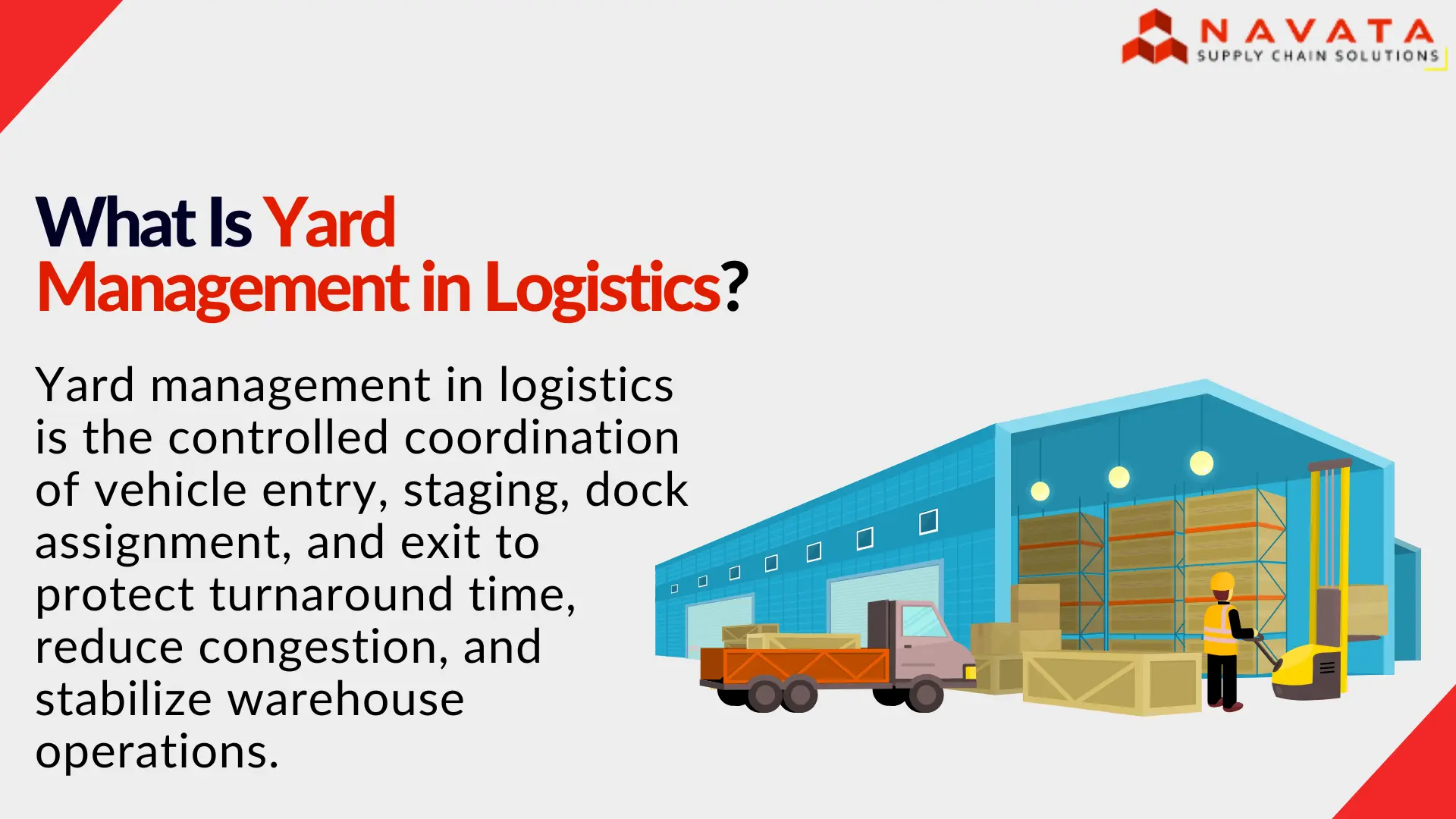
Yard management is the coordinated control of vehicle movement within a logistics facility, starting at the gate and ending at exit. It ensures that trucks are not just visible, but positioned and processed in the right order.
It is not tracking for visibility’s sake. It is decision control:
which vehicle enters now
which waits
which docks next
which exits
Rather than allowing vehicles to arrive and wait randomly, yard management introduces sequence and discipline. This reduces congestion, minimizes idle time, and ensures that dock activity aligns with warehouse readiness.
You May Also Like to Read: What Are Logistics Hubs? Your Guide to Their Role, Benefits & Types
Why Yard Management Impact on Logistics Performance?
The yard is the only physical space where transport timelines, warehouse readiness, labor availability, and service commitments collide.
When this collision is unmanaged, logistics teams experience familiar symptoms:
trucks waiting even when docks are free, warehouse teams rushing because vehicles arrive together, dispatch cut-offs missed for reasons no one can clearly explain.
These failures are often blamed on traffic, capacity shortages, or manpower. In reality, they are sequencing failures.
Yard management fixes this by enforcing order before congestion becomes visible.
What Yard Management Controls?
Yard management does not try to control everything. It controls a few critical points where time is either protected or destroyed.
It controls entry timing, preventing unplanned arrivals from overwhelming the yard.
It controls staging logic, ensuring vehicles wait in the right place, not just any place.
It controls dock sequencing, aligning vehicle movement with warehouse readiness rather than hope.
It controls dwell time, making waiting visible before it becomes detention.
When these are controlled, flow stabilizes automatically. When they are not, no amount of supervision can compensate.
Why Manual Yard Control Always Fails at Scale?
Manual yard control only works when volumes are low and variability is forgiving. As soon as operations grow, it breaks — not gradually, but suddenly.
Phone calls lag reality. Spreadsheets go stale. Visual checks miss compounding delays. Decisions are made after congestion has already formed.
This is why Yard Management Systems (YMS) exist. Not to digitize tracking, but to enforce sequencing discipline in real time.
A YMS does what humans cannot at scale: continuously align vehicle movement with warehouse capacity and transport plans as conditions change.
The Yard Is the Missing Link Between TMS and WMS
Many logistics networks invest heavily in Transportation Management Systems and Warehouse Management Systems, yet still struggle operationally.
The reason is simple: plans collide in the yard.
TMS plans arrival.
WMS plans execution.
The yard decides whether either plan survives contact with reality.
Without yard control, transport arrives at the wrong time, warehouses execute out of sequence, and both sides blame each other. Yard management is what turns planning into execution.
Where Yard Management Fails — And What That Failure Costs?
At scale, yard failures follow predictable patterns.
Vehicles queue externally while docks remain idle.
Priority loads wait behind low-urgency movements.
Trailers sit parked without ownership clarity.
Detention charges appear with no clear root cause.
These are not operational errors. They are control failures.
Every hour lost inside the yard multiplies across fleet productivity, labor utilization, SLA performance, and cost governance. The damage is rarely visible in a single metric, but it accumulates relentlessly.
Yard Management Is an Executive Control Issue, Not an Operational Detail
Once volume crosses a threshold, yard management stops being an operational concern and becomes a leadership one.
It directly determines:
whether costs remain controllable
whether SLAs are consistently met
whether assets are productively used
whether the operation can scale without chaos
Organizations with mature yard control scale predictably. Organizations without it scale volatility.
Safety Is a Consequence of Control, Not Enforcement
Congested yards are unsafe not because rules are ignored, but because flow is unmanaged.
When vehicles move without sequence, drivers rush, blind spots increase, and pedestrian risk rises. Structured movement reduces risk naturally. Safe yards are not enforced into existence — they emerge from disciplined control.
Where Yard Management Is Non-Negotiable?
Yard management becomes critical in high-volume distribution centers, multi-dock warehouses, manufacturing plants, cross-docking hubs, and mixed inbound–outbound facilities.
In these environments, throughput is decided in the yard, not on the road.
Conclusion
Yard management is not about monitoring vehicles. It is about protecting time before it is lost, cost before it leaks, and service before it degrades.
Immature logistics networks treat yards as waiting spaces.
Mature ones treat them as controlled execution zones.
That distinction determines whether logistics operates reactively — or predictably.
In modern logistics, yard management is not an optimization. It is a prerequisite for stability at scale.
Thanks For Reading: Yard Management in Logistics: How Yard Control Impacts Cost, SLA, and Scalability
Powered By 360Presence