

Table of Contents
Add a header to begin generating the table of contents
What is Fourth Party Logistics?
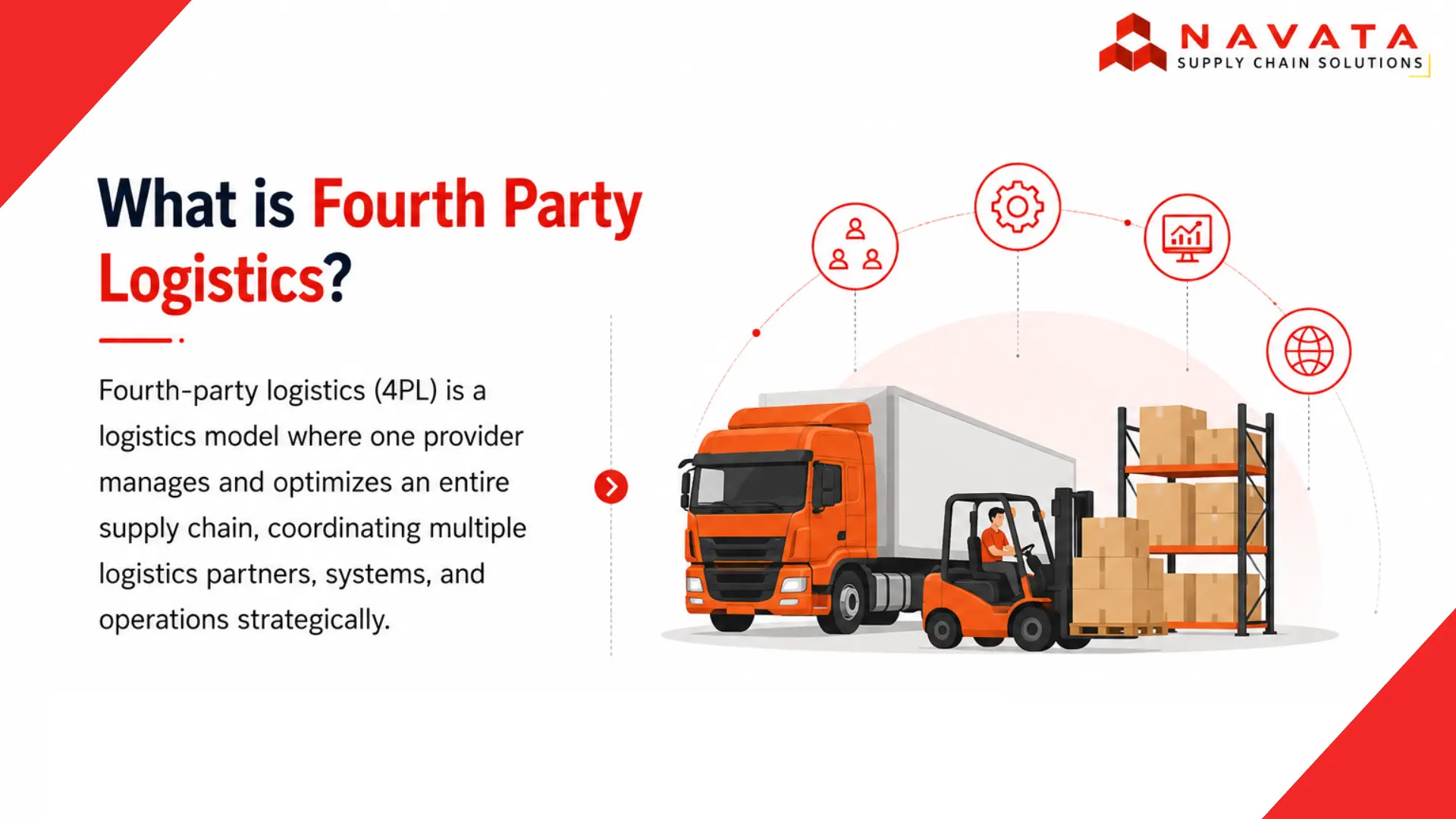
Unlike a third-party logistics (3PL) provider, which executes specific logistics tasks such as warehousing, transportation, or last-mile delivery, a 4PL acts as the architect and conductor of the whole supply chain. The client deals with one point of contact; the 4PL deals with everyone else.
The term fourth-party logistics was first coined by Accenture in a 1996 trademark filing, describing the model as a supply chain integrator that assembles and manages the resources, capabilities, and technology of its own organisation and other organisations to design, build, and run comprehensive supply chain solutions. Today it is widely used across the industry.
In practical terms, a 4PL will assess your current supply chain, design an optimised network structure, select and manage the right 3PLs and carriers for each lane, implement or integrate technology (TMS, WMS, visibility platforms), and continuously measure performance against agreed KPIs. The client retains strategic oversight; the 4PL handles execution complexity.
Fourth-party logistics is sometimes referred to as a Lead Logistics Provider (LLP) a term preferred in Europe and by some global players like DHL and Accenture. The models are functionally identical.
How Does 4PL Work?
A 4PL provider begins by understanding the company’s supply chain, business objectives, logistics network, existing providers, technology systems, and operational challenges. It then develops a strategy for coordinating and improving the entire network.
The process generally includes the following stages:
1. Supply Chain Assessment
The 4PL evaluates the existing supply chain to identify inefficiencies, service gaps, unnecessary costs, and coordination problems. This may include reviewing transportation, warehousing, inventory, technology, vendors, and performance metrics.
2. Supply Chain Strategy and Network Design
Based on the assessment, the 4PL develops a supply chain strategy aligned with the company’s business requirements. This can involve optimizing warehouse locations, transportation networks, inventory flows, service providers, and operating processes.
3. Logistics Provider Selection and Management
A 4PL can select, coordinate, and manage multiple 3PLs, carriers, warehouses, freight forwarders, and other service providers. It can also monitor service levels and vendor performance to ensure that the network operates according to agreed objectives.
4. Technology Integration
Technology plays an important role in 4PL operations. A 4PL can integrate information from different systems, such as transportation management systems (TMS), warehouse management systems (WMS), ERP platforms, and logistics partners.
This creates a more unified view of supply chain activity and makes it easier to monitor shipments, inventory, costs, and performance.
5. Performance Monitoring and Optimization
The 4PL continuously monitors key performance indicators (KPIs), identifies problems, and recommends improvements. Instead of simply managing day-to-day activities, the provider focuses on improving the performance of the supply chain as a whole.
Types of 4PL
The types of 4PL vary based on the provider’s responsibilities and the client’s supply chain structure. Common 4PL models include the Synergy Plus Operating Model, Solution Integrator Model, and Industry Innovator Model. Each model coordinates logistics partners, technology, and resources differently to improve supply chain performance and achieve strategic business goals.
Solution Integrator
A solution integrator brings together different logistics providers, technologies, and resources to create an integrated supply chain solution for the client.
Synergy Plus Operating Model
This model focuses on collaboration between the 4PL, logistics providers, and the client. The provider coordinates different capabilities and uses them together to improve overall supply chain performance.
Industry Innovator Model
An industry-focused 4PL develops solutions around the specific requirements of a particular sector. This can be useful for industries with specialized logistics, regulatory, or operational requirements.
The exact terminology and structure of 4PL models can vary between providers, so these categories should be treated as broad operating models rather than universal industry standards.
Benefits of Fourth Party Logistics
The benefits of Fourth Party Logistics become especially valuable when supply chains are too complex to manage efficiently. A 4PL coordinates multiple logistics providers, technologies, and processes through one strategic framework, helping businesses improve visibility, reduce inefficiencies, optimize costs, support scalability, and focus on core operations while maintaining stronger supply chain control.
End-to-End Supply Chain Coordination
A 4PL provides a broader view of the supply chain and coordinates different logistics functions through one management structure.
Single Point of Contact
Instead of dealing separately with multiple logistics providers, the business can work with one strategic partner responsible for coordinating the wider network.
Better Supply Chain Visibility
By integrating information from different logistics partners and technology systems, a 4PL can provide a more unified view of transportation, inventory, and operational performance.
Cost Optimization
A 4PL can identify inefficiencies across the network, optimize logistics processes, manage provider performance, and help businesses make better use of their logistics resources.
Improved Scalability
As businesses expand into new markets, add distribution locations, or experience changes in demand, a 4PL can help coordinate the additional logistics requirements.
Access to Expertise and Technology
Businesses can gain access to supply chain expertise, analytics, integration capabilities, and logistics technologies without having to build and manage all of these capabilities internally.
Better Risk Management
Centralized monitoring can help identify supply chain disruptions, performance problems, and potential bottlenecks earlier, allowing businesses to respond more effectively.
Focus on Core Business
By outsourcing supply chain coordination, internal teams can spend more time on areas such as product development, sales, customer relationships, and business growth.
4PL vs 3PL: The 7 Key Differences
The core difference between 3PL vs 4PL is scope of responsibility. A 3PL executes logistics functions it moves, stores, and ships goods. A 4PL manages the managers it oversees multiple service providers, optimises the network, and owns supply chain strategy on the client’s behalf.
Here are the seven dimensions where 4PL vs 3PL diverge most sharply:
1. Ownership of assets
Most 3PLs own warehouses, trucks, and handling equipment. A pure 4PL is typically asset-light it manages assets owned by others, which is the source of both its flexibility and its dependency risk.
2. Scope of services
A 3PL handles a defined slice of logistics (e.g., warehousing + fulfilment in Hyderabad). A 4PL handles the entire supply chain across all nodes, modes, and geographies.
3. Number of relationships
With a 3PL, businesses manage multiple logistics partners themselves. With a 4PL, one provider coordinates those relationships, offering a single contract and centralized escalation point.
4. Data and visibility
A 4PL aggregates data from all providers into a single dashboard, giving you end-to-end visibility that a 3PL simply cannot provide. This is increasingly powered by control tower technology.
5. Strategic input
A 3PL executes to your spec. A 4PL challenges and redesigns your spec it is expected to recommend network changes, consolidation opportunities, and technology upgrades.
6. Cost model
3PL pricing is transactional (per pallet, per shipment, per sqft). 4PL pricing is typically a management fee plus either a cost-plus or gain-share structure.
7. Best fit by company size.
3PLs are optimal for small-to-mid-size businesses with contained logistics complexity. 4PLs deliver the most value for mid-to-large enterprises with multi-modal, multi-region, multi-provider networks typically those spending ₹10 crore or more per year on logistics.
In India, the key 4PL vs 3PL difference is responsibility. Many providers market themselves as “4PL-capable” while operating as advanced 3PLs. The real test is whether they manage other logistics providers on your behalf or directly execute logistics operations themselves.
When Should a Business Use 4PL
A 4PL model can be particularly useful when a company’s supply chain has become complex and difficult to coordinate internally.
A business may consider 4PL when it:
- Works with multiple 3PLs or logistics providers
- Operates across several regions or markets
- Has multiple warehouses or distribution centers
- Needs better end-to-end supply chain visibility
- Struggles to coordinate different logistics partners
- Wants to optimize its logistics network rather than individual activities
- Is expanding and needs a scalable supply chain structure
- Wants one strategic partner to manage supply chain coordination
For a business with a relatively simple logistics operation, working directly with a 3PL may be sufficient. A 4PL becomes more relevant when coordination, integration, and strategic oversight become major challenges.
Risks and Pitfalls of the 4PL Model
The main risks of 4PL are loss of direct visibility into operations, over-dependency on a single provider, transition disruption, and misaligned commercial incentives. Mitigating these requires robust contract governance, dual-sourcing where critical, and retaining in-house supply chain expertise.
The market for 4PL providers in India is growing rapidly as organizations seek greater supply chain visibility, centralized control, and end-to-end logistics management. Demand is particularly strong across FMCG, automotive, pharma, retail, and e-commerce sectors where logistics networks involve multiple providers and regions.
Loss of operational control
When a single provider manages your entire supply chain, you lose direct relationships with carriers and 3PLs. If the 4PL relationship sours, switching is complex and slow. Mitigation: retain access to all underlying contracts and ensure exit provisions are clearly defined.
Single point of failure.
A 4PL systems outage, a financial crisis at the provider, or a key-person departure can ripple across your entire network simultaneously. With a 3PL setup, a failure at one provider affects one node. Mitigation: ensure business continuity clauses are in the contract; consider dual-sourcing on critical lanes.
Erosion of in-house expertise
Over time, institutional knowledge of your supply chain migrates to the 4PL. This creates dependency and negotiating weakness at contract renewal. Mitigation: maintain a small, capable in-house logistics governance function — even if day-to-day execution is outsourced.
Management fee vs savings trade-off
If your network is already lean and well-managed, there may not be sufficient savings potential to justify the 4PL management fee. Conduct an honest baseline assessment before committing.
Provider capability gaps
Not all providers offering “4PL services” in India have the technology, process maturity, and sector expertise to deliver at that level. Some are 3PLs with a control tower sales deck. Due diligence on actual capability particularly technology infrastructure is non-negotiable.
When comparing 4PL providers in India, organizations should evaluate technology capabilities, network reach, industry expertise, governance frameworks, and proven optimization results rather than selecting a provider solely on price.
As supply chains become increasingly complex, fourth party logistics is emerging as the preferred model for enterprises seeking end-to-end visibility, centralized governance, and continuous optimization. Businesses evaluating 4PL vs 3PL options should focus on long-term operational efficiency, strategic control, and scalability rather than short-term cost alone.
How 4PL Improves Supply Chain Visibility
One of the strongest advantages of a 4PL model is its ability to bring information from different logistics partners into a more unified operating view.
A company working with multiple 3PLs may receive separate reports and updates from each provider. A 4PL can integrate this information through technology platforms and centralized monitoring systems, helping businesses track logistics activity across the wider network.
This can support:
- Shipment monitoring
- Inventory visibility
- Vendor performance tracking
- Cost analysis
- Exception management
- KPI reporting
- Data-driven decision-making
Centralized visibility also allows supply chain managers to identify problems across the network rather than looking at individual logistics providers separately.
What Does 4PL Actually Cost in India?
For a business spending ₹20 crore per year on logistics, a cost-plus 4PL arrangement might add ₹30–60 lakh in management fees annually. Against this, credible 4PL providers typically target 10–15% reduction in total logistics cost in the first two years a saving of ₹2–3 crore on a ₹20 crore base. The ROI case is clear when the network is complex enough for those savings to be achievable.
When evaluating 4PL cost, businesses should look beyond management fees alone. The true financial impact comes from reduced freight costs, improved inventory efficiency, better service levels, and long-term supply chain optimization.
Examples of 4PL in Action - Indian and Global
In India, 4PL models are most advanced in FMCG, pharma, and automotive sectors, where companies like Navata Supply Chain Solutions, Mahindra Logistics, TVS Supply Chain Solutions, and DHL Supply Chain India manage multi-provider networks on behalf of large manufacturers.
Indian 4PL Deployments
FMCG sector
A large FMCG company distributing to 500+ districts across India might deploy a 4PL to manage a network of regional 3PLs (one per zone), a primary freight operator for trunk routes, and state-specific distributors for last-mile. The 4PL runs the TMS, manages compliance across states (GST e-way bill management, state entry permits), and reports weekly OTIF by SKU cluster to the client’s supply chain leadership.
Pharma sector
Cold chain logistics in India requires strict temperature monitoring, GDP-compliant storage, and lane-by-lane documentation. A 4PL managing a pharma network coordinates cold chain 3PLs, ambient warehouse operators, and temperature-validated air freight all under one service agreement with unified visibility and regulatory reporting.
Automotive sector
Tier-1 automotive suppliers managing inbound JIT logistics from multiple sub-suppliers to an assembly line use 4PL models to synchronise milk-run routes, manage call-off scheduling, and ensure near-zero line stoppage risk.
Global Reference Cases
Procter & Gamble and Unilever are among the most cited global adopters of the 4PL model, both use lead logistics providers to manage their distribution networks across dozens of countries, consolidating what would otherwise be hundreds of individual carrier and 3PL relationships.
In the e-commerce sector, platforms managing marketplace logistics coordinating sellers’ inventory across multiple fulfilment centres operated by different 3PLs effectively operate a 4PL model, even if they do not use the term.

Conclusion
Fourth-party logistics (4PL) takes supply chain outsourcing beyond individual logistics services. Instead of focusing only on transportation, warehousing, or fulfillment, a 4PL provider coordinates multiple logistics partners, technologies, and processes to manage the supply chain as an integrated system.
The model can help businesses improve visibility, coordinate multiple providers, optimize costs, scale operations, and focus more closely on their core business. For companies with complex or multi-provider supply chains, 4PL can provide the strategic coordination needed to manage logistics more efficiently.