What is Nearshoring vs Offshoring?
Global supply chains have traditionally relied on offshoring to reduce production costs. Manufacturing operations were moved to distant countries where labor and operational expenses were lower, enabling companies to achieve significant cost advantages.
However, disruptions over the past decade—including geopolitical tensions, transportation bottlenecks, and global pandemics—have exposed the vulnerabilities of extended supply chains. As a result, many companies are reconsidering their sourcing strategies and exploring alternatives such as nearshoring.
Understanding the difference between nearshoring and offshoring, and how each strategy affects supply chain performance, has become essential for businesses seeking resilience and efficiency in a volatile global environment.

What Is Offshoring in Supply Chains?
Offshoring refers to relocating production, manufacturing, or service operations to a country that is geographically distant from the primary market. The primary objective of offshoring is cost efficiency. Companies typically move operations to regions where labor, infrastructure, or regulatory costs are significantly lower.
Common offshoring destinations for global businesses have historically included countries in Asia and Eastern Europe, where manufacturing ecosystems and labor availability allow large-scale production at reduced costs.
While offshoring can deliver substantial financial advantages, it also introduces longer supply chains and greater logistical complexity.
What Is Nearshoring in Supply Chains?
Nearshoring involves relocating production or sourcing operations to countries that are geographically closer to the primary consumer market.
Instead of manufacturing in distant regions, companies establish operations in neighboring or nearby countries to shorten supply chains and improve responsiveness.
The goal of nearshoring is not necessarily to achieve the lowest possible cost, but to balance cost efficiency with operational flexibility, shorter transit times, and reduced supply chain risk.
Nearshoring has gained traction as organizations prioritize resilience and faster response to demand fluctuations.
Impact of Offshoring on Supply Chain Operations
Offshoring has historically allowed companies to build highly efficient production systems that maximize cost savings. For industries with stable demand and high production volumes, this model can remain highly effective.
However, longer supply chains introduce operational challenges. Extended transit times require higher inventory buffers, increasing working capital requirements. Coordination between suppliers, manufacturers, and logistics providers becomes more complex as geographic distance increases.
Additionally, disruptions in global shipping networks can quickly ripple through offshore supply chains, affecting production schedules and product availability.
Impact of Nearshoring on Supply Chain Performance
Nearshoring provides a different set of advantages focused on agility and resilience. By locating production closer to the end market, companies can shorten lead times, improve supply chain visibility, and respond more quickly to changes in demand.
Reduced transportation distances can also decrease reliance on long-haul shipping routes, lowering exposure to international logistics disruptions.
While nearshoring may involve higher production costs in some cases, the overall supply chain can benefit from lower inventory levels, improved service reliability, and faster market responsiveness.
Choosing Between Nearshoring and Offshoring
The decision between nearshoring and offshoring depends on multiple factors, including product characteristics, demand variability, transportation costs, and supply chain risk tolerance.
Companies producing high-volume goods with predictable demand may continue to benefit from offshoring strategies that emphasize cost efficiency.
Businesses operating in fast-moving markets, where responsiveness and flexibility are critical, may find nearshoring more advantageous due to shorter supply chains and faster replenishment cycles.
In many cases, organizations adopt a hybrid approach, combining offshore production for base demand with nearshore operations to support rapid market response.
Key Differences Between Nearshoring and Offshoring
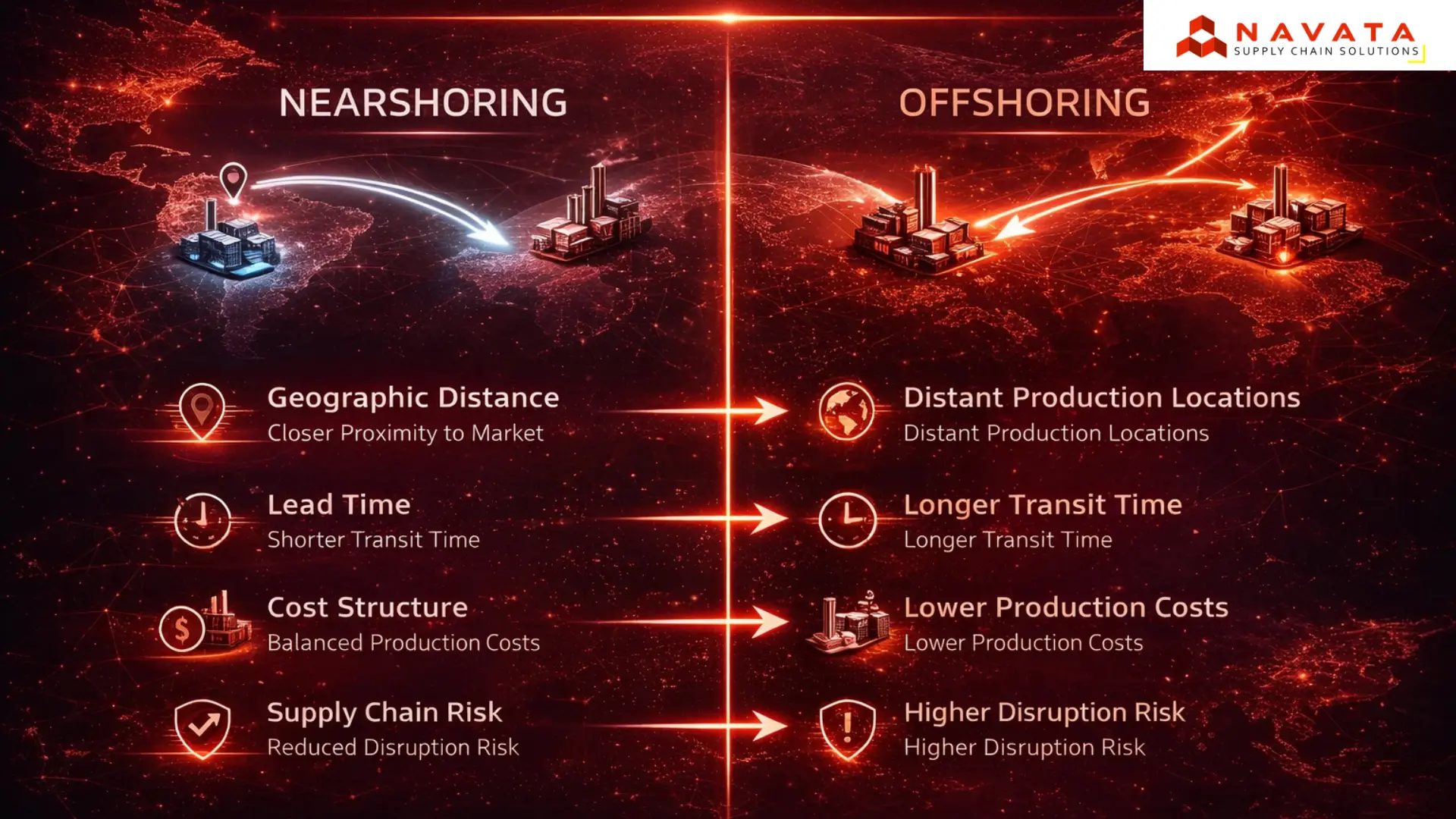
The difference between nearshoring and offshoring becomes clearer when examining their impact on core supply chain factors.
Geographic Distance
Offshoring typically involves production in distant countries, which increases transit distances and shipping times.
Nearshoring reduces geographic distance by locating operations closer to the end market.
Lead Time
Long-distance shipping in offshoring models can extend lead times significantly. Nearshoring reduces transit time, enabling faster replenishment cycles and improved responsiveness to market demand.
Cost Structure
Offshoring usually offers lower production costs due to cheaper labor and operating expenses. Nearshoring may involve slightly higher manufacturing costs but often reduces transportation costs and inventory holding requirements.
Supply Chain Risk
Extended global supply chains are more exposed to disruptions such as port congestion, geopolitical tensions, and regulatory changes. Nearshoring can mitigate some of these risks by shortening supply routes and improving visibility.
Operational Flexibility
Nearshoring allows businesses to adjust production volumes more quickly in response to market changes, whereas offshoring can limit flexibility due to long lead times and complex logistics.
Explore About: Cost of Delay in Supply Chains: How Minutes Turn Into Crores
Conclusion
Nearshoring and offshoring represent two different approaches to global supply chain design.
Offshoring prioritizes cost efficiency through large-scale production in distant regions, while nearshoring emphasizes proximity, responsiveness, and reduced supply chain risk.
As global trade environments become increasingly complex, companies are reevaluating their sourcing strategies to strike the right balance between cost, resilience, and operational agility.
The most effective supply chain strategies often integrate both models, leveraging the strengths of each to build a network that is both efficient and adaptable.
Thanks For Reading: Nearshoring vs Offshoring: Impact on Supply Chains
Powered By 360Presence